


Five women who accuse Slovenian priest Marko Ivan Rupnik of abuse have sent an open letter to Leo XIV denouncing the silence surrounding the canonical process against the former Jesuit and demanding clarity, transparency, speed, and judicial independence. The letter, dated September 23 in Rome and released by lawyer Laura Sgrò, has been published in full by La Nuova Bussola Quotidiana.
The signatories are Gloria Branciani, Mirjam Kovač, Sister Samuelle, Vida Bernard, and a fifth woman who uses the pseudonym Pia for fear of possible retaliation. They state that they only learned through the media that proceedings against Rupnik had begun and that Sgrò, despite repeatedly contacting the Dicastery for the Doctrine of the Faith to request information, “has never received a response.”
“A new and painful violence of silence”
The five women describe this situation as an extension of the harm they say they have suffered.
“This deafening and prolonged silence is experienced by us, the victims, as further and ongoing violence,” they state. In the letter they speak of “sexual, physical, psychological, and spiritual” abuse and maintain that “this new and painful violence of silence and abandonment by the judicial system” has now been added.
They also claim to have been publicly discredited, accused of being “prostitutes,” “liars,” of having received money to accuse Rupnik, and of having profited from the case.
According to the signatories, the way the case has been handled may discourage others who are considering reporting abuse to ecclesiastical authorities. “The message conveyed by our complaints is precisely this: it is useless to report abuse to ecclesiastical authority, because nothing happens anyway, no one will pay, and victims will never obtain justice,” they write.
Francis ordered the case reopened in 2023
The accusations against Rupnik became public at the end of 2022. Several women, some of them former religious sisters of the Loyola Community, have since accused him of sexual, spiritual, and psychological abuse.
In October 2023, after the Pontifical Commission for the Protection of Minors informed Francis that there were “serious problems” in the way the case had been handled and a lack of closeness to the victims, the then-Pontiff asked the Dicastery for the Doctrine of the Faith to review the file.
Francis also decided to lift the statute of limitations to allow a trial to proceed, as the Holy See officially announced on October 27, 2023.
The procedure took a decisive step in October 2025 with the appointment of the five judges assigned to the case. The Dicastery explained at the time that the tribunal was composed of individuals outside the Dicastery itself and without positions in other Roman Curia dicasteries, a choice intended to better ensure “autonomy and independence” of the court.
Read also: The Vatican announces the tribunal that will judge the Rupnik case
Rupnik has not been found guilty in these proceedings and retains the presumption of innocence until the tribunal issues a ruling.
The complainants say no one has contacted them
The main objection now raised by the five women concerns precisely how the process is functioning.
According to their letter, they only know of the proceedings through media reports. They state that Sgrò has repeatedly requested information from the Dicastery for the Doctrine of the Faith without receiving a response. Reuters also reports that the five women claim they have not been able to give testimony in the current process.
The lack of information became especially significant during the summer, when reports began circulating suggesting a supposed acquittal of Rupnik.
On July 22, Holy See Press Office director Matteo Bruni denied those reports and stated that any news of a judicial deliberation was “absolutely unfounded.”
Bruni confirmed that the evaluation was still ongoing and that the tribunal was examining documentation from the dioceses involved, from the Jesuits, from the interested parties, and from information published in the media.
The Vatican defends confidentiality
The Holy See then expressly defended the secrecy of the proceedings. According to Bruni, during a judicial process information about ongoing activity cannot be disclosed, both out of respect for the process itself and to avoid harm to the individuals involved.
The spokesperson added that if the tribunal considers additional information necessary, the judicial college itself will request it. He also confirmed that this is a penal canonical process of a judicial nature, held despite any statute of limitations that might affect possible offenses, and that it must rule on Rupnik’s guilt or innocence in accordance with Canon Law.
The Holy See’s explanation contrasts with the position now expressed by the complainants. For the Vatican, confidentiality protects the integrity of the proceedings; for the five women, the level of silence surrounding it has left them without information about a process in which their complaints occupy a central place.
“A trial conducted in oblivion offers no guarantees to anyone”
The five complainants now question the consequences this confidentiality is having on those who filed the accusations.
“A trial conducted in oblivion offers no guarantees to anyone, neither to the accused nor to the victims,” they write. They maintain that such a situation is incompatible with “the very concepts of law, truth, justice, equity, and mercy.”
The signatories state that they do not intend to “surrender to oblivion” or to give up seeking justice and ask to be considered “a resource, not an obstacle” in clarifying the facts.
Their final request is addressed directly to Leo XIV: they demand that “adversarial proceedings between the parties, clarity, transparency, speed, impartiality, and independence of the judges” be guaranteed, so that both the trial and its outcome, “whatever it may be,” retain no shadows.
Leo XIV spoke about the case in November 2025, shortly after the appointment of the tribunal. The Pontiff then recalled that the presumption of innocence until guilt is proven also applies in the Church and expressed hope that the process could bring “clarity and justice for all involved.”
The five women close their petition with a phrase addressed to the Pontiff: “We need truth, Your Holiness, but just as we do, the Church also needs it very much.”
Read also: Leo XIV will meet in Lourdes with abuse victims; advocacy groups will be excluded from the meeting
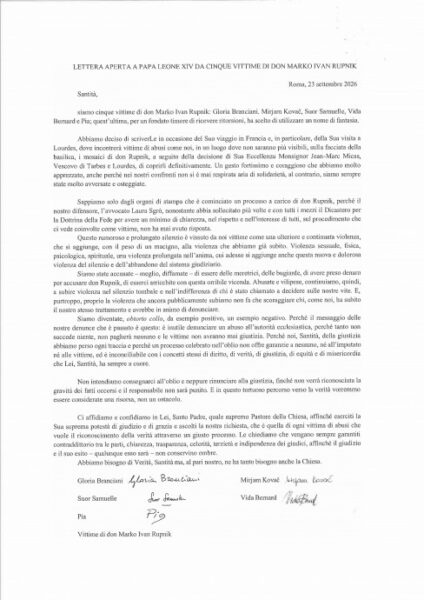
Below, we offer the full English translation of the letter published by La Nuova Bussola Quotidiana:
Open letter to Pope Leo XIV from five victims of Fr. Marko Ivan Rupnik
Rome, September 23, 2026
Your Holiness:
We are five victims of Fr. Marko Ivan Rupnik: Gloria Branciani, Mirjam Kovač, Sister Samuelle, Vida Bernard, and Pia; the latter, out of well-founded fear of retaliation, has chosen to use a fictitious name.
We have decided to write to you on the occasion of your trip to France and, in particular, of your visit to Lourdes, where you will meet with victims of abuse like us, in a place where the mosaics by Fr. Rupnik will no longer be visible on the façade of the basilica, following the decision of His Excellency Bishop Jean-Marc Micas, Bishop of Tarbes and Lourdes, to cover them permanently. A very strong and courageous gesture that we have greatly appreciated, also because toward us there has never been an atmosphere of solidarity; on the contrary, we have always encountered much opposition and hostility.
We only know through the media that proceedings against Fr. Rupnik have begun, because our lawyer, Laura Sgrò, despite repeatedly and by all means contacting the Dicastery for the Doctrine of the Faith to obtain at least some clarity—in respect and in the interest of all—regarding the procedure in which we are involved as victims, has never received a response.
This deafening and prolonged silence is experienced by us, the victims, as further and ongoing violence, which adds, with the weight of a rock, to the violence we have already suffered. Sexual, physical, psychological, spiritual violence; a violence prolonged in the soul, to which is now added this new and painful violence of silence and abandonment by the judicial system.
We have been accused—rather, defamed—of being prostitutes, liars, of having received money to accuse Fr. Rupnik, of having enriched ourselves with this horrible story. Abused and outraged, we therefore continue to suffer violence amid the sepulchral silence and indifference of those who have been called to decide on our lives. And unfortunately, precisely the violence we still suffer publicly only discourages those who, like us, have suffered the same treatment and might be thinking of reporting it.
We have become, obtorto collo, from a positive example into a negative one. Because the message that has remained from our complaints is precisely this: it is useless to report abuse to ecclesiastical authority, because nothing happens anyway, no one will pay, and victims will never obtain justice. Because we, Your Holiness, have lost all trace of justice and because a trial conducted in oblivion offers no guarantees to anyone, neither to the accused nor to the victims, and is incompatible with the very concepts of law, truth, justice, equity, and mercy that you, Your Holiness, always keep in mind.
We have no intention of surrendering to oblivion or of giving up on justice, until the gravity of the facts that occurred is recognized and the person responsible is punished. And on this tortuous path toward the truth, we would like to be considered a resource, not an obstacle.
We place ourselves in your hands and trust in you, Holy Father, as supreme Shepherd of the Church, to exercise your supreme power of judgment and grace and to hear our request, which is that of every victim of abuse who desires the recognition of truth through a fair trial.
We ask that adversarial proceedings between the parties, clarity, transparency, speed, impartiality, and independence of the judges always be guaranteed, so that the trial and its outcome—whatever it may be—retain no shadows.
We need truth, Your Holiness, but just as we do, the Church also needs it very much.
Gloria Branciani
Mirjam Kovač
Sister Samuelle
Vida Bernard
Pia