


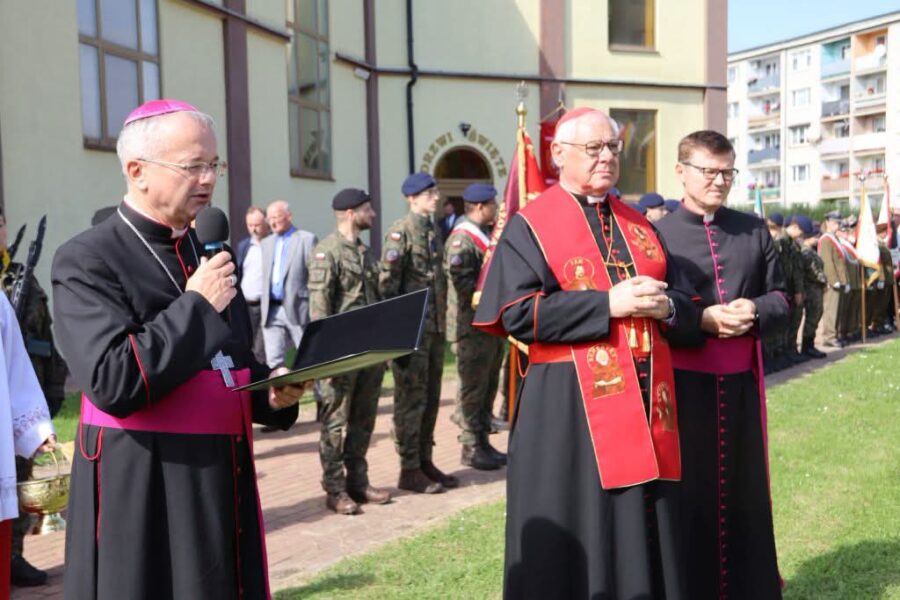
Cardinal Gerhard Ludwig Müller has claimed in Poland the «true masculinity» in the face of contemporary attempts to redefine it, and has summarized it in three traits: building on solid foundations, being willing to suffer for higher values, and personally assuming the responsibility to protect what has been entrusted to man.
The prefect emeritus of the Congregation for the Doctrine of the Faith developed this reflection during the men’s pilgrimage held on September 12 at the Shrine of the First Martyrs of Poland, in Międzyrzecz, diocese of Zielona Góra-Gorzów. The full homily has been published by Kath.net.
«The world today tries to redefine masculinity», Müller warned. «We are often led to believe that strength means domination and that success is solely a matter of the bank account balance».
Against that model, the cardinal proposed a Christian conception of masculinity founded on fidelity, sacrifice, responsibility, and the protection of what deserves to be defended.
Mieszko, the martyrs, and Jagellon
Müller built his reflection on three episodes from Poland’s Christian history.
The first was the conversion of Mieszko I, whose decision to embrace Christianity he presented as a choice that did not respond to «a passing impulse», but became the foundation on which he built the State.
The second was the martyrdom of Benedict, John, Matthew, Isaac, and Christian, the five religious men killed at the beginning of the 11th century and venerated as the first martyrs of Poland. For Müller, they showed that «faith does not consist only of beautiful words, but in the willingness to give one’s life for Christ».
The third example was King Vladislaus Jagellon. Müller recalled that in 1426 the monarch personally traveled to Międzyrzecz to inspect the fortifications on the western border of his kingdom.
«The great king, victor of Grunwald, did not rule the country from the safety of distant Wawel», he noted. Jagellon went where the security of the people entrusted to him was at stake.
From the three examples, Müller drew his definition:
«If we unite these three threads—the decision of Mieszko, the blood of the martyrs, and the responsibility of King Jagellon—a single and powerful image of true masculinity emerges. A true man is one who builds on solid foundations, knows how to suffer for higher values, and personally watches over the borders of his kingdom».
«The true triumph of a man is often born in silence»
The homily then transferred these great historical examples to ordinary life.
The martyrs of Międzyrzecz, Müller recalled, «were not legendary heroes», but flesh-and-blood men who left everything to build something meant to last.
«The true triumph of a man is often born in silence, in the daily and persevering assumption of responsibility for those whom God has entrusted to our care», he affirmed.
The cardinal then used the pilgrimage itself as an image of masculine life. Walking means leaving comfort behind and accepting «fatigue, sweat, and pain», because «good requires effort».
The application to family life was direct: «A strong character, a happy marriage, or a deep faith cannot be built without self-denial».
Müller therefore asked for the grace of a «man’s heart»: a heart «that does not fear difficulties», capable of «a demanding and sacrificial love» and that, when the test comes, can respond: «I am here, I watch, I will not fail».
The primacy of conscience
Müller’s reflection also included an extensive reference to Saint John Paul II and the value of conscience over material advantages.
The cardinal recalled the words spoken by the Polish Pope during his pilgrimage to Gorzów in 1997: «Is not the dignity of conscience more important than any external advantage?».
John Paul II then pointed to the martyrs as witnesses «of the primacy of conscience and its indestructible dignity, of the primacy of the spirit over the body, of the primacy of eternity over the temporal».
Müller considered those words especially relevant today and linked them to the fidelity of the martyrs and to the responsibility that, in his view, must characterize the Christian man.
His proposal of masculinity is thus far from identifying virility with power or domination. The model presented by the cardinal requires precisely the opposite of comfort: to remain when it would be easier to leave, to take responsibility for others, to accept sacrifice, and to guard what has been placed under one’s care.
«Be courageous, be faithful, be witnesses of Christ», he concluded before the pilgrims.