


By Francis X. Maier
The flight from Dakar to Guinea-Bissau was ninety minutes late, and as luck would have it, half a dozen other Americans had sprawled across the waiting room. They were late-teen boys, part of a high-end adventure-travel group that specializes in attracting the culturally enlightened elite. They were headed for a three-week “cultural immersion” in the achievements of African socialism. A former Portuguese colony on Africa’s western hump, Guinea-Bissau had won its independence only a few years earlier. Now, in the summer of 1981, it was a magnet for a new congregation of political pilgrims.
“They’re really doing something new and different in [Guinea-Bissau],” one of the teenagers said earnestly. “I just hope we can learn something to take back home. I don’t want these people to think all Americans are bad.” He then wandered off to buy whiskey at the duty-free shop.
Not everyone shared his youthful enthusiasm. I struck up a conversation with a pasty-white couple guarding a pile of groceries and overstuffed suitcases that, they said, contained canned food. He was a U.S. embassy aid official in Bissau. She was his wife. They liked Bissau, they said unconvincingly, but it was “hard on families because there’s nothing to do. There’s no food either, so we always stock up when we go to Dakar.”
I mentioned the nasty 1980 coup in Bissau, just eight months earlier. “Oh, that wasn’t very serious,” he shrugged. “A couple of people got shot; the rest were just relocated.”
We boarded a battered Air Senegal DC-6, crowded with restless bodies and cardboard luggage lashed with rope. A lone, listless flight attendant reminded us to review the safety instructions in the seat pocket ahead, but of course the card had been missing for years.
The plane crossed a river into Guinea-Bissau. I looked at the landscape below: empty marshes, isolated dry patches cut by tangled rivers with silver-smooth surfaces, flooded forests, and plains of wet mud. It felt familiar. It looked like Vietnam.
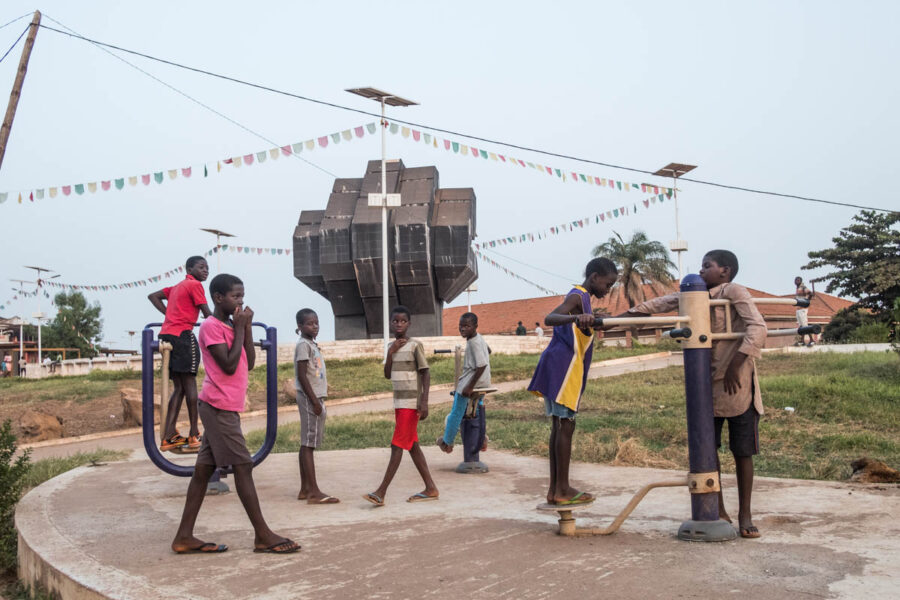
Bissau, the capital, was equally suggestive. The city (and the country) had a bookstore lined with Marxist-Leninist texts gathering dust; a bank with fantasy interest rates on deposits; half a dozen gas pumps; and a movie theater showing kung-fu films. The Soviet Union had donated the national monument commemorating Guinea-Bissau’s independence: a massive black-marble fist ringed by eternal flames, overlooking the docks where a strike had first ignited the revolution. But the nation was out of propane, so the flames had gone out.
Weeds had begun to take over the place. Across the street, a small international-class hotel had been abandoned mid-construction. So had an aluminum factory. So had a modern road to the capital. An automobile manufacturing plant had closed when the market quickly became saturated. The local “People’s Store” lacked rice, meat, and bananas, but had an entire wall of Chinese communist dolls, a dark form of foreign aid. The only factory that couldn’t keep up with demand was the brewery.
I was there to write about the local Church. And so, a few days after arriving, I accompanied the Italian-born bishop of Bissau on a trip into the countryside. After twenty minutes, we stopped, walked half a mile into the bush, and came upon a series of parallel trenches in the earth. In each of those trenches were hundreds of bleached human bones: skulls and clavicles, ribs and femurs. There were other such sites throughout the country.
The political killings had begun right after independence in 1974. In a nation of fewer than 760,000 people, as many as 50,000 men, women, and children were massacred before the 1980 coup. And while the new regime, expressing shock, had opened the mass graves to discredit the government it had overthrown, “everyone in the new regime had known about the [killings] from the beginning,” according to a missionary priest. “They were all involved.”
On the scale of modern horrors, what happened in Guinea-Bissau was a small atrocity in a forgotten corner of the world. But that never matters to the victims. Stepping down into a trench, I picked up the skull of someone who had been full of life just a few years earlier. While he or she was being shot into the ground, some professor or political tourist somewhere was lecturing on the exciting dynamism of Guinea-Bissau’s pristine socialist experiment. We see what we want to see. Reality lies buried in a ditch.
What, then, is the lesson?
Today, forty-five years later, Guinea-Bissau remains as shattered as ever: impoverished; politically unstable; and now a hub of the global drug trade. The only public actor that has always worked faithfully in service of the country’s hungry, poor, and suffering is the Catholic Church.
Indeed, despite its minority status—Catholics make up only twenty percent of the population—the Church is the social conscience of Guinea-Bissau. Its institutions run key social services, including clinics, schools, and a range of programs serving the needy without regard to faith. More importantly, it anchors these efforts in the preaching of the Gospel of Jesus Christ, proving its words with its actions.
After a few trips to Africa, one inevitably comes to a crossroads. Either you choose to trust the future, or you become cynical, seeing nothing beyond Africa’s problems and contradictions. We in the “developed” world rarely suffer, much less risk our lives, for what we claim to believe. We too easily imagine ourselves reaching out to lift up the Church in Africa. But the truth, so often, is exactly the reverse.
The courage, resilience, and enormous fruitfulness of the Church in Africa, despite the violence of its enemies and the poverty of its means, invite us to become something better than ourselves; to love Someone greater than ourselves. The Church is in the business of sanctifying the world, one soul at a time. In that light, we might profitably examine our own.
About the Author
Francis X. Maier is a senior fellow in Catholic studies at the Ethics and Public Policy Center. He is the author of True Confessions: Voices of Faith from a Life in the Church.