


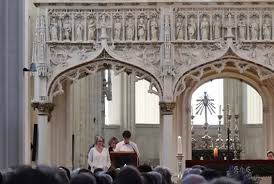
The Catholic University of Leuven (KU Leuven), in Belgium, included a recitation of Quranic verses during the Mass for the opening of the 2026-2027 academic year, held on September 16 in St. Peter’s Church in Leuven and attended by the Archbishop of Mechelen-Brussels and president of the Belgian Episcopal Conference, Monsignor Luc Terlinden.
Images of the celebration began circulating days later and prompted criticism from a Catholic student association. Following the controversy, the university offered explanations about what happened and confirmed that the presence of interventions from other religions was not improvised: according to KU Leuven, the decision was made by the University Parish in consultation with the Rectorate and the Flemish bishops.
A Quranic recitation during the Mass
The Eucharist on September 16 was presided over by Jesuit Jacques Haers. During the celebration, a young man stood before the ambo and sang in Arabic verses 69 and 70 of Surah 26 of the Quran, The Poets, corresponding to the passage in which Abraham asks his father and his people what they worshipped.
Among those present was Monsignor Luc Terlinden, Archbishop of Mechelen-Brussels, along with other ecclesiastical representatives.
The images were later shared by KVHV-Leuven, a Flemish student association linked to the university. The group questioned the inclusion of expressions from other religions within the Eucharistic celebration, although it defended the university as a place for dialogue and exchange between different confessions.
According to the explanation later provided by KU Leuven, the celebration also included a Jewish blessing in Hebrew and prayers offered by Protestant and Anglican ministers.
The university confirms it consulted the bishops
After the images were shared, KU Leuven explained to AdVaticanum how the celebration had been organized. A university representative stated that the decision to include these interventions corresponds to the University Parish “in consultation with the Rectorate and the Flemish bishops.”
The institution defended their presence as an “ecumenical and interreligious” gesture intended to express a vision of “peace and reconciliation” among peoples and religious traditions.
KU Leuven further clarified that this is not a practice introduced this year. According to the university, for approximately a decade the University Parish has invited representatives of the religious and philosophical traditions with which it maintains relations to offer a blessing both during the Mass for the opening of the academic year and during the institution’s patronal feast celebration.
The verses were selected and approved in advance
The university also detailed the procedure followed for the Muslim intervention. The verses are selected by the student mosque in accordance with the theme planned for the celebration and are then sent to the University Parish for approval.
One of KU Leuven’s chaplains, trained as an Arabist, reviews the content in Arabic beforehand.
The institution also noted that these interventions are deliberately placed toward the end of the Mass, after the prayer following Communion and before the conclusion of the celebration. KU Leuven maintains that this is the “most appropriate liturgical place” to include them.
For its part, the KVHV-Leuven association considers that interreligious dialogue should take place in academic spaces intended for the exchange of ideas and not within the Eucharistic celebration. The students also pointed out that a similar Islamic intervention had already taken place during the previous year’s inaugural Mass.
Read also: An imam presents Islam in a church in Italy with the bishop’s support
KU Leuven’s response confirms that these interventions have been part of its main celebrations for years and that their inclusion is carried out with the knowledge of the Rectorate and after consulting the Flemish bishops.