


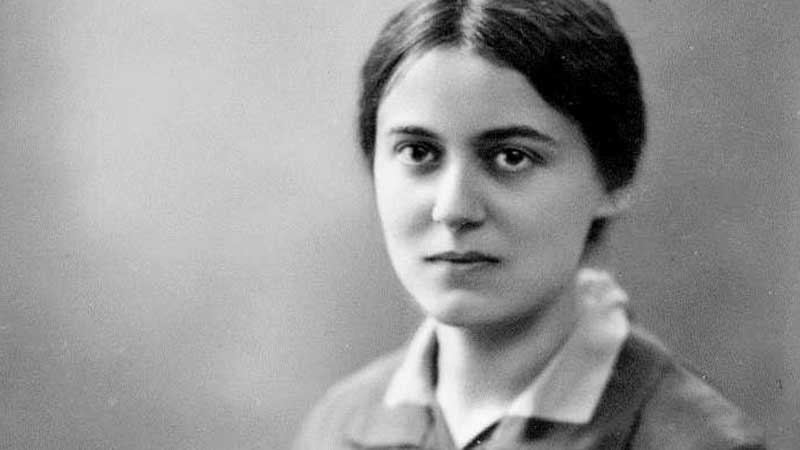
One Night Finds the Truth with Teresa
One August night in 1921, in Bad Bergzabern, in the Palatinate, a twenty-nine-year-old Jewish philosopher found herself alone in the home of her friends, the couple Hedwig Conrad-Martius and Theodor Conrad. They had gone out, and Edith, looking for something to read, approached the library and picked up, almost at random, a thick volume: it was the Book of Her Life by Saint Teresa of Jesus. She began to read and could not put it down all night; when at dawn she closed the book, she uttered a phrase that would decide her existence: “This is the truth!”
Few conversions possess such singular intellectual beauty. It was not one reasoning overcoming another, nor an apologetic argument toppling the last resistance of an unbeliever. It had been precisely her relentless love of truth that had led Edith Stein, since adolescence, to abandon the religious practice received from her Jewish mother, to study philosophy, to seek out Edmund Husserl in Göttingen, and to devote herself to phenomenology in the hope that things could be contemplated without prejudices or intervening systems. And it was another passionate seeker of truth, Teresa of Jesus, who met her that night. The Saint of Ávila had written that “God is supreme Truth” and that “humility is walking in truth”; the disciple of Husserl, after an entire night reading the life of that woman who had made truth a relationship with a Person, recognized that the Truth sought for so many years was not merely something that could be thought: it could be found, obeyed, loved, and, finally, adored.
On January 1, 1922, she received baptism in the church of Saint Martin in Bergzabern, taking the names Teresa Hedwig; the following day she made her first communion, and on February 2 she was confirmed in the private chapel of the bishop of Speyer. From the very first moment she wished to enter the Carmel, but her spiritual director judged that the time had not yet come. And that postponement, which might have seemed a delay in her vocation, gave the Church and European thought more than ten extraordinarily fruitful years. Between 1923 and 1931 she taught at Santa Magdalena in Speyer, with the Dominicans, translated Newman and, above all, the Quaestiones disputatae de veritate of Saint Thomas, returned to philosophical research, and traveled to numerous cities as a lecturer. Baptism did not extinguish the philosopher; on the contrary, it broadened the horizon of her intellect.
From the late 1920s, and especially after her resounding intervention in Salzburg on September 1, 1930, on The Ethos of Women’s Professions, her name began to be known in wide Catholic intellectual circles. She had already spoken in Ludwigshafen on The Proper Value of Woman and Its Significance for the Life of the People; in Munich she dealt with The Participation of Religious Institutions in the Formation of Youth; in Nuremberg, with The Theoretical Foundations of Social Educational Work; in Heidelberg, on December 2, 1930, with The Intellect and the Intellectuals; in Vienna, on May 30, 1931, she delivered her lecture on Saint Elizabeth of Hungary, Nature and Supernature in the Formation of a Holy Figure; and in Aachen, on October 30 of that same year, she spoke on The Vocation of Man and Woman According to the Order of Nature and of Grace. Still in 1932 we find Edith in Essen, Augsburg, and, above all, in Juvisy, near Paris, participating as the only invited woman in the celebrated session of the Société Thomiste devoted precisely to the relations between phenomenology and Thomism. In January 1933 she delivered in Berlin one of her last public interventions, The Formation of Youth in the Light of the Catholic Faith. She had not passed from philosophy to piety, abandoning the former; she was attempting, with growing awareness, to bring both together.
When Philosophy Ceased to Ask First About Being
To understand the profound significance of this itinerary, one must go much further back than Husserl. In classical and medieval metaphysics, and eminently in Saint Thomas Aquinas, the human intellect appears constitutively open to being. The understanding knows because before it there exists an intelligible reality and because, though limited, it is proportioned to it: starting from concrete things, it abstracts their natures, discovers causes and ends, distinguishes substance and accident, act and potency, essence and existence, and can rise from contingent beings to the question of the ultimate foundation of all that is. Philosophy begins, before the knowing consciousness, in wonder before a reality that is there and that has not awaited our gaze to exist.
Late medieval nominalism represents a profound modification of that horizon. It would not be historically serious to make William of Ockham directly responsible for Descartes, Kant, or Husserl, as if five centuries of philosophy could be reduced to a simple causal genealogy; but neither can the importance of the displacement he introduces be ignored. For Ockham, everything that exists extramentally is singular; the universal is not a common nature really existing in things, but belongs to the conceptual and significative realm. Thereby one of the convictions on which the great edifice of medieval metaphysics had been raised is weakened: that the intellect attains in things natures and universal structures that possess in them a real foundation.
From then on, through a very long and by no means linear process, the philosophical question slowly changes its center. It no longer asks only what things are and what it means that they are, but how the subject can know them, what guarantees the truth of his knowledge, and what are the conditions that allow an object to appear before a consciousness. Descartes will seek radical certainty in the cogito; Kant will make the conditions of possibility of knowledge one of the great problems of philosophy; and Husserl, after that long history, will bring to extraordinary radicality the investigation of consciousness and of the way in which objects present themselves in it. In this sense, and only in this, can it be affirmed that nominalism remotely prepares the ground of phenomenology: not because Husserl continues nominalist doctrine, but because both belong to a history in which the center of gravity is progressively shifting from being toward the problem of knowledge and, finally, toward the knowing subject.
Husserl, Much Less a Nominalist Than He Seems
It would be paradoxical to call Husserl simply a nominalist, because one of his great philosophical enterprises consisted precisely in rescuing the objectivity of truth against psychologism and relativism. The Logical Investigations vigorously rejected the idea that the laws of logic were merely psychological laws about how our mind works: a proposition is not true because someone thinks it, nor do necessary truths become products of certain cerebral mechanisms. There is an objectivity of the true that does not depend on the particular events of our consciousness.
Moreover, Husserl recognizes the possibility of attaining essences: Wesen. Phenomenology is not limited to describing a succession of individual data, but attempts to discover that without which a reality would cease to be what it is. Hence the importance of Wesensschau, the intuition or vision of essences, and of the eidetic reduction, by which the phenomenologist seeks the necessary that manifests itself through multiple particular realizations. At this point, Husserl is much further from Ockham than a hasty history of ideas might lead one to believe: against any dissolution of the universal into mere words or subjective representations, he again affirms that the intellect can discover objective and necessary structures.
And here we already find one of the reasons why Edith Stein will be able to pass from Husserl to Saint Thomas without feeling that she has destroyed the entire bridge she leaves behind. Husserlian eidetic intuition and Thomistic abstraction are not the same, nor do they proceed from an identical theory of knowledge, but both rest on a confidence that a good part of modern philosophy had placed in danger: the human intellect is not condemned to revolve endlessly upon its own subjective states; it can attain something true about what things are.
Placing the World in Parentheses
The decisive distance from classical metaphysics appears elsewhere. For Saint Thomas, the point of departure is ens, being that comes to meet the intellect. Husserl adopts a radically different methodological procedure: by means of the celebrated epoché he suspends or places in parentheses the spontaneous affirmation of the existence of the external world. He does not deny it, as if the world were an illusion; he simply provisionally leaves that question in suspense in order to study with maximum purity how the world is given to consciousness, in what way an object appears, what structure the intentional act possesses by which consciousness is always consciousness of something, and how the sense of what it knows is constituted for it.
The difference with Saint Thomas is great, though it must be expressed with precision. Thomism starts from real being and from it investigates the operations of the intellect; transcendental phenomenology starts from consciousness and studies in it the manifestation and constitution of the sense of the object. If Thomas proceeds from being to the intellect and from this to the knowledge of being, Husserl proceeds from consciousness, through intentionality, toward the object as it is given to consciousness. Husserl does not therefore teach that consciousness arbitrarily fabricates reality—“constitution” is not equivalent to creation—but the fundamental philosophical problem no longer falls immediately upon the actus essendi, upon the radical fact that something is, but upon its appearing and upon the conditions that make possible its meaningful presence before a consciousness.
At this point lies the limit that Edith Stein will ultimately perceive. Phenomenology had succeeded in making philosophy look again with respect upon whatever appears, but was it not now in danger of stopping at the conditions of that appearing? If the phenomenon manifests something, does it not finally refer to a reality that does not receive its ontological consistency from consciousness? Can one truly obey the Husserlian injunction without, at the opportune moment, abandoning the enclosure of transcendental subjectivity?
“Zu den Sachen selbst!”
“To the things themselves!” This watchword had fascinated the young people gathered around Husserl because it sounded almost like a liberation. Against the great systems that seemed to construct reality before contemplating it, phenomenology demanded looking without prejudices, describing with rigor, and letting the thing show itself. Edith Stein arrived in Göttingen in 1913 precisely attracted by that promise. There she found Adolf Reinach, Max Scheler, Roman Ingarden, Hedwig Conrad-Martius, and that entire extraordinary circle of young intellectuals for whom phenomenology seemed to restore to philosophy contact with the real. Her doctoral thesis, On the Problem of Empathy, defended summa cum laude, and her subsequent work as Husserl’s assistant show to what extent she belonged from within to the birth of that school.
That is why Husserl’s so-called transcendental turn, manifested especially from Ideas I in 1913 and developed thereafter, produced uneasiness among several disciples from Göttingen. The phenomenology they had received as a return to objectivity seemed progressively to orient itself toward transcendental subjectivity, converted into the ultimate sphere from which the constitution of objective sense had to be clarified. Edith Stein did not therefore abandon phenomenology, but neither did she follow her master without reservations along that path. Her position would mature until it became what today is usually called phenomenological realism: the demand to attend scrupulously to how reality manifests itself without thereby concluding that the being of reality depends on the consciousness that contemplates it. The Stanford Encyclopedia of Philosophy presents her precisely as a realist phenomenologist of the Göttingen school who, in her later work, developed an original integration between Husserlian phenomenology and Thomistic metaphysics.
Separating from the Master… in Order to Obey Him
There is in this evolution a beautiful paradox: Edith Stein seems to distance herself from the mature Husserl in order to remain faithful to the first great demand she had learned from Husserl. If one must truly return “to the things themselves,” one will have to admit that things possess a reality of their own that does not wait to be constituted by me in order to be. Consciousness discovers them, receives them, knows them from certain perspectives, penetrates their structures, and receives sense from them; but it does not found them in their act of existing.
This will be one of the fundamental disagreements of Stein with transcendental phenomenology. Husserl attempts to guarantee objectivity from the analysis of subjectivity; Edith considers that one must start from a realism of being. She does not deny the fruitfulness of analyzing consciousness, nor does she in any way renounce intentionality, eidetic investigation, or the extraordinary phenomenological finesse learned from her master; she simply resists allowing transcendental consciousness to become the ultimate philosophical instance. Reality precedes the subject and measures his knowledge, not the reverse. This is precisely one of the points that John Paul II would highlight in presenting her as co-patroness of Europe: her phenomenological itinerary made her sensitive to an objective reality that, far from dissolving into the subject, precedes it and becomes the measure of subjective knowledge.
Thus one understands that her approach to Saint Thomas was not a foreign body added after her conversion. Religious conversion certainly accelerated the encounter; but the philosophical question was already prepared. Stein translated the De veritate, studied scholasticism ever more deeply, and in 1929, on the occasion of Husserl’s seventieth birthday, wrote Husserl’s Phenomenology and the Philosophy of Saint Thomas Aquinas, where, rather than opposing two irreconcilable worlds, she boldly seeks both divergences and coincidences. Husserl and Thomas believe in the intelligibility of the real, in the objectivity of truth, and in the capacity of reason to attain it; what separates them, above all, is the point from which they undertake the journey and the ultimate horizon toward which they lead it.
From Essence to Esse
Here lies Edith Stein’s most profound contribution. If Husserl had taught her to look at essences, Thomas will compel her to ask about being. Phenomenological Wesensschau allows one to attempt to grasp what a thing is, but the metaphysical question opens yet a further abyss: what does it mean that that which possesses an essence really exists? From where does it receive its act of being? What relation is there between what a thing is and the fact that it is?
In Potency and Act and, above all, in Finite and Eternal Being, Edith Stein already decisively enters the territory of metaphysics. Act and potency, essence and existence, substance, causality, individual, soul, spirit, contingency reappear; but they reappear traversed by the intellectual experience of a twentieth-century phenomenologist whose originality does not consist in dressing Aquinas in Husserlian terminology or translating Husserl into scholastic vocabulary, but in attempting to put into dialogue two forms of access to the real. If phenomenology taught her a discipline of the gaze, metaphysics allowed her to ask about that which ontologically sustains all that that gaze discovers.
The question then reaches a depth that could no longer fit entirely within the Husserlian horizon. Finite being is a being that does not possess in itself the sufficient reason for its existence: it is, but it could not be; it exists, but it has not given itself the act of existing. Contingency ceases to be a mere description and becomes a metaphysical indication. And thus the question about finite being leads toward the Being that does not receive existence from another, toward that Being in whom it is no longer possible to distinguish a received existence from an essence capable of receiving it. The title Finite and Eternal Being admirably expresses the entire itinerary: the disciple formed to investigate how phenomena manifest themselves ends by asking about that which ultimately makes it possible for something capable even of manifesting itself to exist.
From the Transcendental Ego to Eternal Being
That is why the divergence between Husserl and Saint Thomas is not for Edith a secondary disagreement of school, but a difference in the very architectonic principle of philosophy. The ultimate point of departure for Husserl is the transcendental ego; for Thomas it is being, which ends by referring to the Ipsum Esse subsistens. Stein was able to characterize this opposition by means of the terms “egocentric” and “theocentric,” which would be unjust if understood morally, but are very expressive in a philosophical sense: one philosophy attempts to reconstruct objectivity starting from the subject; the other receives subject and world within an order of being that precedes both.
This does not mean that Edith simply returns to a thought prior to modernity, as if Descartes, Kant, and Husserl had never existed. That would be the gravest error in reading her. Stein carries with her everything learned in the phenomenological laboratory: the analysis of consciousness, lived corporeality, empathy, affectivity, the person, the will, community, values. The Angelic Doctor could not pose many of these questions with the conceptual tools developed by contemporary philosophy; Husserl, on the other hand, lacked a metaphysics of esse capable of carrying to its ultimate consequences the question of the foundation of being. Edith’s originality consists precisely in refusing to sacrifice one of these worlds to the other.
Reason Before the Truth That Reveals Itself
There remained still a threshold. Husserl attributes to philosophical reason a task in principle indefinitely open and attempts to lead it by its own method to a rigorous science. Thomas also knows the dignity and true autonomy of natural reason, but he knows that man does not live solely under the light of what he can discover by it: there exists a supernatural Revelation that communicates truths that reason, left to its own powers, could not attain or would not attain with equal certainty.
For Edith Stein this does not mean confusing philosophy and theology. Faith does not make a philosophical conclusion true by decree, nor does it dispense reason from the rigor proper to it. But neither can the believing philosopher be asked to act as if he were unaware of a truth that he really knows from another source. Revelation does not destroy reason; it discloses to it a horizon within which certain questions appear in a new light. And thus, in some way, the circle opened that night in Bergzabern is closed: the philosopher who sought truth through the exercise of reason discovers that Truth can also come to meet her.
And here the Teresian phrase acquires its deepest sense: “Humility is walking in truth.” For intellectual humility is not demanding that the real submit to the dimensions previously marked out by method; recognizing that consciousness does not found what it knows, that being is not exhausted in its appearing, and that reason itself attains its greatness precisely when it renounces becoming the absolute measure of all that exists. Edith Stein’s philosophical search does not end because faith has closed the questions, but because these, pursued with radicality, open toward a horizon that none of them could entirely contain.
The Phenomenologist, Discalced Carmelite
Edith Stein’s public ascent was as rapid as it was brief. In February 1932 she had begun teaching at the German Institute of Scientific Pedagogy in Münster, where she developed her courses on women’s formation and, above all, her philosophical anthropology, The Structure of the Human Person. But in 1933 the anti-Jewish laws made the continuation of her teaching impossible. On April 20 she officially left her academic activities; a few days later, on April 30, during a long prayer in the church of Saint Ludger in Münster, that call to the Carmel that she had experienced since her conversion returned with force. On October 14, 1933, she finally entered the Discalced Carmel of Cologne as a postulant. She was forty-two years old.
She received the habit on April 15, 1934, with the name Teresa Benedicta of the Cross; she made temporary profession on April 21, 1935, and pronounced her solemn vows on April 21, 1938. But she did not leave philosophy outside the cloister. In the Carmel she reworked Potency and Act until it became Finite and Eternal Being, and, already in her last years, she entered into Saint John of the Cross to write The Science of the Cross. The old disciple of Husserl had become a daughter of Teresa of Jesus and a pupil of Thomas Aquinas without ceasing to be a philosopher; moreover, it is possible that only then could she fully realize the intellectual project that had accompanied her since her youth.
“Come, Let Us Go for Our People”
On December 31, 1938, she was transferred to the Carmel of Echt, in the Netherlands, in the hope of protecting her from racial persecution, but there the National Socialist machinery finally reached her. On August 2, 1942, the Gestapo appeared at the convent to arrest her together with her sister Rosa, also converted to Catholicism. Tradition has preserved the last words Edith addressed to Rosa upon leaving the monastery: “Come, let us go for our people.” After passing through Amersfoort and Westerbork, they were included in the transport that departed for Auschwitz on August 7. On August 9, 1942, Edith and Rosa Stein died in the gas chambers of Auschwitz-Birkenau.
History had brought to a terrible conclusion that intellectual itinerary begun so many years before. The young woman who had studied empathy ended by physically sharing the fate of her people; the woman who had investigated the mystery of the person was murdered by a system that had converted persons into racial categories; the philosopher who had sought all her life the sense of being ended by surrendering hers in the darkest night of European nihilism. And the Carmelite who had chosen to call herself “Benedicta of the Cross” fulfilled her name.
The Phenomenologist, Patroness of Europe
John Paul II beatified her in Cologne on May 1, 1987, presenting her expressly as a “daughter of Israel” and witness of Christ crucified; on October 11, 1998, he solemnly canonized her in Saint Peter’s Square. Less than a year later, on October 1, 1999, through the apostolic letter Spes aedificandi, he proclaimed her co-patroness of Europe, together with Saint Bridget of Sweden and Saint Catherine of Siena, thus uniting them to the three already existing European patrons: Saint Benedict and Saints Cyril and Methodius. In Edith Stein, saint, martyr, and co-patroness of Europe, in her condition as thinker, Jew, Christian, and victim of the Shoah, Saint John Paul II saw a figure capable of expressing at once the deepest tragedies and hopes of the old Christendom.
Europe engendered Greek metaphysics, the medieval Christian synthesis, nominalism, rationalism, criticism, idealism, and phenomenology; and it also engendered the totalitarianisms capable of erasing, in the name of an ideological abstraction, the dignity of concrete man. And in that history appears this woman from Breslau who traversed a good part of those paths: born in Judaism, estranged from the faith, formed in the great German university, disciple and assistant of Husserl, phenomenologist of the first rank, student of Saint Thomas, convert, lecturer throughout Europe, Discalced Carmelite, and finally martyr in Auschwitz.
Nominalism had contributed to the weakening of the great metaphysics of being; modern philosophy displaced its center toward the subject; Husserl rigorously conducted the investigation of consciousness, but recovered, against psychologism and relativism, the objectivity of essences; Edith Stein received that conquest, refused to remain enclosed in transcendental subjectivity, and returned to asking about being. From essence she arrived at esse; from consciousness, at the reality that precedes it; from contingent being, at Eternal Being.
She was not, therefore, a Thomist who had accidentally learned some techniques of Husserl, nor a phenomenologist to whom a pious layer of Catholicism was later added. Her philosophical stature resides precisely in having dared to keep open at the same time the two great demands that marked her life: to look reality in the face and to obey the truth when it shows itself. Husserl had taught her to go “to the things themselves”; Teresa of Jesus made her understand that Truth is Someone; Thomas showed her that all that is refers to the mystery of Being.
That August night of 1921 is the best door through which to enter her thought: the philosopher who opens a book seeking the truth, at dawn closes it understanding that Truth had been seeking her for many years. Between the library of Bad Bergzabern and the gas chamber of Auschwitz extends one of the most impressive intellectual, spiritual, and human itineraries of contemporary Europe: that of Edith Stein, Teresa Benedicta of the Cross, the patroness of Europe who never ceased to be a phenomenologist because she never ceased wanting to go, beyond all appearances, to the things themselves and, beyond the things, to Truth itself.