


By Stephen P. White
Everyone who knows anything about Pope John Paul II’s “theology of the body” “knows” that it is about sex. Anyone who knows more than a little about the theology of the body understands that to say it is about sex is a bit like saying that the book of Genesis is a treatise on the morality of eating fruit.
The theology of the body is a prolonged exercise in incarnational anthropology. It is about human embodiment. That is why it has so much to teach us beyond the realm of human sexuality.
In particular, the theology of the body offers a surprising and underappreciated relevance to our thinking about Artificial Intelligence.
Much of our fascination (and anxiety) about AI has understandably centered on AI’s ability to simulate the human mind. And much of the discussion about AI focuses on our ability to reliably distinguish AI “thinking” from human thought.
In his encyclical Magnifica humanitas, Pope Leo XIV distinguishes some of the tempting capacities of artificial intelligence from the authentically human capacities that AI is designed to imitate:
The so-called artificial intelligences do not undergo experiences, do not possess a body, do not feel joy or pain, do not mature through relationships, and do not know from within what love, work, friendship, or responsibility mean. Nor do they have moral conscience, for they do not judge good and evil, do not grasp the ultimate meaning of situations, nor assume responsibility for consequences. They can imitate language, behavior, and analytical skills, and even simulate empathy and understanding, but they do not understand what they produce, because they lack the affective, relational, and spiritual perspective through which human beings grow in wisdom. (MH, 99)
Pope Leo mentions the human body from the outset, but focuses on distinguishing AI’s capacity to simulate human language and learning from our human capacity for the same.
All of these are important distinctions, to be sure. But the obvious and objective differences between AI and the human mind are not the only—and perhaps not even the most important—distinction between humanity and AI.
The old scholastic categories of form and matter suddenly become relevant again. To be human is to be body-and-soul, not simply a soul in a body. Our souls are the form and principle of our bodies. One cannot exist independently of the other, except by supernatural means. That is why we are mortal and why we are made for the resurrection.
To be human means to be, in some way, incomplete in ourselves. We were made for communion, a reality of which our own bodies, male and female, are a sign. To be human is to be a social and political animal, both of which require bodies. To be human is to be, so to speak, a matrimonial animal. None of this could be accomplished simply by uploading a mind into a machine (even if it were a biological machine), even if such a thing were possible.
It is worth noting that we humans also learn language by imitation. We learn “behavior and analytical skills,” “empathy and understanding” in much the same way. If we are to identify what separates us from AI, we will have to dig deeper than the claim that AI’s capacities are a mere “simulation” of human qualities, however accurate the imitation may be.
Our consciences are formed (or deformed) by learning through imitation. Through conscience we can distinguish good from evil, but we do not always do so. We can feign moral judgment and conviction.
In fact, humans are so good at feigning certain judgments and behaviors that we can deceive others, and even ourselves, about our true motives and feelings. Although we may be good judges of our own authentic intentions (provided our conscience is well-formed), we are often quite poor at judging the same in others.
Each of us is intimately aware of our own personal experiences of both consciousness and conscience. But these experiences in others, though in some way communicable, remain in some way entirely inaccessible to us. We can never be “in the mind” of another person as we are “in” our own.
Which is to say that my ability to distinguish between a human person and “artificial intelligence” should not rest on the assumption that I can notice the difference between the subjective experience of another human and the “subjective experience” of AI.
Because the fact is that I cannot know either directly.
The most enduring and outwardly recognizable (not to say the most important) difference between human beings and AI is not, therefore, the capacity for language or “thought” or the appearance of emotion—which perhaps we cannot distinguish between “real” and “simulated”—but precisely our bodies, which, again, are much more than biological machines.
Our bodies, understood particularly in light of the theology of the body, reveal both what we are and what we are for. Moreover, our bodies reveal much about creation as a whole and about the God who created us and who Himself became incarnate.
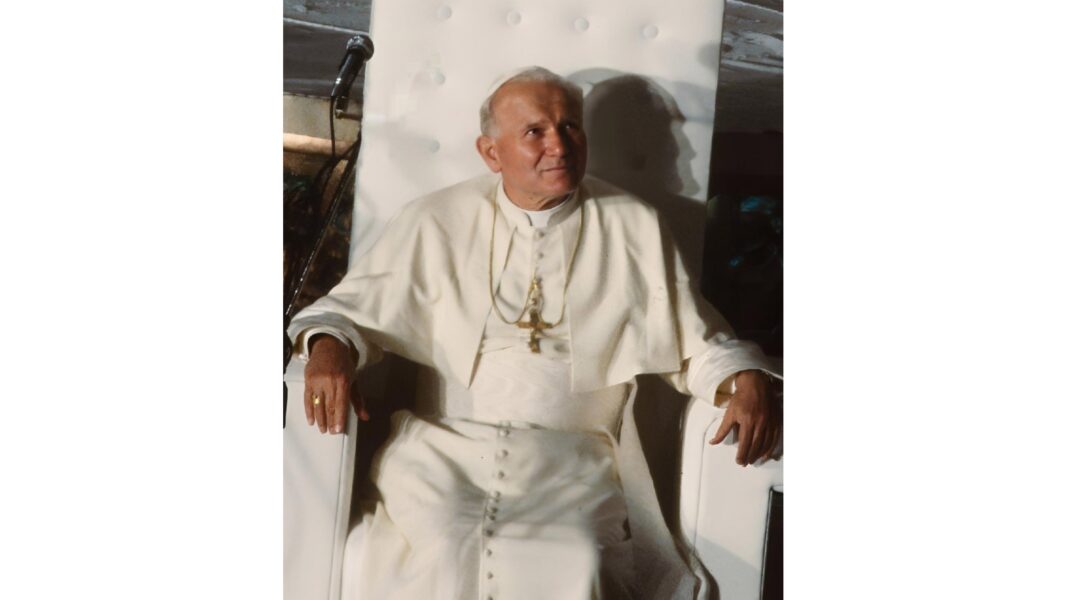
Which brings us back to John Paul II and the theology of the body:
The body, and it alone, is capable of making visible what is invisible: the spiritual and the divine. It was created to transfer into the visible reality of the world the mystery hidden from time immemorial in God, and thus to be a sign of him. Thus, the very sacramentality of creation, the sacramentality of the world, was in some way revealed in man created in the image of God. (Emphasis added.)
This is the very heart of the theology of the body, in which John Paul II gave us a powerful account of what human embodiment tells us about ourselves, the world, and God. It is a message that people today desperately need to hear—perhaps no one more than those in Silicon Valley, who seem to be in danger of losing sight of humanity even as they attempt to recreate it.
About the author
Stephen P. White is executive director of the Saint John Paul II National Shrine and a fellow in Catholic Studies at the Ethics and Public Policy Center.