


By Steven Jonathan Rummelsburg
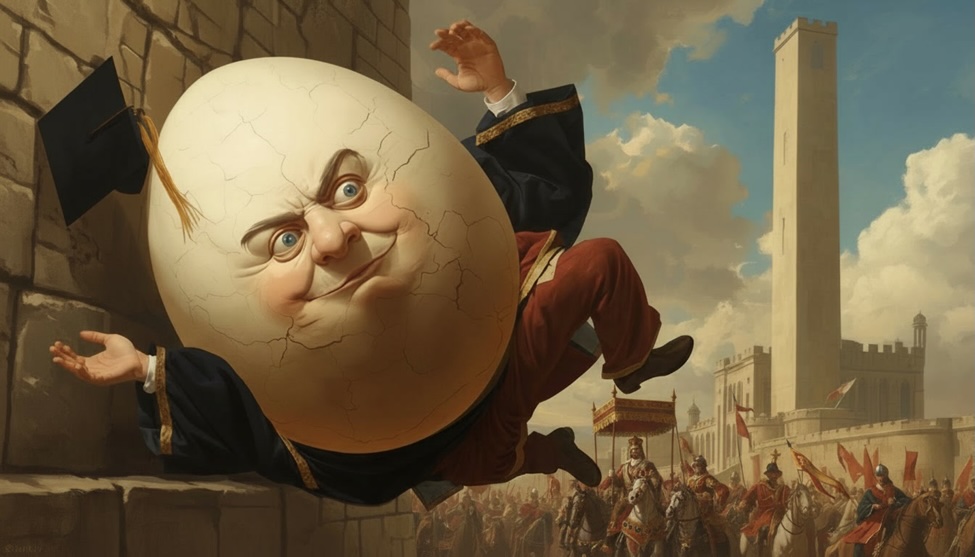
Seated atop his ivory wall, the pedantic shell Humpty Dumpty tells Alice that any word he uses means “precisely what I choose it to mean: neither more nor less.” “The question is,” said Alice, “whether you can make words mean so many different things.” Humpty Dumpty deflects: “The question is. . . .who is to be the master—that is all.” Humpty Dumpty understands master in the sense of ruler, the one who wields power over the word. But “master” carries an older sense that he has discarded: the ancient term for teacher (magister), whose authority should never be power, but the conformity of his mind with reality.
In this scene with Humpty Dumpty, Lewis Carroll offers us the portrait of a certain type of Oxford academic: pompous, contemptuous, and certain of his own authority. He subordinates the true source of speech, which is reality, to his will. Humpty Dumpty is the prototype of a veritable army of modern professors, convinced that by controlling the meaning of words, they control the world. Attend an accreditation review, or a staff-development day, and you will find the prolific progeny of Humpty. The radical abuse of speech is not an isolated phenomenon; it is the new norm in “education.”
What Carroll conveyed through Humpty Dumpty has now proliferated throughout the profession. Even the most vital words in teaching, “school” and “education,” have lost their anchor in reality, a crisis that academia does not confront.
We must instead follow the thought of St. Augustine in De magistro “On the Teacher”; the meaning of a word is never ours to invent. Augustine offers us a dialogue with his son about what a teacher’s words can truly do when they pass from one mind to another.
Augustine demonstrates that words cannot introduce truth into another human soul; they can only induce the listener to accept or reject the truth of what is said. He asserts that only the “inner teacher,” the Logos himself, is the one true teacher. In the borrowed wisdom of Augustine himself, “we are not to call anyone on earth our teacher because there is only one Teacher of all who is in Heaven.” A teacher who arrogates the right to make his words mean whatever he wishes has abandoned the source of all truth.
We tend to think that “school” is a building to which children go to receive instruction. Our modern notions of “school” differ radically from ancient exemplars such as Plato’s Academy, Aristotle’s Lyceum, or the gymnasium where bodily discipline accompanied the contemplation of philosophical truth.
The word “school” once conveyed a surprising meaning. In antiquity, school meant leisure, not in the modern sense, but as an interior disposition of the soul: at rest, still, and yet fully awake to receive all of reality as it truly is. School, or leisure, is the proper interior state of being for hearing a good lesson or receiving from a teacher what is real and true. In ages past, if one was gifted with leisure time, the fitting response was to employ that time in cultivating the interior life.
The word “education” is as abused as “school.” A few years ago I interviewed top-tier teachers, school leaders, and county administrators and asked them to define the word “education.” The responses were remarkable in at least two troubling respects.
First, I received as many different definitions as people questioned.
Second, none of the answers conveyed a concept of education rooted in reality.
In the Catholic Intellectual Tradition, to educate has always meant educe, to lead a pupil forward, out of the darkness of error and sin, and into the light of truth and virtue. Education is the formal cause of a nation, or as Chesterton said, “education is simply the soul of a society as it passes from one generation to another.” This understanding of education is nowhere to be found in modern schools.
It is no small irony that leisure and “leading a pupil forward” are now conspicuously absent from the very institutions we call “schools.” The institutions originally named for leisure are now occupied exclusively with pure activity. Modern schools—when they are not merely functioning as government day-care centers or indoctrination hubs for minors—are factories that produce graduates prone to anxiety, overloaded with schedules, and driven by examinations, rather than cultivating the intellectual and moral virtues once attributed to true education.
The consequences of trading the Catholic Tradition for the “erudition” of Humpty Dumpty are catastrophic. At least Humpty Dumpty was honest: he claimed to be the source of his own meaning and intended that it remain so. Our academic failures have left our linguistic heritage broken beyond all repair, and all the king’s horses and all the king’s men cannot put it back together again. No secular humanist institution can restore what that fall has shattered.
We must turn away from false dominion and turn toward the grace of God, cooperating with nature and accepting the guidance of the saints. As the primary educators of our children, it falls to us to recover the realities to which our words were always meant to point. True education demands the cultivation of virtue and the eradication of vice in pursuit of the Beatific Vision.
That recovery will not come from yet another accreditation review. It begins in the family, the first school of conscience, where the restoration of language, learning, and truth must once again take root.
About the author
Steven Jonathan Rummelsburg directs City of Truth Educational Consulting for the Diocese of Charleston and writes St. Isidore’s Artisan Academy, a newsletter that recovers authentic Catholic education through the wisdom of the Church’s 2,500-year intellectual tradition.