


By Anthony Esolen
In the pilot episode of the old television series The Waltons, the six Walton children have gathered outdoors in the cold and snow, where a lady from a religious charity is handing out Christmas gifts to the youngest. The gifts have been donated by people better off than almost anyone in their mountain village. She gives a gift in exchange for a verse from the Bible. Mary Ellen, the oldest of the Walton girls, knows many verses, not because she is pious, but because Mrs. Walton makes her memorize them when she has misbehaved or talked back to her elders, which happens often. She is the one to turn to when a verse is needed.
“That one’s too long!” says one of the local boys. “Give me a shorter one.”
“Jesus wept,” says Mary Ellen.
That earns the boy a gift, and a look of pious ecstasy from the charitable lady. But not everything goes well. When the youngest of the Waltons, Elizabeth, about five years old, opens her gift, it is a porcelain baby doll with a crack and a large hole in the face.
“It’s dead!” the little girl cries out in horror and dismay. We are meant to feel the shame of it, and the indignation, that someone would donate a dead baby doll to the poor. Not out of malice, but out of sheer thoughtlessness.
Fifty years later, the feminist nonsense called Barbie opens with a group of girls playing with their baby dolls, when a goddess-like Barbie appears, stylish and gigantic and as feminine as a mannequin in a couturier’s shop. Then, to the fanfare of Richard Strauss from Also Sprach Zarathustra, one of the girls, in awe, smashes her doll’s head against a rock, and another flings hers into the air, spinning through space, just like the bone one of the apes has thrown in Stanley Kubrick’s 2001: A Space Odyssey. It becomes the title card: BARBIE.
So our “evolution” goes from girls playing with baby dolls, as the narrator tells us, to Barbie—or, as I would put it, from something warm, natural, generous, and productive, to something cold, unnatural, self-worshipping, and sterile. Sure, I know, it’s a joke. We’re not supposed to take it seriously. That’s how the bait-and-switch works.
Yet somehow, I cannot see the humor in a dead baby.
“Did you hear the one about the dead baby flying through the air?” said no one in a bar, ever.
The strange thing about the matter, which the makers of the film somehow managed to overlook, is that without babies there is no evolution. That is the Darwinian imperative. In mammals, the mother must nurse the babies, and the longer the period of immaturity, the greater the dependence of the offspring upon the parents. Without a strong maternal instinct, mammals do not survive.
We need not accept Darwin’s account of the origin of species to admit this. It is the inexorable logic of survival. You must play your cards with the utmost wisdom to beat the house. Throw away your aces, and you die. Not immediately; but the house, Nature, has all the time in the world, and you do not.
Only the spiritually exhausted Western world would make a joke about girls smashing their baby dolls. But the joke is on the West. We are committing suicide by contraception and abortion.
Nor are we healthy apart from those obvious evils, since we have sown confusion in our children and suspicion and recrimination between the sexes, supposing even that we stoop to acknowledge that there are two sexes. And only two. The croupier looks at your winnings and shrugs. The pile will dwindle to nothing. It must.
“I have set before you life and death, blessing and cursing,” says the aged Moses to the people. “Therefore choose life, that you and your descendants may live.” (Deuteronomy 30:19) The terms are not ours, but God’s. Man cannot create a moral law any more than he can conjure a grain of sand out of nothing, or invent and impose a new law of gravitation.
And the people of Israel would have the option of death right before them as they entered Canaan. The worship of the Canaanite god Moloch, accompanied by the sacrifice of children as a quid pro quo, turns the public square into a necropolis. It must.
Solomon was fabulously rich and famous. But his thousand wives and concubines, many of them foreign, “turned away his heart after other gods,” so that he built “a high place for Chemosh, the abomination of Moab,” and for “Moloch, the abomination of the children of Ammon.” (1 Kings 11:4, 7)
Chemosh was a god of lust and orgies; Molech or Moloch, a god of fertility, demanding blood for blood. The two go well together, “lust beside hatred,” says Milton, “until good Josiah drove them thence to Hell.” (cf. 2 Kings 22)
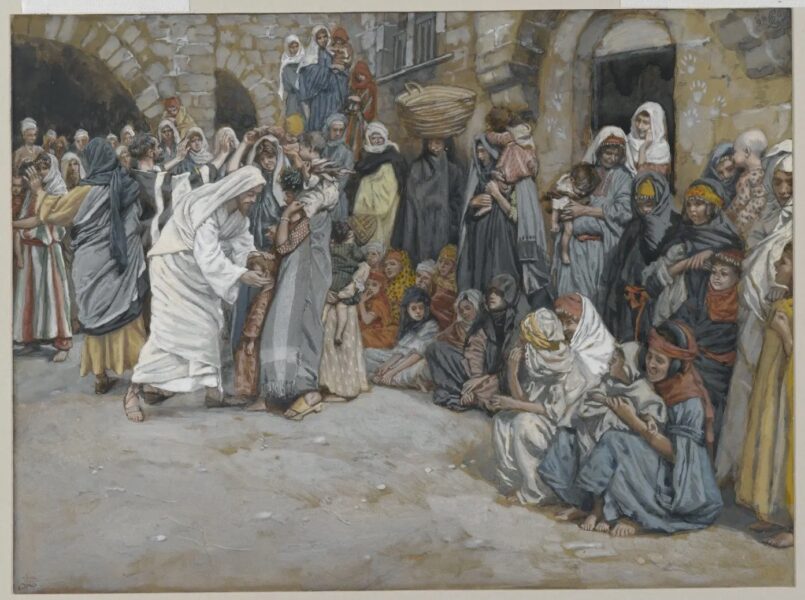
“Let the children come to me, and do not hinder them,” says Jesus, “for to such belongs the kingdom of God.” (Mark 10:14) That is not Jesus being sentimental. For sentimentality is to true feeling what plastic is to warm flesh.
We must take it as an affirmation of the essential and inestimable value of the child, and as a warning. We must not dare to leave childhood behind as we have done, stunting it, corrupting it, or putting it to death.
There is no life in lust, ambition, and greed. Moloch gives death for death, and at great cost. The murder of children is suicide. The only next step for man is that infinite which he cannot cross by his own power. It will not be found in heaven, nor in the advance of science, nor in a new computer program, nor in plastic people and dead babies.
Here, then, is a verse to memorize. It is from Peter, preaching of Jesus before the high priests: “And there is salvation in no one else, for there is no other name under heaven given among men by which we must be saved.”
About the Author
Anthony Esolen is a lecturer, translator, and writer. Among his books are Out of the Ashes: Rebuilding American Culture, and Nostalgia: Going Home in a Homeless World, and most recently The Hundredfold: Songs for the Lord. He is Distinguished Professor at Thales College. Be sure to visit his new website, Word and Song.