


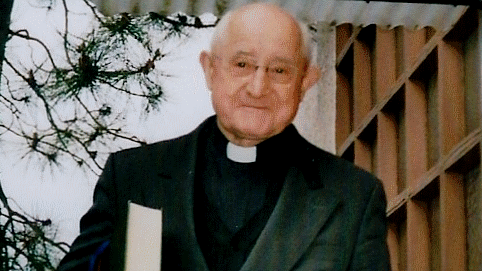
The German priest and canonist Georg May has turned one hundred this September 14. A professor for more than three decades at Johannes Gutenberg University in Mainz, May is one of the historic figures of traditional German Catholicism and a particularly critical voice regarding the doctrinal, theological, and liturgical drift that has followed the Second Vatican Council.
Born on September 14, 1926, in Liegnitz, then German Silesia, he was ordained a priest on April 1, 1951. His centenary thus coincides with his 75 years of priesthood, after a life in which he has combined the study of Canon Law with priestly ministry and a public defense of the Church’s doctrine and tradition.
A canonist marked by the defense of tradition
May earned his doctorate in 1955 and continued his formation at the Institute of Canon Law in Munich, where he later obtained his habilitation. In 1958 he was appointed professor in Freising, and two years later he assumed the chair of Canon Law at the Johannes Gutenberg University of Mainz.
There he taught from 1960 until his retirement in 1994. He also served as dean of the Faculty of Catholic Theology and chaired the association of Catholic theology faculties in Germany from 1966 to 1969.
But May’s importance within German Catholicism is not limited to his academic career. He is especially known for his defense of doctrinal and liturgical tradition and for his critiques of the Church’s development after the Second Vatican Council.
Against those who have interpreted Vatican II as the beginning of a substantially new Church, May has upheld continuity with the preceding Magisterium and Tradition.
“The Second Vatican Council was not a super-council,” he stated in a 2013 interview reflecting on the pontificate of Benedict XVI. For the canonist, the latest Council cannot become the sole criterion by which to judge the entire preceding history of the Church.
His critique of the post-conciliar crisis
A significant part of May’s work is devoted precisely to diagnosing the crisis of faith following the Council.
For decades the canonist has pointed to the loss of the primacy of doctrine, the influence of Protestantism on sectors of Catholic theology, the weakening of ecclesiastical discipline, and the consequences of liturgical transformations.
His critique does not consist simply in attributing all the Church’s problems to Vatican II. May distinguishes between the conciliar texts and the subsequent interpretations and developments, yet rejects the notion that an appeal to the so-called “spirit of the Council” can justify a rupture with earlier tradition.
This concern runs through much of his extensive intellectual output and finds one of its most ambitious expressions in 300 Jahre gläubige und ungläubige Theologie (“300 Years of Believing and Unbelieving Theology”), a work published in 2017 in which he examines three centuries of Protestant and Catholic theology according to the criterion of fidelity to the faith.
Benedict XVI: “You have always defended the doctrine of the Catholic faith”
May’s work and career also received personal recognition from Benedict XVI, with whom the canonist maintained correspondence for years.
Before the publication of 300 Jahre gläubige und ungläubige Theologie, Joseph Ratzinger expressed to May his concern about the situation of German theological faculties. The Pope emeritus lamented that many of them no longer led students toward the faith and still less helped them on the path to the priesthood.
For this reason he considered a study that critically addressed the emergence and expansion of a theology that had ceased to take the Church’s faith as its starting point particularly timely.
In another letter, Benedict XVI thanked May for “the clarity with which you have always defended the doctrine of the Catholic faith and publicly committed yourself to it”.
The recognition was not limited to the intellectual sphere. In 2011, during his pontificate, Benedict XVI conferred on Georg May the dignity of protonotary apostolic.
Faithful to the traditional liturgy
May also maintains a close identification with the traditional liturgy, in which he began his priestly ministry long before the liturgical reform that followed Vatican II.
His position on the liturgy forms part of his overall diagnosis of the Church’s situation: in his view, external secularization is not enough to explain the loss of religious practice and vocations; it is also necessary to examine what has occurred within the Church itself in theology, catechesis, discipline, and worship.
May has continued to exercise his priestly ministry. For decades he celebrated Mass and regularly heard confessions. In November 2025 it was reported that his health no longer allowed him to continue celebrating Mass publicly or hearing confessions as he had done until then.
One hundred years and 75 of priesthood
The centenary also prompted congratulations from the bishop of Mainz, Peter Kohlgraf, who recalled both May’s long academic career and his fidelity to priestly ministry.
“One hundred years is a very blessed age, for which one can be grateful,” the prelate noted, recalling that May taught Canon Law for several decades in Mainz and “has always remained faithful to priestly ministry.”
At one hundred years of age and after 75 of priesthood, Georg May remains a reference point for traditional German-speaking Catholicism: a canonist who has devoted decades to defending the doctrinal and liturgical continuity of the Church and to warning about the consequences of those currents that, under the guise of the post-conciliar period, have sought to turn ecclesial renewal into a rupture with tradition.
Read also: “Sine mandato” or “contra mandatum”: the letter that attempts to sustain a schism
Read also: Hartmut Zapp, the canonist who fought against the bishops’ extortionate revenue-collection system
Read also: “The issue is no longer liturgical”: French canonist warns about the direction of the FSSPX