


By James P. MacGuire
In 1896, the Episcopal clergyman John Byron Diman founded St. George’s School in Newport, R.I. It became one of the so-called Saint Grottlesex schools, a portmanteau of St. George’s, St. Mark’s, St. Paul’s, Groton and Middlesex: Protestant prep schools that quite precisely defined the Gilded Age.
But then the Rev. Diman had a change of heart. He converted to Catholicism and entered the Benedictine Order at nearby Portsmouth Priory, a community founded from Fort Augustus in Scotland.
Now Father Hugh Diman, O.S.B., and still the energetic educator, he founded Portsmouth School on the priory grounds in 1926. (Hugh was the name he “took in religion.”)
In his original prospectus, Fr. Diman noted that Portsmouth School would be the first Benedictine school in the United States belonging to the English Congregation and cited characteristics of Benedictine education such as:
a general appreciation of scholarship, thoroughness in work, and a belief in a broad and liberal education as opposed to narrow specialization….Religion enters into the very fabric of the daily life of the School. The chapel of the religious community and of the School is the same. The boys may come and go at will. Thus, although religion is not forced upon them, the daily spectacle of Mass, the occasional presence of sung Vespers or some other part of the Office, the sight of the quiet and ordered routine of the Community, often reaches the mind and soul even of the most careless observer, where calculated effort would generally fail.
English boys’ preparatory schools such as Ampleforth College and Downside School served as models, and like Portsmouth Abbey, both are coeducational today.
Eighteen boys enrolled in the school’s first year. Among them was Christopher Wyatt, brother of actress Jane, whose mother’s name, Euphemia van Rensselaer Waddington Wyatt, was the longest in the Social Register. Enrollment doubled in the second year, and by the early 1930s, “Father Diman’s School” had a national reputation, six forms, and boys from across the country. In 1939, the school could count 118 alumni since its first graduation in 1931. Of these, thirty had gone to Harvard, nineteen to Yale, thirteen to Georgetown, and eight to Princeton.
Father Hugh died after a second heart attack in March 1948. Alumni from his three schools attended the pontifical requiem Mass for his soul in the Priory chapel. The headmasters served as pallbearers, a fitting tribute to an extraordinary educator and priest.
In more recent years, the now Portsmouth Abbey School has experienced both development and crisis.
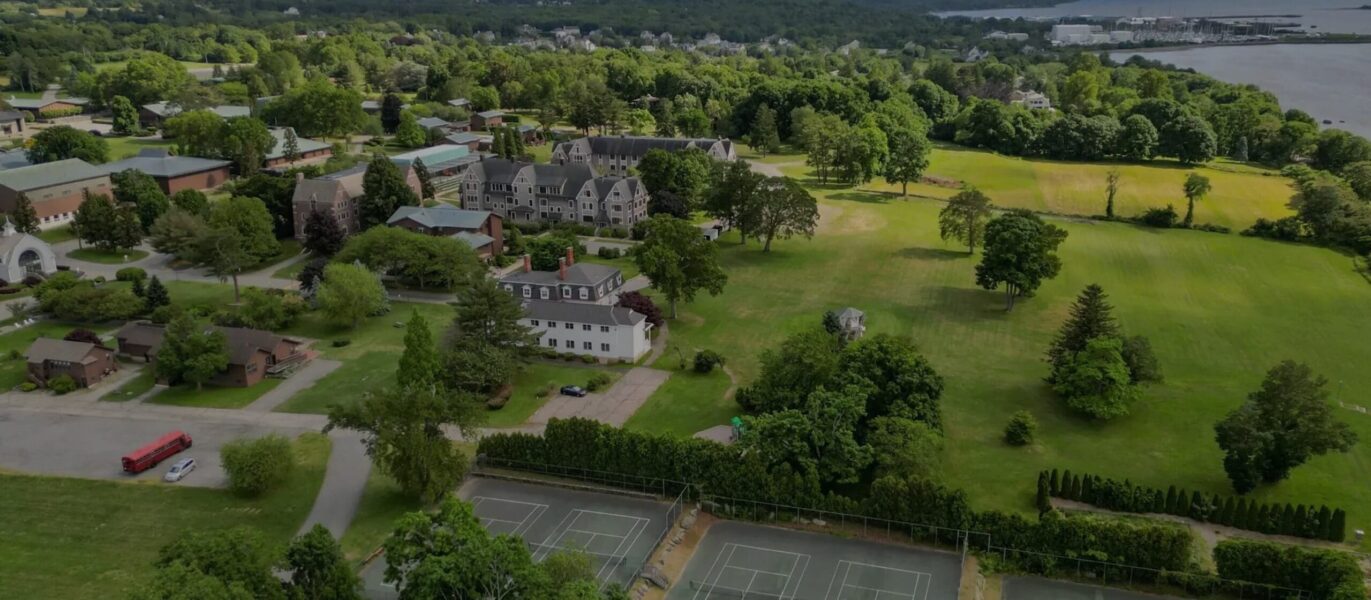
Most of the present campus was designed by the Italian-American architect Pietro Belluschi in a modernist motif of redwood and fieldstone; the octagonal church at its center, modeled on the Church of San Vitale in Ravenna from the Justinian Revival, is often referred to by architectural historians as a “mid-twentieth-century masterpiece.”
But Portsmouth Abbey has suffered the impact of several cases of sexual abuse by faculty and successive abbots who resigned over troubling personal failings. Yet under the headmastership of Matthew Walter and his dynamic wife Paula, Portsmouth Abbey School is entering what St. John Henry Newman would call a “Second Spring,” with record numbers of applications, a much-strengthened faculty, and ever-improving college placement.
Along the way, Portsmouth has known some wonderful characters. Brother Basil Cunningham, the librarian, for example, a prominent tournament bridge player who could recite entire genealogies of European royal families, yet had a mortal fear of lightning such that he would summon a taxi from Newport, eight miles away, to carry him during a storm the two hundred yards from the library to the monastery. Or the eccentric polymath genius Dom Andrew Jenks, who seemed never to sleep, rarely showered, calculated in his head the school’s entire daily class schedule, and pulled day-old pancakes from his habit to feed boys he thought might be hungry. Strange but charming.
The list of distinguished Portsmouth alumni is long. I may or may not be on it. A 29 on the final Mathematics exam, in fact, forced me back to school in August 1969, after having spent the summer in Haight-Ashbury, then marching for civil rights in Cairo, Illinois, and finally at Woodstock. As penance, I lived with the monks for three weeks, was lovingly tutored, and wondered whether, of all the things I had done that summer, this was the most countercultural of all. And the words of St. Benedict rang in my ears:
Seek peace and quiet; be more a listener than a talker; listen with reverence; if you must speak, speak the truth from the heart. In other words, walk in the presence of God under the guidance of the gospel, to see Him who has called us to His kingdom. To begin, ask God for His help; then, never give up.
Catholic education nationwide has been in steep decline since the 1960s, from 5.7 million students to 1.6 million today; whereas in the sixties Catholic schools represented 12% of the student population, today the figure is barely 3%. Of the three traditional New England Catholic boarding schools, Cranwell, a Jesuit school in Lenox, Massachusetts, closed in 1976 for financial reasons; Canterbury, in New Milford, Connecticut, has radically de-emphasized its Catholic identity. Only Portsmouth Abbey School maintains traditional academic rigor and Catholic fidelity.
Father Diman’s firm vision for the school remains: “An education of the reason without faith can only lead its possessors halfway, if it gets that far.”
About the author
Jamie MacGuire, former U.S. editor of The Catholic Herald, is, like his father and sons, an alumnus of Portsmouth Abbey School. He is founding director emeritus of the Portsmouth Institute. His grandson, Patterson James MacGuire, hopes to enter Portsmouth Abbey School in 2032.