


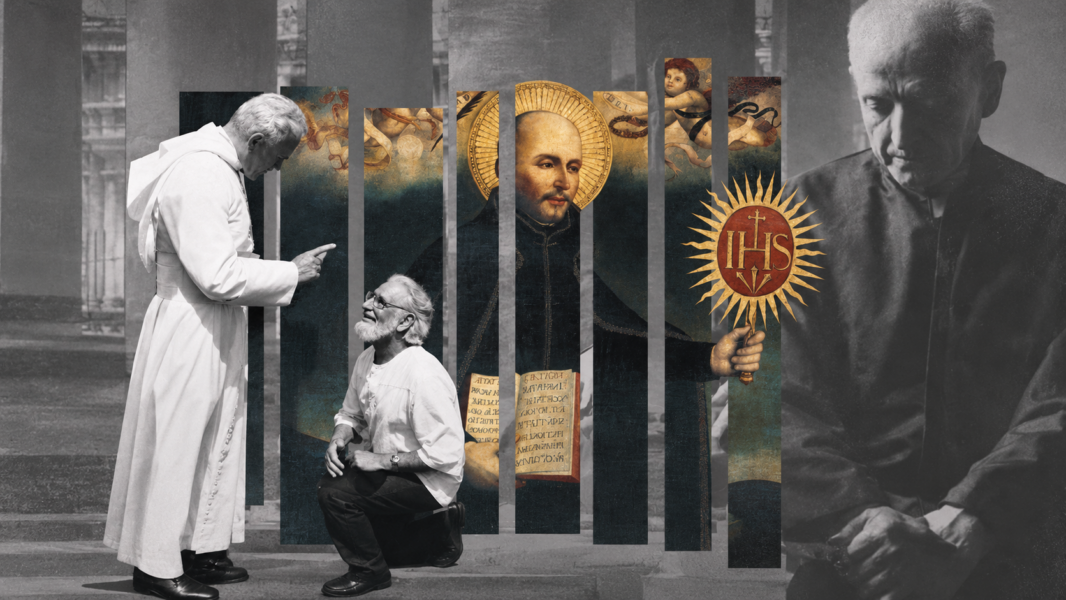
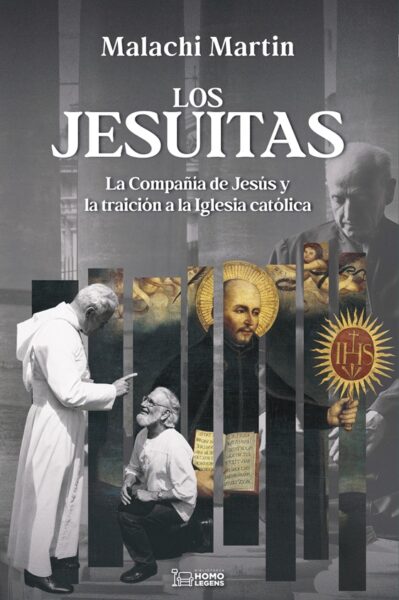
The Society of Jesus celebrates this month 486 years since its papal approval with little more than a third of the men it had in 1965 and closing houses in Navarre and in Mexico. The available explanation speaks of a vocational winter. Malachi Martin, a Jesuit for twenty years and witness to the Second Vatican Council, gave another reason: the order did not fade away, but lost a war it had itself declared. Homo Legens now publishes in Spanish The Jesuits: The Society of Jesus and the Betrayal of the Catholic Church.
On 27 September 1540, Paul III signed the bull Regimini militantis Ecclesiae and the Society of Jesus existed for the first time in law. This month marks 486 years since that signature. The order that was born then to be the pope’s available militia, the one that brought Catholicism to Japan through St Francis Xavier and to the Paraguay of the reductions, reaches its anniversary in retreat.
On 13 August, the Society left one of its communities in Tabasco, Mexico, after 53 years of presence, for lack of personnel. A year earlier it had closed the community of Javier, in Navarre, the house built beside the castle where the patron of the missions was born. These are not isolated cases: they are the form taken on the ground by a statistical series spanning sixty years. In 1965 the Society reached its historic peak with 36,038 members; the latest counts place it around 13,800. It has lost almost two out of every three men.
The available explanation is the general one: secularisation, the collapse of vocations in Europe, the ageing of the clergy. It is true and it is insufficient. It does not explain why the decline begins precisely in 1965, at the highest point in its entire history and in the year the order gave itself a new direction, nor why it has continued for six decades without a single reversal. An institution that loses two-thirds of its personnel in two generations is not undergoing a crisis: it has changed its nature. And the legitimate question is when it changed and by whose decision.
On 7 August this year, Leo XIV received in the Vatican Father Arturo Sosa, Superior General of the Society since 2016. It is the first time since 2013 that the person receiving the Jesuit General is not himself a Jesuit, and the old Roman relationship between the white pope and the black pope returns to what it was for four centuries: a relationship between two different men, invested with two different authorities. No one voiced aloud, that day, the underlying question.
There was someone who asked it when almost no one dared, and answered it with names and dates. Malachi Martin (1921-1999) was a Jesuit for twenty years. He studied in Louvain, earned a doctorate in Semitic languages, worked as an archaeologist in the Dead Sea and at the age of 37 entered the service of the Holy See as secretary to Cardinal Agustín Bea, one of the architects of the Council. In 1964 he requested dispensation from his vows and moved to the United States. In 1987 he published the book that Homo Legens now issues in Spanish, The Jesuits: The Society of Jesus and the Betrayal of the Catholic Church, and opened it without any preamble: “There exists a state of war between the papacy and the religious order of the Jesuits, the Society of Jesus, by its official name.”
That war, he maintains, was not fought over privileges or nuances of school, but over two concrete questions. The first is authority: who commands in the universal Church and who determines what Catholics must believe and what moral norms they must observe. The second is purpose: what the Church exists for in this world. For the papacy, both answers had been given from ancient times. For a considerable part of the Society after 1965, neither of the two is any longer.
The second question is the decisive one, and it is the one that orders the entire book. Martin describes how the supernatural purpose of the Church —securing for every man the means to attain eternal life— was gradually replaced by another entirely worldly one: the liberation, here and now, of those who suffer social, economic and political injustice. The vehicle of that substitution has a name and has authors. “Properly speaking, liberation theology was a Jesuit creation,” he writes, and later adds a definition that in 1987 could seem the exaggeration of a polemicist: “Liberation theology was a theology turned into geopolitics.”
The book puts a face to the conflict. Paul VI and Pedro Arrupe, raised to their offices two years apart, were united by the immemorial bond between the Roman papacy and the Jesuit generalate: “As white pope and black pope.” Martin portrays them with an almost cruel symmetry —similar even physically, equally convinced that their office was messianic, both incapable of yielding— and condenses the drama that began in 1965 in a formula that serves as an index: “the men of the pope against the popes.”
What is most valuable in these pages is not the thesis, but the material with which it is sustained: the voices of the Jesuits themselves. One writes, astonished at the ease with which the established order in his order was dissolving, that “a coup d’état is taking place.” Another, years later: “They snatched the Society of Jesus from beneath our feet and turned it into a monstrous entity under the appearance of commendable objectives.” It is not the enemies of the Society who speak there. It is the Society.
That the conflict was real does not depend on Martin’s word. It is recorded in the acts. In October 1981, John Paul II did something unprecedented in the modern history of the order: instead of allowing the vicar general to assume interim government, he appointed his personal delegate, Father Paolo Dezza, nearly eighty years old and almost blind, to govern the Society until further notice. In 1984, the Congregation for the Doctrine of the Faith published the instruction Libertatis nuntius against the use of Marxist analysis in theology. The then General, Peter-Hans Kolvenbach, responded with a public critique of the Roman document. A Superior General correcting the Holy See in writing: that too forms part of the record.
Martin is a disputed author. His prophetic tone, his taste for dramatic scenes and several of his statements outside the books have earned him serious reservations, inside and outside the Society. But the reservation does not reach the core of the argument: the chronology, the pontifical documents, the general congregations, the names of the protagonists and the decisions they took are verifiable one by one, and the outcome the book announced in 1987 is today a column of declining figures.
There is something, however, that Martin did not live to see. He died in 1999, fourteen years before the Church elected a Jesuit pope, and moreover a South American one. Nor did he see what has come since: a pontificate that is no longer one and a Society that continues to lose around three hundred men a year while closing houses such as those in Navarre and Tabasco. The two things together alter the way of reading him. The book is no longer a warning about what could come to pass; it is the chronicle of what is happening, written forty years earlier.
In its final pages, Martin recalls a reply of Clement XIII. When the enemies of the Society pressed the pope to modify its Constitutions and turn it into an order like any other, the pontiff answered with six Latin monosyllables: Sint ut sunt, vel non sint. Let them remain as they are or cease to exist. And Martin, who has devoted the entire book to documenting the drift of the order, closes it by maintaining that the Society in its original form “was and is irreplaceable.” Both things fit in the same volume, and in that discomfort lies its honesty. On 27 September, when the Society completes 486 years, the pertinent question will not be how many Jesuits will remain in 2036. It will be which of the two Societies is the one that remains.

The Jesuits: The Society of Jesus and the Betrayal of the Catholic Church, by Malachi Martin. Bibliotheca Homo Legens.