


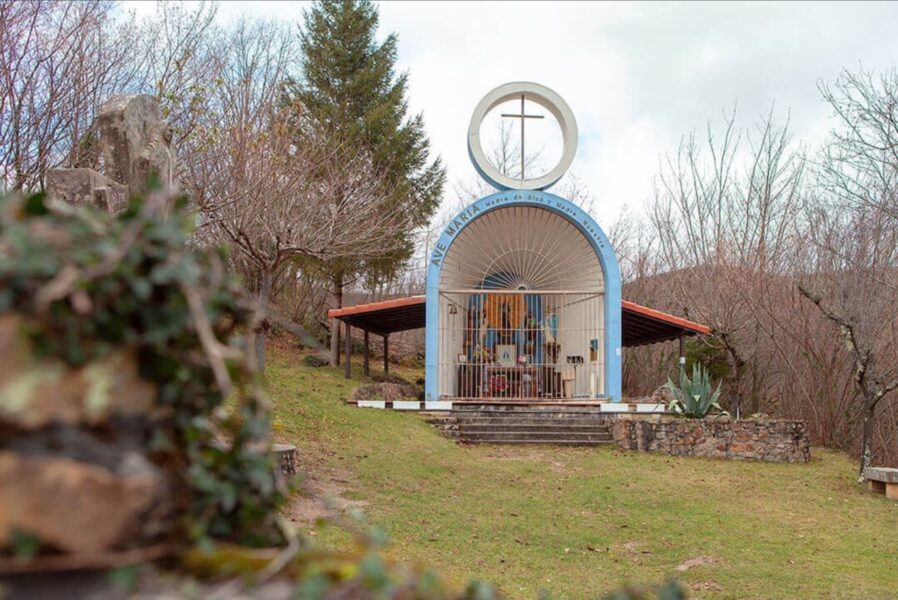
There is a phrase from Doña Concepción González —Conchita, as they call her— that should suffice, by itself, to impose far greater modesty regarding Garabandal. Speaking years after the great Miracle that had been announced, whose fulfillment would constitute one of the decisive pieces of the entire prophetic framework of those supposed apparitions, she came to say with extraordinary simplicity that, if the Miracle did not come, then one would have to conclude that none of it had been true. She sought no hermeneutical escapes, did not speak of a purely spiritual fulfillment, did not explain that perhaps the dates had been misunderstood, nor did she construct a theory to preserve the phenomenon indefinitely against the passage of time: if the Miracle does not come, “nothing was true.” And perhaps one of the most surprising aspects of Garabandal is precisely this: that some of its defenders seem to have arrived at a certainty about those events far greater than the certainty that, at certain moments, those who claimed to have lived them possessed.
Hence the title, which may sound provocative, but which contains a very serious question: the apparitionists know more than the visionaries. Or, at least, they seem to. While a girl claims to have contemplated the Virgin, to have spoken with Saint Michael, to have received a host from the hands of an angel, or that an Warning, a Miracle, and a Chastisement have been announced to her, each of her words acquires an almost notarial value; hours, gestures, utterances, and movements are meticulously reconstructed; photographs, testimonies, and memories are compared. But when that same girl doubts, denies, retracts, admits that she may have imagined something, or simply declares that she did not see the Virgin, then that testimonial authority disappears and a parade of explanations begins, intended to save the apparition from its own protagonists: they were under pressure, they suffered threats, they were going through a psychological crisis, they experienced a kind of dark night, the devil sowed doubts in them, or God mysteriously permitted those denials because that too formed part of the supernatural design, and even the Virgin had announced it to them.
The problem is not to deny that some of these explanations may contain a grain of truth. An adolescent subjected for years to extraordinary pressure can contradict herself; she can experience genuine doubts about previous experiences; she can become confused, sincerely retract something true, or later reaffirm something she had sincerely denied. All of that belongs to the fragility of human memory and conscience. The difficulty begins when a system is constructed in which any favorable statement proves Garabandal and any unfavorable statement also ends up proving Garabandal. If the visionary affirms, it confirms; if she denies, her denial was prophesied and therefore confirms; if she remembers clearly, it confirms; if she doubts her own memories, that doubt would be a foreseen proof and also confirms. At that point, the hypothesis has become practically impregnable, and a proposition that no imaginable fact can contradict ceases, precisely for that reason, to be subject to genuine discernment.
The episode of Conchita with Father José Olano in August 1966 is particularly significant in this regard. According to the testimony given by Olano many years later, it was Conchita herself who wanted to speak with him on August 15. Initially she wished to do so in confession, but the priest, upon realizing the matter she wanted to discuss, deliberately preferred that the conversation remain outside sacramental secrecy, precisely in order to retain freedom of action and to be able to advise her to report the same thing to the bishop. Olano recounted that Conchita then denied the reality of what had occurred and that she later confirmed this before Bishop Vicente Puchol. The priest himself added a caution that honors his testimony: he did not claim to remember Conchita having pronounced the absolute formula that “everything” was false, but he said that it had been invented. And the documentation favorable to Garabandal likewise acknowledges that Conchita spoke that summer of what she had experienced as a possible “illusion, dream, or lie,” and that before the bishop she came to deny having seen the Virgin.
We must not turn those 1966 denials into a kind of inverse dogma. It would be intellectually just as poor to claim that a later retraction necessarily destroys all previous testimony as to pretend that an initial affirmation is immunized against any subsequent retraction. A denial can be sincere or insincere, spontaneous or induced, lucid or confused. But precisely for that reason it belongs to the critical dossier with the same right as the first affirmations. It is not reasonable to maintain that when Conchita said she had seen the Virgin we should believe her because she was there, but that when she said she had not seen her she lacked authority over her own experience because we know better than she what had truly happened to her. At that moment a very curious methodological inversion occurs: it is no longer the visionary’s testimony that grounds the apparition, but the prior belief in the apparition that decides which fragments of the visionary’s testimony may be accepted.
Something similar happens with Mari Cruz. Her later trajectory contains statements extraordinarily difficult to reconcile with the certainty with which some speak today of Garabandal. Already in 1984 she came to declare publicly that she had never seen the Virgin or the angel. Many years later, questioned again about those events, she acknowledged the difficulty of distinguishing with certainty between what had occurred and what the imagination might have elaborated: “In the end you don’t know if you’re imagining it or if it really happened.” This is not a phrase from the pen of an unbeliever or one of those ecclesiastics to whom Garabandalist literature attributes systematic hostility; it belongs to one of the four protagonists of the phenomenon. Naturally, her adult doubt does not mathematically prove that nothing supernatural occurred in 1961, but neither can it be treated as irrelevant precisely by those who have grounded a good part of Garabandal’s credibility on the sincerity and spontaneity of those girls.
Conchita herself offers other testimonies that invite prudence. On one occasion, when explaining what she understood by “being good,” she spoke of each person, “in their religion, in their environment, in their family, in their work,” somehow knowing how they should behave, because they possess a conscience through which God speaks to them. It does not seem fair to simplify those words by saying that she simply proclaimed the indifference of all religions; but neither is it necessary to convert each of her phrases retrospectively into an impeccable theological formulation. Conchita was a simple girl speaking about what she believed she had lived, not a Doctor of the Church. And something of this elementary common sense should be applied to the phenomenon as a whole: let us not make those girls say more than they said, let us not attribute dogmatic precision to spontaneous expressions, and above all, let us not build upon them certainties that they themselves did not always possess.
For that is another point on which one must speak with exquisite respect. The protagonists of Garabandal —not because marriage is spiritually imperfect, which would be un-Catholic to affirm— are not Saint Bernadette Soubirous nor Saint Francisco and Saint Jacinta Marto, in whom the Church has recognized the heroism of virtue. The girls of San Sebastián de Garabandal grew up, married, formed families, and continued legitimate, respectable, and Christianly most dignified lives: married women who have lived for decades in the United States or in Avilés and who deserve, above all, that their own lives and even their silences be respected. But precisely for that reason we cannot attribute to them a kind of spontaneous canonization nor turn every gesture of those adolescents into a supernaturally infallible datum. There does not yet exist that public exemplarity officially recognized by the Church which, for example, allows us to contemplate the life of Bernadette after Lourdes or that of the little shepherds after Fatima as a spiritual corroboration of the grace received.
And it is even more difficult to understand the unshakeable certainty of certain defenders when one contemplates the position maintained by ecclesiastical authority. It is worth stating with rigorous exactness: the Church has not declared that Garabandal is a proven imposture nor has it pronounced a definitive condemnation of its protagonists. But neither has it approved it, nor recognized its supernatural character, nor has it ever invited Catholics to believe in it. The successive heads of the diocese of Santander who had to pronounce on the events maintained the judgment that their supernatural character was not established. One may discuss whether all the initial investigations were carried out perfectly; one may criticize the methodology of certain commissions, the manner of questioning the girls, or the precipitateness of some judgment. But from the fact that an investigation may have been imperfect it does not logically follow that the apparition is true. The defects of the judge do not automatically constitute the proven innocence of that which was being judged.
And Rome did not correct that underlying line either. In the time of Cardinal Joseph Ratzinger, when the Congregation for the Doctrine of the Faith again took up the dossier sent from Santander, it advised maintaining substantially the non constat de supernaturalitate. This datum seems to me particularly important because for years a kind of imaginary Ratzinger secretly favorable to Garabandal has circulated in devotional circles, when the known documentation does not authorize such a conclusion. As for the claim that Paul VI said that Garabandal was the most beautiful story of humanity since the birth of Christ… it is an aurora-borealis testimony, taken from a flying leaflet. The pronouncements of Saint Pio of Pietrelcina and Saint Teresa of Calcutta are also documentarily debatable. And very recently the Dicastery for the Doctrine of the Faith has recalled that the situation remains substantially at that point: the supernatural character of the events is not established. To say this does not, I insist, amount to affirming a positively demonstrated falsehood, but neither can the burden of proof be inverted until the non constat is turned into something resembling a pending approval. Not being condemned does not mean being approved.
To all this is added an element which, in my opinion, deserves a much deeper reflection than is usual: the extraordinary physicalism of Garabandal. There is something strikingly bodily, measurable, and spectacular in a good part of that phenomenology: bodies that during ecstasies seemed to acquire anomalous weights or become impossible to lift, backward marches at surprising speed, nocturnal races, falls and unusual postures, objects presented to be kissed, medals and rosaries supposedly identified or returned to their correct owners, priests recognized even when dressed in civilian clothes, a host visibly appearing on Conchita’s tongue, girls who seem for certain moments to escape the ordinary laws of weight or balance, the Child who offers himself to be kissed, and an enormous casuistry in which attention constantly runs the risk of being fascinated by physical anomaly.
I do not deny a priori any of those facts nor do I pretend to explain each of them precipitately. It would be as unphilosophical to deny in advance any extraordinary phenomenon as to declare it supernatural simply because we do not yet know how to explain it. The metaphysical problem lies precisely there: what is physically inexplicable is not equivalent to what is supernatural. Between the two extends the entire immense territory of secondary causes: perception, imagination, collective suggestion, automatisms, dissociative states, uncommon psychophysiological phenomena, insufficiently known human capacities, and, for those who admit from Christian metaphysics the existence of the spiritual world, even a possible preternatural causality which by definition would not be divine either. The leap from “I do not know how to explain this” to “the Virgin did this” is philosophically illegitimate. The current insufficiency of a natural explanation does not constitute positive proof of a supernatural cause.
And it is here that Saint John of the Cross becomes uncomfortable for any apparitionism. Not because he denies the possibility of extraordinary graces—he knows perfectly the mystical tradition of bodily, imaginary, and intellectual visions—but because he radically distrusts the appetite for phenomena and signs. The Mystical Doctor knows that even a true communication can be misinterpreted by the one who receives it, that the human intellect can turn into an absolute affirmation what God shows in a conditioned, symbolic, or analogous way, and that the desire for extraordinary revelations opens a most dangerous zone for self-deception. His entire doctrine of the Ascent is traversed by that supernatural hygiene: not to rely on visions, not to desire them, not to make faith depend on them, and to walk toward God in the luminous nakedness of theological faith. All visions, locutions, and revelations imaginable weigh less, in the supernatural order, than a single authentic act of humility. The Christian criterion is not the rarity of the phenomenon, but its capacity to lead to a purer adherence to God; not physical anomaly, but the transformation of the person; not how many medals were recognized nor how many bodies proved difficult to lift, but how much faith, hope, charity, obedience, and detachment grow. And even then one must remember that even subsequent spiritual fruits do not mechanically demonstrate the historical authenticity of an apparition. God can grant a true conversion to someone who pilgrimages in good faith to a place about which he is humanly mistaken, because God’s grace is not conditioned by the critical accuracy of all our premises.
Saint Teresa offers the same lesson by another path. Few persons in the history of the Church have received such extraordinary mystical graces, and few, nevertheless, showed such serious fear of being deceived. Teresa sought confessors, submitted her experiences to learned men, underwent interrogations, accepted adverse judgments, and never established as the ultimate criterion of truth the psychological intensity with which she had perceived a vision. Precisely because she knew that an interior experience can be extremely strong and yet still need discernment. The true mystic fears being mistaken much more than he fears that others will not believe him. Apparitionism runs the opposite danger: needing the apparition to be true to the point of interpreting any objection as additional proof in its favor.
From this perspective the denials and hesitations of the visionaries acquire their true weight. They are not a mathematical demonstration of falsehood; they are something much simpler and epistemologically decisive: they prevent the certainty that certain defenders claim to possess. If one protagonist comes to say that she never saw the Virgin; if another can go to a priest to communicate that it had all been an illusion, a dream, or a lie; if decades later someone admits that she does not know with certainty where the event ends and where the imagination may have begun; if the principal visionary affirms that, if the great Miracle does not come, then none of it was true, with what right can a third party, sixty years later, proclaim a certainty superior to that of the visionaries themselves?
Let us therefore listen to the girls of 1961, but let us also listen to the adolescents of 1966 and to the adult women those girls became. Let us listen to them whole. When they affirm and when they deny, when they remember and when they doubt, when they are convinced and when they are not. It is intellectually unclean to select from an entire biographical trajectory only what confirms the previously accepted system. If personal testimony is one of the great foundations of Garabandal, it must be accepted with all its lights and shadows. Otherwise, we stop believing the visionaries in order to begin using them.
There is in this a fundamental difference between faith and apparitionism. Catholic faith has nothing to lose if the Virgin did not appear at Garabandal. Nothing. Not a single syllable of the Creed depends on Garabandal. Private revelations, even those the Church prudently recognizes, never complete the Revelation of Christ nor belong to the deposit of faith. That is why the nervousness with which an apparition is sometimes defended seems to me so un-Catholic. There is no need to insult Garabandal, nor to call those girls liars, nor to caricature the pilgrims who pray there, many of them with sincere and edifying devotion. Much less should one despise the conversions, confessions, or spiritual graces that someone may have received in that place. The only thing necessary is to recover a virtue: prudence, regarding that whose supernatural character the Church has also not recognized.
Perhaps this is precisely the paradox of Garabandal that should concern us most. Not those backward races along the paths of a Cantabrian village, nor the bodies apparently heavy during an ecstasy, nor the visible host on a child’s tongue, nor the kissing of medals and rosaries, but the possibility that a religious mechanism has ended up being produced by virtue of which nothing can any longer disprove the apparition. If six successive bishops do not recognize it, all six were mistaken; if Rome supports the prudence of Santander, Rome also did not study the matter well; if a visionary denies, she was confused; if another doubts, her memory has been damaged; if the Miracle takes decades, one will have to keep waiting; and if one day it does not come, perhaps someone will then discover that it should never have been understood as Conchita herself understood it.
Thus one arrives at the strange result announced in the title: the apparitionists know more than the visionaries. They know what the visionaries saw even when the visionaries themselves said they had not seen it; they know that their denials should not be believed although their affirmations should; they know that the Miracle will come even though Conchita left open precisely in its non-fulfillment the proof that everything might not have been true; they know how to interpret better than the bishops what occurred in their own diocese and they know better than the Congregation for the Doctrine of the Faith the degree of supernatural certainty we should attribute to those events.
Perhaps it would be simpler to accept that we do not know. And that humble “we do not know” is infinitely more Catholic than a private certainty imposed against the very prudence of the Church. One can make a pilgrimage to Garabandal, pray a Rosary there, go to confession, adore the Blessed Sacrament, ask the Virgin for a grace, and return home a better Christian without needing to hold an immovable opinion about what happened between 1961 and 1965. One can love Our Lady passionately without believing in Garabandal, exactly as one can be a perfect Catholic without even knowing of the existence of Garabandal.
Because Mary is infinitely greater than all her apparitions, even the true ones. We do not need her to make bodies weigh, to discover objects, to kiss medals, to make girls run backward through the alleys of a village, or to leave visible prodigies in order to know that She is our Mother. The Virgin of the Gospel speaks little and always points to Another; at Cana she pronounces almost her spiritual testament and then disappears behind Christ: “Do whatever He tells you.” Such is the best medicine for any apparitionist excess: to return from the phenomenon to Christ, from curiosity to faith, from the prodigy to grace, from the excitement of the extraordinary to the silent greatness of the ordinary supernatural.
It is not necessary, then, to condemn Garabandal. Nor to canonize it in advance. It suffices to leave it in the place where the Church has left it and where, curiously, the protagonists themselves still allow us to leave it: under discernment, among questions, waiting for the truth to make its way without the need to force it. Because the Virgin does not need us to defend her from the truth. And the truth, if it truly comes from Her, will never need us to know more than those who said they had seen her.
Read also