


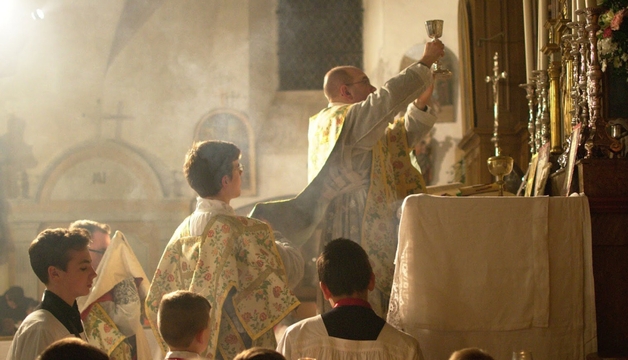
Peter A. Kwasniewski, professor, writer, and well-known defender of the traditional liturgy, maintains that the recovery of the Vetus Ordo can play a decisive role in the face of the doctrinal, moral, and spiritual crisis of the Church. “The lex orandi has the power to stabilize a Church that has lost its bearings,” he states in an interview in which he also addresses the restrictions of Traditionis custodes, the signals coming from Rome under Leo XIV, and the situation of the Priestly Fraternity of Saint Pius X (FSSPX).
In an interview published on September 5 by the German Catholic outlet Certamen, Kwasniewski argues that the liturgical question takes precedence over other ecclesial problems because the way we worship God also shapes faith and moral life. From this perspective, he calls for a return to the “liturgical peace of Summorum Pontificum,” the motu proprio issued by Benedict XVI in 2007 that expanded the celebration according to the 1962 Roman Missal.
“We need to return to the liturgical peace of Summorum Pontificum”
Starting from the statements made at the end of July by Cardinal Arthur Roche—prefect of the Dicastery for Divine Worship and the Discipline of the Sacraments—who ruled out any modification of Traditionis custodes and a return to the framework established by Summorum Pontificum, Kwasniewski believes these words should not be automatically interpreted as a definitive expression of Leo XIV’s position.
“First of all, we must be clear that Cardinal Roche is speaking for himself. One cannot assume that he perfectly knows the mind of the Pope—who knows it at this point?—nor that the Pope automatically endorses everything Vatican collaborators say in interviews or articles,” he maintains.
The scholar recalls that Leo XIV has held meetings with well-known defenders of the traditional liturgy and also highlights the words addressed by the Pontiff to the French bishops, asking them to act pastorally toward the faithful attached to the ancient rite.
Read also: Roche assures that Leo XIV will not reverse the restrictions on the Traditional Mass
He likewise points out that, until a clearer decision is made, the situation on the ground will continue to depend largely on each bishop.
“In one diocese a bishop erects a new traditional parish served by an Ecclesia Dei institute, while in the neighboring diocese another bishop suppresses all Latin Masses,” he explains.
In his view, this disparity cannot continue indefinitely. “The Catholic Church increasingly seems to behave like the Anglicans, pretending unity amid radical disagreement in doctrine and life. This cannot be sustained in the long run. We need to return to the liturgical peace of Summorum Pontificum.”
Kwasniewski is especially critical of Traditionis custodes. He considers the norms promulgated by Francis in 2021 to present both juridical and theological problems and cites their uneven application as proof of their difficulties.
“It is already being applied, adapted, and ignored in parts: the sure sign of failed legislation,” he states.
“The lex orandi has the power to reorient the Church toward the divine”
Placing the liturgical question beyond the debate over authorizing or prohibiting certain celebrations, for him the recovery of traditional worship is linked to the restoration of Catholic doctrine and moral life.
“The lex orandi has the power to reorient the Church toward the divine; anthropocentric disorientation is the gravest and most deforming evil of our time. The lex orandi has the power to stabilize a Church that has lost its bearings. The lex orandi has the power to re-root the Church in its dogmatic patrimony and in the moral demands that flow from it,” he maintains.
This conviction explains why he places the recovery of the Vetus Ordo ahead of other ecclesial battles. Kwasniewski acknowledges the doctrinal and moral deviations he identifies in the period after the Second Vatican Council, but considers it insufficient to combat them without also addressing the way the Church worships.
As he explains, for more than half a century so-called “conservative” sectors have attempted to recover clarity in dogmatic and moral matters while numerous Catholic institutions—dioceses, universities, and religious communities—have weakened and large numbers of the baptized have abandoned religious practice.
“The only ‘medicine’ that can cure this illness is the radical decision to surrender oneself to divine worship as it has traditionally been understood and practiced. That is the mustard seed from which renewal can grow. Elsewhere we seek in vain,” he states.
From this perspective, Kwasniewski considers firm fidelity to the ancient rite necessary among priests who celebrate it. He defends that they should continue to do so even discreetly when necessary and goes so far as to maintain that, in the face of certain attempts at prohibition, they should “oppose them openly.”
“They must do what had to be done at the end of the 1960s and the beginning of the 1970s to preserve the Roman tradition. If no one had acted then with such courage and zeal, today we would not have the usus antiquior,” he asserts.
The FSSPX and what “formal adherence” means
After the episcopal consecrations carried out without papal mandate last July by the FSSPX and the subsequent decisions taken by Rome, Certamen asks Kwasniewski about the Roman note which, in addition to the declaration concerning the six bishops involved, addresses the situation of the Fraternity’s clergy and of those laypeople who “formally adhere” to it.
The scholar maintains that a distinction must be made between the penalty declared against the six bishops and the explanatory content of the note.
“The penalties of the declaration apply only to the six bishops, not to the clergy or the lay faithful, and the note does not change that,” he states.
Regarding the laity, he rejects the idea that merely attending an FSSPX chapel by itself constitutes formal adherence.
“No layperson who attends Mass in a Fraternity chapel because he loves the ancient rite and wishes to worship God in it is thereby a schismatic,” he maintains.
Kwasniewski nevertheless introduces a distinction with respect to those who defend attending Fraternity chapels indiscriminately. In his view, it is “more difficult to justify” doing so when another possibility exists in the same area to participate in the traditional rite within a canonically regular structure.
“Maintaining living, active, and visible communion with the local ordinary is a real and fundamental good in the Catholic Church, and its absence is an evil,” he states.
If a Catholic can simultaneously have “the fullness of the traditional liturgy” and hierarchical unity, he adds, that situation constitutes “a fuller and more perfect way of living the Catholic faith” than possessing only one of those goods.
“If I could only find the Mass in the Fraternity, I would go without hesitation”
Finally, he addresses the question of conscience that may arise for a Catholic when he perceives a tension between certain decisions of members of the hierarchy and the preservation of Tradition.
Kwasniewski rejects solutions that reduce the problem to “obedience above all,” but also the opposite extreme of indiscriminately denying the authority of the hierarchy. He expressly rules out sedevacantism, which he describes as a “monstrosity.”
“We are not Donatists who believe that apostolic succession and sacramental efficacy depend on the personal moral rectitude of the ministers; nor are we in a position to become simultaneously judge, jury, and executioner of the ministers we consider heretics,” he explains.
For the scholar, one of the firm points from which he forms his own judgment of conscience is the traditional liturgy in all its breadth. He does not refer only to the Mass, but also to the other sacraments, the Divine Office, sacramentals, pontifical ceremonies, and the theological, spiritual, and cultural patrimony developed around them.
“That for me is simply non-negotiable; there is no other created good that weighs more,” he states.
From this follows his position regarding the possibility of finding himself in a place where the only traditional Mass available was celebrated by the FSSPX.
“If I found myself in a situation where I could only find the Mass in the Fraternity, I would go without hesitation. That has nothing to do with schism and everything to do with divine worship, which is man’s supreme moral duty,” he asserts. If he did not even have that possibility, he adds, he would seek an Eastern Catholic liturgy.
The writer insists that he presents this decision as the result of his own judgment of conscience and not as a rule he intends to impose on other faithful.
“I would not pressure anyone to accept it nor criticize anyone for not doing so if he is not completely convinced that it is right. That is how difficult moral situations are,” he explains.
For Kwasniewski, conscience must be formed individually through faith and reason and cannot be “externalized” so that another person carries out that practical judgment in place of the faithful.
Patience amid “dark times”
The scholar concludes by calling for understanding among Catholics who reach different conclusions on these questions. He describes the present moment as a period of great confusion, in which different authorities offer guidelines that may appear contradictory.
His appeal is directed particularly to traditionalists. Kwasniewski recalls that many of those who today defend the traditional liturgy previously went through a process of discovery and received, in his words, graces they had not deserved.
“Traditionalists have been mistreated for a long time, and it will probably continue to be so for some time. But we can show the world that our response consists in praying more, forgiving, showing sincere love, making the joy of the Lord our strength, not growing weary of doing good, and always renewing the invitation: ‘Come and see.’”
Kwasniewski holds a doctorate in Philosophy from the Catholic University of America and was one of the founders of Wyoming Catholic College, where he taught Theology, Philosophy, Music, and Art History until 2018. He currently works as a writer, lecturer, and editor, directs Os Justi Press, and has published more than twenty books, a good number of them dedicated to the traditional Roman liturgy.