


By Michael Pakaluk
«We know that all things work together for good to those who love God» (Romans 8:28).
Disasters must come in this fallen world, and perhaps they will come to us. There are relatively few sayings of Jesus that the Holy Spirit judged it fitting to preserve. But one of them addresses the fact of disasters. Concerning those Galileans whose blood Pilate mixed with their sacrifices, or the 18 victims of what we might call «the disaster of the tower of Siloam»: «… do you think that they were worse debtors than all the men who dwelt in Jerusalem? No, I tell you; but unless you repent, you will all likewise perish». (Luke 13:4-5)
As is his custom, Our Lord here uses visible realities as signs of the invisible. He knows human nature: that disasters invite us to feel, to our shame, that we, the living, are somehow «better» than those who died. This reaction is revealing, because it shows that we inevitably interpret disasters as moral events. No matter what some may say intellectually: we cannot succeed in interpreting them as meaningless chance events.
And this propensity is fundamentally correct. Our Lord teaches us its meaning: visible disasters are not meant to sift, as the Final Judgment does. They are mere images of the one true disaster, damnation. And they should stimulate us to repent.
We soften Léon Bloy’s saying, that the only tragedy in human life is not to be a saint, if we omit considering that there is only one eternal alternative to holiness.
Many of us, alive in the days after the 9/11 attacks, watched again and again the videos of the planes crashing into the towers, still not believing it. We liked to shock ourselves repeatedly, first, provoking the feeling that «if only» this or that had not happened, we could have avoided it. («If only» the flight school had reported them; «if only» that suspicious airline official in Portland had not let them board). And then, second, with the feeling that «but it really happened», which is the same as «it was really permitted by God. And this is shocking.
But do you and I repent? Was each episode of that self-inflicted shock followed by a cry for mercy, passionate and proportionate? Did Catholics adopt new mortifications in expiation? People did return to church, it was noted, but those good impulses were soon swallowed up by vengeance and war.
Saint Paul speaks of the difference between the «permissive» and the «perfect» will of God. How do we know whether a disaster is one or the other for us? We might look at the day before the disaster.
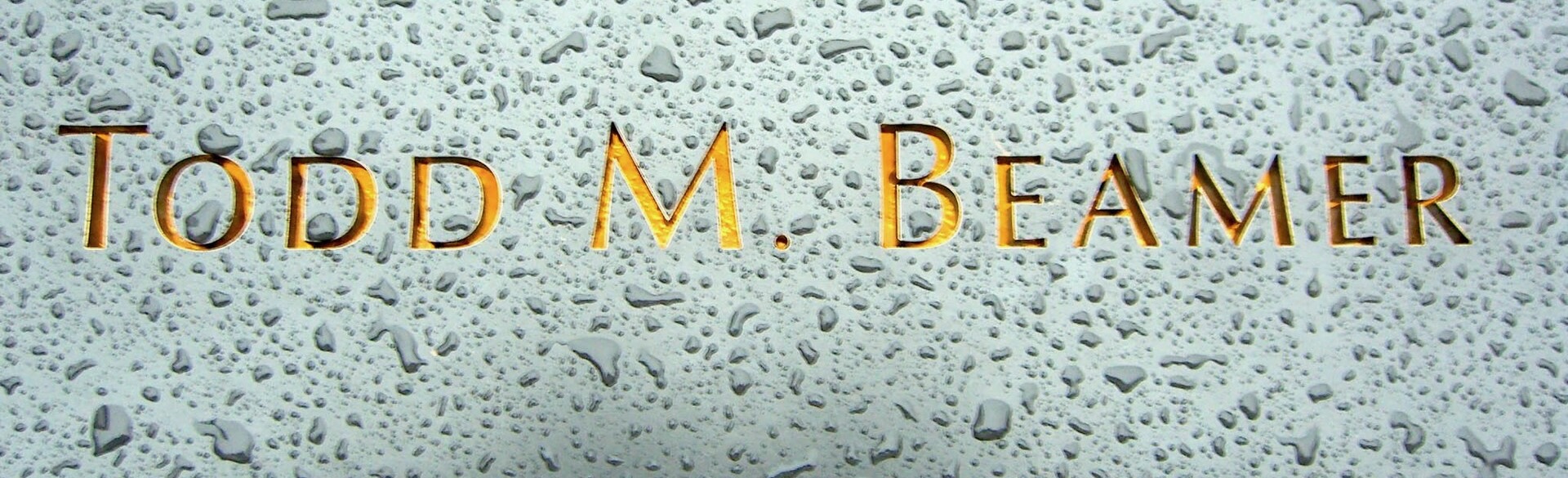
Twenty-five years ago, on September 10, 2001, Todd Beamer returned from a five-day trip to Rome with his wife, Lisa, who was pregnant with their third child. Oracle had sent him there with a group of 500 other employees and guests, as a reward for excellence in sales.
Todd was an evangelical Christian. When he was in Rome, did he and his wife go to hear the man widely reputed as a saint, John Paul II, who gave a General Audience in St. Peter’s Square on Psalm 47? Even if not, surely the saint’s words spoken then articulated the sense of God for their lives:
Until the coming of the Messiah, the hope of the nations, the Gentiles did not worship God and did not know who he is. Until the Messiah redeemed them, God did not reign over the nations through their obedience and their worship. Now, on the contrary, with his Word and his Spirit, God reigns over them because he saved them from deception and made them his friends.
Once home, Todd needed to travel to San Francisco to do a favor for a friend by being present at a meeting with Sony. However, to spend more time at home with his wife and young children before leaving again, he decided not to take a night flight, which was his usual practice, to arrive the night before, but to take a morning flight, on September 11. Was this choice a fatal mistake?
In short: he was a believing Christian. He did his job well. He and his wife were generous in welcoming children. He was a good friend to a colleague. He made sacrifices to spend time with his family. For a young Christian, one can hardly think of a stretch of days better lived.
Since he was doing exactly what God wanted («to those who love God»), it follows, I believe, that his presence on that plane was in accordance with the perfect will of God. The evil hijackers did what they did only in accordance with the permissive will of God. But Todd was following the perfect will of God and, when it became clear to him, as to the other heroes of Flight 93, that he must die, he was able to affirm that God put him on that flight for a reason.
Most likely he himself saw it, because he asked a dispatcher over an Airfone to pray the Our Father with him, with its petition: «Thy will be done». All things worked together for good for him, not because he avoided disasters—clearly—but because he was granted the gift of imitating Christ.
On the eve of the 25th anniversary of the 9/11 attacks, if we seek lessons, let us follow the example of Todd Beamer. A critic might say that we spent twenty-five years expressing anger instead of repenting. We built a security state and fought two wars and do not seem any more willing to sacrifice our lives for others than we were on September 10, 2001. Todd Beamer was prepared, not because he foresaw terrors and took precautions, but because his ordinary days already belonged to God.
Let us also commemorate the ordinariness of September 10 and ask: if today were our day before, would our life the next day give the same testimony that his did?
About the author
Michael Pakaluk, a scholar of Aristotle and Ordinary Member of the Pontifical Academy of St. Thomas Aquinas, is Professor of Political Economy at the Busch School of Business of The Catholic University of America. He lives in Hyattsville, MD, with his wife Catherine, also a professor at the Busch School, and their children. His collection of essays, The Shock of Holiness (Ignatius Press), is now available. His book on Christian friendship, The Company We Keep, is now available from Scepter Press. He was a contributor to Natural Law: Five Views, published by Zondervan last May, and his most recent evangelical book came out with Regnery Gateway in March, Be Good Bankers: The Economic Interpretation of Matthew’s Gospel. You can follow him on Substack at Michael Pakaluk.