


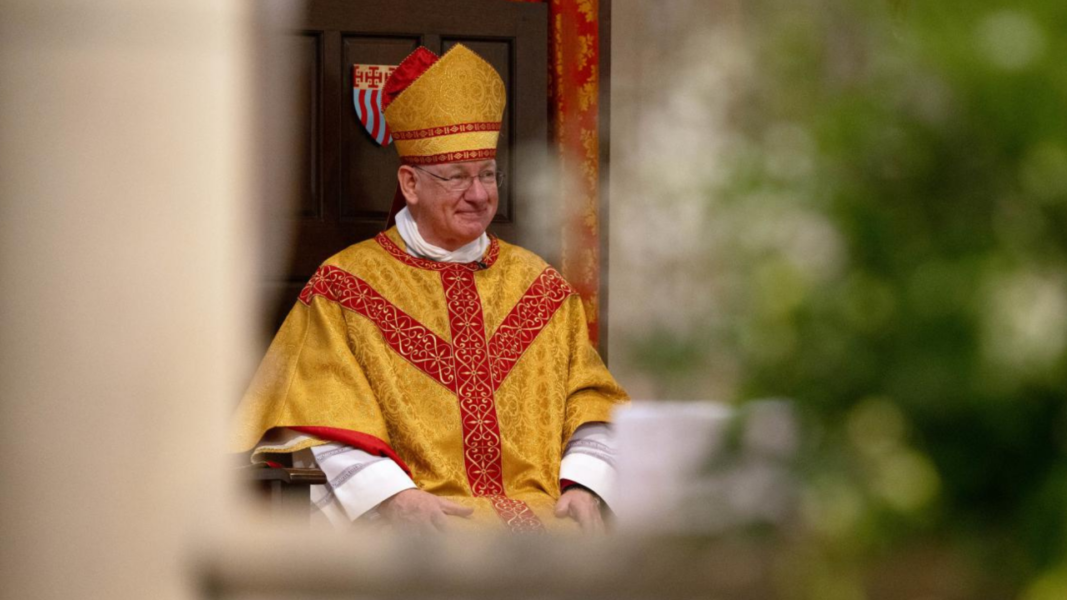
The Archbishop of Westminster, Richard Moth, has defended that the pastoral needs of the faithful should be taken into account when addressing the celebration of the traditional Mass under the restrictions established by Traditionis custodes. «Where there is a pastoral need, I would defend that it be met», the prelate has stated, who since February heads the main Catholic archdiocese of England and Wales.
Moth has set out his position in a wide-ranging interview given to Vatican correspondent Edward Pentin for the National Catholic Register, published on 9 September, in which he has also acknowledged the need to recover a greater sense of transcendence in the liturgy and has addressed the growing number of people coming to the faith, assisted suicide, immigration and the political situation in the United Kingdom.
The traditional Mass as a «pastoral need»
Asked specifically about his position on Traditionis custodes and the Vatican restrictions on the celebration of the traditional Mass, Moth has noted that he has only been at the head of Westminster for a short time, but has explained the criterion he followed during his years as Bishop of Arundel and Brighton.
«I examined it from the point of view of pastoral need», he stated.
The Archbishop added that his disposition is to defend the care of those communities when there is a real pastoral demand: «Where there is a pastoral need, I would defend that it be met».
Moth says this was also the criterion applied in his previous diocese. «Certainly, in my last diocese I can say sincerely, with my hand on my heart, that we responded to that pastoral need», he explained.
His words take on special relevance because of his current responsibility at the head of Westminster and the Bishops’ Conference of England and Wales, at a time when restrictions on the pre-reform liturgy continue and there is particular interest in it among certain groups of young Catholics.
«We need a greater sense of the transcendent»
The interview also addresses the relationship between the liturgy and the centrality of Christ. Asked about the possibility that some of the Church’s problems stem from a loss of that centrality and a liturgy more centred on man than on God, Moth does not share that diagnosis in those terms.
«Christ must be at the centre of everyone’s life, absolutely», he replied. However, he added that the situation described by his interlocutor does not match his own experience.
The Archbishop does recognise a specific need: «I would agree with those who say that we need a greater sense of the transcendent in our liturgical celebration».
Moth believes that this recovery of transcendence can be carried out within the reformed liturgy and highlights as a positive sign the growing interest in adoration of the Blessed Sacrament, especially among young people. As an example, he mentions Youth 2000, a movement strongly focused on eucharistic adoration.
An opportunity for evangelisation in England
Beyond the liturgical question, Moth presents a hopeful vision of the situation of the Church in England and considers that there is currently an opportunity to proclaim the Gospel to a society in search.
The Archbishop uses the expression sweet spot —a particularly favourable moment— to describe the situation. «The world around us is looking, is seeking», he stated, and believes the Church must enter that space «in a new way, with a new confidence».
Moth is, however, cautious about the expression «silent revival» used in recent years to describe the growing interest in Christianity in the United Kingdom.
«One has to be a little careful with the expression “silent revival”», he warns. According to him, a statistician might observe the increase in baptisms over three or four years and conclude that it is still necessary to wait to determine whether a consolidated trend exists.
The Archbishop does consider one pastoral reality evident: «We are definitely seeing a growing number of people coming to the faith».
Asked about the historic aspiration for a reconversion of England, Moth says he prays for it and states that he perceives the action of the Holy Spirit. In his view, the way forward is for every Catholic to live out fully their baptismal vocation and the specific vocation that derives from it, whether marriage, priesthood, diaconate or religious life.
«When that happens, I really believe we will be in a place where the Church’s mission will be unstoppable», he maintains.
Moth against assisted suicide: «It is bad legislation»
Another of the central issues in the interview is the new attempt to introduce assisted suicide in England and Wales.
Moth insists that the bishops have maintained a consistent position against this legislation and summarises his assessment without ambiguity: «It is bad legislation».
The Archbishop says this message is being conveyed «with great force» by the bishops in their respective dioceses and hopes the initiative will fail.
He also anticipates a spiritual mobilisation similar to that carried out during previous parliamentary debates, with holy hours, eucharistic adoration, rosaries and other prayer initiatives in the parishes.
Moth considers it especially important to strengthen palliative care. In his view, if the British system offered adequate palliative care, the reasons put forward for promoting assisted suicide would diminish.
His upcoming meeting with Prime Minister Andy Burnham
The interview also addresses the arrival at Downing Street of Andy Burnham, the first British head of government born and educated as a Catholic, although during his political career he has held positions contrary to the Church’s teaching on issues such as abortion and marriage.
Read also: The bishops of England and Wales congratulate Andy Burnham after his election as prime minister
Moth is due to meet with the prime minister soon.
Asked whether he will address with him his disagreements with Catholic doctrine, the Archbishop avoids anticipating the content of a personal conversation.
«A conversation I had with someone about their conscience remains between that person and me», he replies. Nevertheless, he adds: «If specific issues were raised, I would speak about them and address them».
The Archbishop views positively Burnham’s insistence on the need to improve palliative care before moving forward with legislation on assisted suicide.
«If our palliative care in this country were as it should be, then we would not need to examine these other issues», he states.
Immigration, Islam and conversions to Christianity
Moth also responds to questions about immigration and its consequences for British society. The Archbishop starts from the dignity of every person and recalls that the majority of those who leave their countries do not do so easily.
Asked about the criticism that Church leaders may pay more attention to the immigrant than to host societies and the preservation of their Christian culture, Moth recalls that Catholicism in England and Wales has historically had an important immigrant component.
Likewise, the Archbishop states that his experience of relations between Catholics and Muslims has been «exceptionally good» and points out that there are possibilities for collaboration.
At the same time, he acknowledges the existence of people from other religions who are entering the Church. Asked about the increase in Muslims converting to Christianity and the organisations created to accompany them, he says there will be openness to those who wish to know the Catholic faith.
«We are not going to go out proselytising or forcing people to be baptised —absolutely not—. But the doors are open; the conversation is there», he maintains.
«We are seeing this thirst for the Gospel»
Moth also dedicates some words to persecuted Christians and calls for continued prayer and support for them. He warns, however, that in certain circumstances such help must be carried out discreetly, because excessive public exposure can increase the persecution suffered by local communities.
At the conclusion of the interview, the Archbishop returns to his diagnosis of the moment the Church in England is going through.
«I think the Church is in a very good moment», Moth states. «We are seeing this thirst for the Gospel and, as a Catholic community in this country, that is a space we must enter, with everyone in the Church taking their place in the task the Lord has given us».