


By Amy Fahey
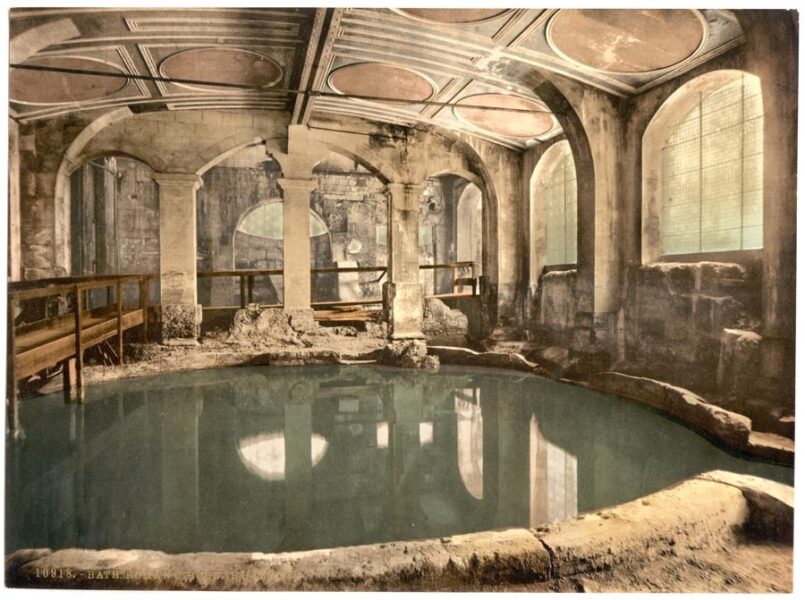
A little over a year ago, I took my elderly father to an appointment with a specialist. The visit, which I still recall with painful clarity, made me think of the Anglo-Saxon poem known simply as “The Ruin.” The manuscript is damaged, so what remains is itself a kind of ruin, a meditation on ancient splendor contrasted with breakage and fragmentation. It seemed to me then, as it does now, an apt metaphor for the current state of health care in our nation.
The receptionist hands me a tablet and a stylus and tells me to check my father in. There is a series of questions on the screen, all related to his bladder. Besides having recently lost his sight, my father now hears poorly, so I begin: “How many times a day do you have to…” But I stop, realizing how embarrassing, even dehumanizing, this would be in a crowded waiting room. My father waves his hand in the air and says with his characteristic Midwestern frankness: “Just answer the middle for all of them. They don’t read that shit anyway.”
The wife of a nearby couple brings her hand to her mouth in a stifled giggle. Her husband turns to her and says dryly, “Well, he’s right.”
When we reach the exam room, the good doctor (I’ve heard from my father that he is a good man, a Catholic) hurries in with his own handheld screen, followed by a young woman in a white coat, presumably accompanying the doctor on his rounds to learn the art of healing. He begins scrolling quickly through the screen, reviewing my father’s records.
Meanwhile my father, summoning all his courage, launches into a well-rehearsed declaration of independence: “Today I’m not getting any injection. I don’t want any more of that junk put into my body. I’ve had enough chemicals already: they’ve completely wrecked my system.”
I’m sure the doctor listened attentively. But I’m also sure his mind was working—working fast. It had to: as he told us, my father was one of seventy patients he would see that day.
I did some quick math. Say the doctor arrived at the clinic at 7:00 a.m. and didn’t leave until 6:00 p.m., with a break at some point to eat or to discuss a patient’s clinical notes with that young woman, or to dictate those clinical notes by voice-to-text, or even just to use the restroom. That would mean an average of about eight minutes per patient.
My father’s weeks of anxious anticipation, reduced to an eight-minute appointment.
Even so, my father hands the doctor one of his favorite cigars: a Rocky Patel Decade. The doctor is effusive in his thanks. The Decades, he says, are his favorites too. He’s going to play golf later that week and will smoke it then. The good doctor then simply says: “Your numbers have been going down. We’ll give you a break and reassess. And That. Is. All.”
I think it is too generous to say that American health care is at a crossroads. It is, like the once-glorious city of Roman Britain contemplated by that anonymous Anglo-Saxon poet a millennium ago, in ruins.
Fears that AI might depersonalize health care seem to have overlooked the obvious reality that health care has been growing steadily more depersonalized for years. When was the last time a doctor spent more time looking at you than at a screen? Who hasn’t had the experience of feeling that the doctor is only one Google search ahead of you (or sometimes behind) in diagnosing or determining treatment options?
I’m not suggesting there aren’t excellent, dedicated, and humane people in the medical profession. There are, and I have been blessed to meet some of them. Yet even as studies warn of the “cognitive overload of overworked medical staff,” and prognosticators predict the “cognitive debt” that AI will introduce, it seems obvious that both overload and debt have already crossed the threshold of our clinics and hospitals. As in education, COVID only exposed and accelerated a problem that was already there.
Still, there are signs of hope. For several years, my family and I have belonged to a Christian health share, an alternative to conventional insurance in which participants “bear one another’s burdens.” In some of the darkest moments of uncertainty with our children’s health, receiving the comforting support of the prayers that accompanied each reimbursement check from a “member” sustained me, even when physical healing was elusive and medical professionals seemed disconnected or overburdened.
And several months ago, I found myself in a café with the founder of the Regina Caeli Clinic, listening to her radically different vision for Catholic health care in my corner of New England.
The clinic commits to one-hour appointments. It is conceived as “a place of refuge for patients and providers alike where rights of conscience are respected, where [the Hippocratic Oath] ‘Do no harm’ is taken seriously, where the sanctity of life from conception to natural death admits of no compromise, where dignity is recognized and nurtured; a place where health care aims to heal the whole person, mind, body, and soul.”
That is, of course, an ambitious vision, and one not easily implemented on a large scale these days. But given the current state of affairs, why not try?
A fitting patroness for any effort to rebuild Catholic health care is the Venerable Rose Hawthorne Lathrop, whose faith enabled her to see beyond the wound of soul and body that so tormented her literary father, Nathaniel. “See in every sufferer Our Lord Jesus Christ,” she told her Dominican sisters at the Home for Incurable Cancer that she founded.
That kind of radical vision is the only foundation for a truly Catholic—and truly effective and sustainable—health care.
My father passed away several months ago. I suspect that, as the good doctor slowly smoked his Rocky Patel during golf with his friends, he remembered my father, and even prayed for him. It is not the only solution for our broken health-care system—but it is a beginning.
About the author
Amy Fahey is a Teaching Fellow at Thomas More College, where she also directs the Center for the Restoration of Christian Culture.