


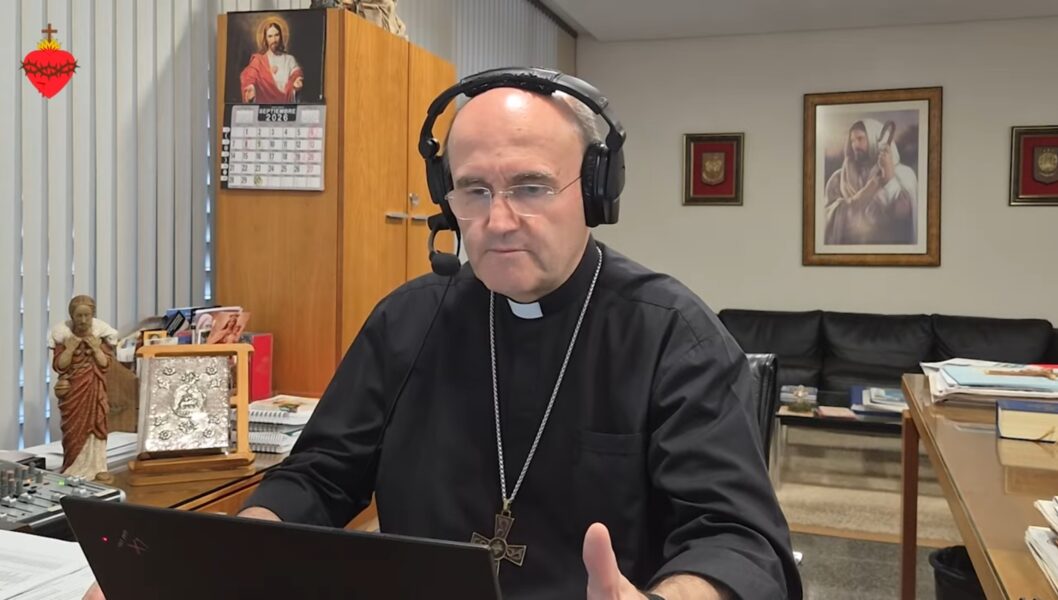
One listens to Sexto Continente on Mondays at eight with the discipline of an entomologist returning to the same trunk: not in hope of novelty, but out of fidelity to method. This Monday the trunk yielded more than usual. Monsignor José Ignacio Munilla, bishop of Orihuela-Alicante, opened the program with a catechesis against victimhood, that “whining narcissism,” and to bolster it he turned to Viktor Frankl and “a page from the well-known book A Man for All Seasons,” which the bishop says he read as a seminarian. A Man for All Seasons is Zinnemann’s film about Thomas More; Frankl’s book is titled Man’s Search for Meaning. One forgives the slip without effort, because More had his head cut off for refusing to sign what was put in front of him, and that is, as will be seen, exactly the charge the bishop was going to level a little later against Delcy Rodríguez, only in reverse. From that page, in any case, he drew a sentence from Dostoevsky that one noted for personal use: “the only thing I fear is not being worthy of my sufferings.” A good start. Then he moved on to current events.
The current event was the oil agreement between the Trump administration and that of Delcy Rodríguez, which the bishop declared “profoundly immoral” before reasoning it out, as he himself warned with a frankness one appreciates, and which he explained with a two-minute video from an Instagram account in which it is acknowledged that the decisive clauses of the agreement have not been made public. One is not going to argue with the account, although he made it in front of everyone: he divided what Caracas expects to collect in taxes by what lies underground, called the quotient the price per barrel, said “we know how to divide,” and one divided with him and got the same result, which is what is worrying. One will not argue because the agreement, honestly, matters a damn. What matters is what the bishop did with it next.
Because the bishop, perhaps aware that indignation without hierarchy is only noise, set about establishing a hierarchy, and one must quote him literally because there are phrases that do not admit paraphrase: “It is extremely serious that politicians who support abortionist, LGBT agendas, etc., obviously their policies are of the utmost gravity. But politicians who are taking advantage of the poverty or the inability of certain nations, such as Venezuela, to govern themselves democratically, in order to extract all the resources, also deserve the same consideration.” The same consideration. One has gone back over the sentence several times in case the “also” concealed a nuance. It does not. A bishop has said on a Catholic radio station that promoting abortion and signing an oil concession on advantageous terms deserve the same moral consideration. Not an analogous consideration, nor a similar one, nor comparable in some respect: the same. And he said it of a contract which, according to his own program, no one has been able to read in full, which adds to the equivalence the detail that one of the two terms is unknown. Abortion weighs what it weighs; the agreement weighs the same, and we do not know what it weighs.
In May it was explained here, with regard to the same bishop and with the doctrinal note of 2002 in hand, that Catholic moral theology distinguishes between intrinsically evil acts, whose evil does not depend on circumstances or intentions, and the vast territory of the contingent, where doctrine sets principles and leaves solutions to prudential judgment. There is no need to repeat it. It suffices to add a text that Munilla, by age and by office, knows: the memorandum that Cardinal Ratzinger sent in 2004 to the American bishops on the communion of politicians. “Not all moral issues have the same moral weight as abortion and euthanasia,” wrote the man who would become Benedict XVI; a Catholic may disagree with the Pope on capital punishment or on the decision to wage war without thereby becoming unworthy of receiving communion, because “there may be a legitimate diversity of opinion among Catholics about war and the death penalty, but not about abortion and euthanasia.” Ratzinger was speaking of war, that is, of killing. If legitimate diversity of opinion among Catholics is possible on killing, then on an oil concession there is room, a fortiori, for an ocean. Munilla not only equates what Ratzinger separated: he equates something several floors below what Ratzinger separated. In May the leveling came disguised as even-handedness, with that “all parties fail” that distributed blame equally. Today it comes without disguise. The same consideration.
And he did not present it as opinion. He presented it as prophecy: “in that prophetic dimension of our baptismal vocation, we are called to raise our voice and say: this is profoundly immoral.” The Council has a paragraph for this moment, and it is not in the Syllabus but in Gaudium et spes, number 43: when the faithful, with equal sincerity, judge a temporal matter differently, “no one is permitted to claim exclusively for his own opinion the authority of the Church.” Munilla did not claim the authority of the Church; he claimed that of baptism, which is more serious, because we all have baptism, and he placed it at the service of an equivalence that the Magisterium has rejected by name. It is the opposite of prudence, which Aristotle defined as the virtue of contingent things, that is, of things that can be otherwise, that is, of things one should look at before speaking of them. An oil contract is the most contingent thing that exists: it depends on the price of crude, on the fiscal formula, on the operator, on the term, on whether the next government respects it. An abortion does not depend on anything. Putting the two things in the same sentence with the same cadence is not moral rigor: it is esprit de géométrie applied where Pascal reserved the esprit de finesse.
The bishop also has a general criterion he considers decisive: negotiating with an illegitimate government is immoral. One does not enter into whether Delcy Rodríguez is what the bishop says she is, a “puppet” who “signs whatever” if she does not want to “end up in jail like Maduro.” One enters into the criterion, because the criterion, taken seriously, sweeps away the Secretariat of State. In October 2024 the Holy See renewed, for four more years, its agreement with the People’s Republic of China on the appointment of bishops, with a government that has not won an election since 1949 and that has Catholic bishops imprisoned or missing. Casaroli’s Ostpolitik negotiated for two decades with governments that not even Munilla would call legitimate. The nunciature in Caracas did not close its doors with Maduro inside Miraflores. One is not saying that all that was wrong. One is saying that if negotiating with an illegitimate government is, tout court, “profoundly immoral,” the bishop of Orihuela has just condemned several pontificates and Cardinal Parolin without realizing it; and that if it is not, then the criterion was not a criterion but an adjective.
There is more, and it is a matter of method. The judgment of intentions, which is what was reproached in June when he attributed to an entire party the phrase of a deputy, is administered on this program wholesale: to Trump, who “did not intervene to liberate but to despoil”; to the oil companies, which know what they are doing because “they are not stupid”; to Americans who want cheaper gasoline; and, in case anyone was missing, to María Corina Machado. The Nobel Peace Prize winner has criticized the agreement, yes, but she criticized Delcy Rodríguez and not Trump, and the bishop knows why: “she has not dared to say a word about Trump, because she too has her freedom compromised by the United States.” Take note of the hermeneutic, because it is the bishop’s and not one’s own: when someone is silent about the power on which he depends, the silence is explained by the dependence.
Because what one misses on Sexto Continente is not oil. One has before him the public list of programs since May: the memorandum between the United States and Iran, Trump’s war against the International Criminal Court, the UN report on genocide in Gaza, Vox and abortion, Bolaños against Argüello, the invasion of Ceuta, the new president of Colombia, and now Venezuelan oil. On the Church side, the excommunications of the Lefebvrists, summarized in that “there is no orthodoxy without obedience to the Pope,” and the pearls of the papal trip to Spain, in three installments. One does not dispute the selection; everyone puts the microphone where he wants. One notes what is not there. Chiclayo is not there, where the case of Father Eleuterio Vásquez, denounced by three sisters for abuses suffered as girls, was closed in November by the dispensation from the clerical state, requested by the accused himself and granted by the Pope, without trial or judgment on the merits and against the express request of the complainants that the case go to the end. Cusco is not there, where on August 13 an official of the Dicastery for the Doctrine of the Faith and papal commissioner for the Sodalitium placed coca leaves in a “payment to the earth” at the opening of a meeting that Vatican News presented as preparation for the trip of Leo XIV to Peru, and whose rite Vatican News omitted. The promotion, two weeks later and with right of succession, of the auxiliary bishop who made the offering just before him is not there. One is fair: between August 17 and September 4 there was no program, and prophets also take summer vacations. But the bishop returned on the 4th and spoke of the Guadalupana, and returned on the 7th and spoke of Delcy Rodríguez and the French euthanasia law. Two programs, zero mentions. And Chiclayo is not from August: it is from November, from December, from May, from every Monday and Friday since then, and it has never fit.
Read also