


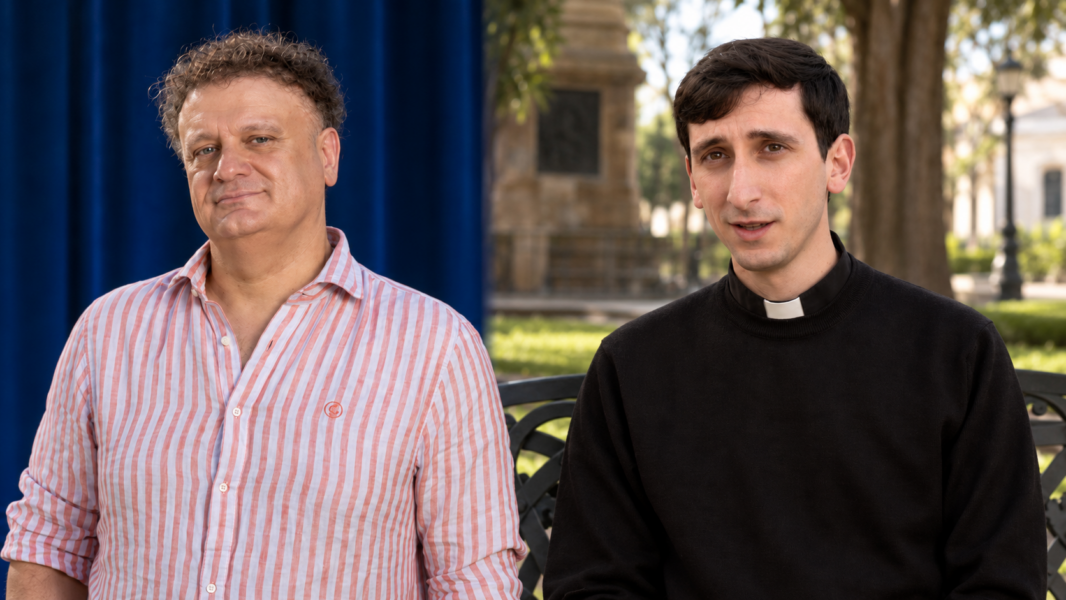
The chapter, published on August 30, brought together the philosopher and the vicar of the Sanctuary of Santa María de África to analyze the controversy sparked by the priest’s words on Telecinco after the Ceuta incursion. The thesis of the colloquium: no one has refuted what Molina said; everyone has refuted something else.
The proof that Father Jesús Francisco Molina spoke correctly is that no one has answered what he actually said. That was the thesis with which Miguel Ángel Quintana Paz opened the colloquium of La Sacristía de la Vendée, published on August 30, and the one he maintained for more than an hour and a half alongside Father Francisco José Delgado and, when the connection allowed, alongside Molina himself, parochial vicar of the Sanctuary of Santa María de África in Ceuta.
Those who have criticized him, the philosopher summarized, either have not listened to him or have preferred to refute a phrase he never uttered: that foreigners are not neighbors or that they should not be helped. What Molina said before the cameras of Vamos a ver was something else, much older and much harder to answer: that when resources are not enough for everyone, choices must be made, and that charity has criteria for doing so.
It is worth recalling the literal words, because the entire program revolved around them. Asked about the wave of Ceutans calling for NGOs to withdraw so that the migrants remaining in the city would go hungry and leave, Molina replied that “the Church is not an NGO and does not have NGOs,” that its main function is not to attend to the needy—“one of the main ones, of course”—but to administer to its people their supernatural needs: the sacraments, preaching, the sustenance of the people of God. He added that if it is in his power to help, he will do so, but that resources are not enough—“not only the Church, but Ceuta”—that the city already had poor people before and that if, in addition, one has to take from those poor what little there is to give to those who have entered, the situation becomes much more complicated: “It is charity that demands that hierarchy. One attends first to one’s neighbor, who is the nearest, the one beside you. The Ceutan before the one who is not.” Delgado played the full clip at the beginning of the program so that no one could later claim it had been quoted out of context.
The context was set by Delgado himself, in Góngora’s absence—he was on procession. On July 30, tens of thousands of people stormed the border; the Government had put the entries at 72,000 and the Autonomous City at 80,000, as many as Ceuta has inhabitants. Most had returned to Morocco within a few days, but at that time a number remained in the city that no one had been able to fix: Interior had spoken of 5,000, Defense of about 8,000, and the Ceutan Executive of up to 11,000. Since the assault, attacks had been reported—Delgado warned that he did not have exact figures—a group of migrants had ambushed a military patrol with stones, and neighborhood tension had translated on August 27 into the hours-long blockade of a Red Cross truck carrying food to Playa del Trampolín. It was in that framework that Telecinco asked Molina how the Church takes the fact that there are Ceutans asking for NGOs to withdraw.
Quintana Paz placed the response in a centuries-old tradition. The problem Molina raised in a minute, he said, is the one Thomistic tradition has been discussing since Saint Thomas and the one Max Weber, “who is not a moralist but an analyst of our society,” formulated as a conflict between principles and responsibility: what to do when one cannot help everyone. And one cannot. No one can help all of humanity, and what cannot be done cannot be obligatory: “If I cannot fly, it cannot be obligatory for me to fly.” Kant summarized it, he recalled, but one does not need Kant to understand it. The question, therefore, is not whether one must help, but whom one helps first when need exceeds means, and to answer it Christianity has criteria that “are not crazy criteria,” because Christianity is not an ideology for the desperate: natural reason, as it could not be otherwise, agrees with the Christian message.
The first of those criteria is proximity, and here the philosopher paused on the etymology that many seemed to discover during those days: neighbor is nearest, in Spanish as in Italian and in Latin, the one one has in front, the one one runs into. That is exactly what happens in the parable of the Good Samaritan, brandished against Molina as if he did not know it: the Samaritan runs into the wounded man and helps him, just as the priest and the Levite had also run into him and passed by. The parable also provides the second criterion, that of urgency, which corrects the first. Quintana Paz gave his own example: his sister is nearer to him than a stranger, but if on the way to his sister’s house he finds a stranger bleeding on the sidewalk, the inconvenience of arriving ten minutes late is incomparable to the urgency of the one in front of him. What was happening in Ceuta, however, was that both needs were in front at the same time, and then proximity decided again: if two people are bleeding and one is his friend, one attends first to the friend and then, if one can, to the other. “No father, if three children have fallen into the pool, goes first for the children who are not his.” None of this was new: at the beginning of 2025 the whole world discussed the ordo amoris when Vice President Vance invoked it and Pope Francis responded, and the philosopher then celebrated, in an article, that the discussion had moved from the rights of fashionable minorities to discussing Saint Thomas.
But he acknowledged that the comparison with the American debate fell short, because in Ceuta there was an element that was not there: the one who needed help had entered violently into foreign territory and had the return half an hour’s walk away, “his two little legs are enough.” That changed the nature of the choice. Feeding, housing, and providing services to those who remained—setting up a camp at the riding school, said Delgado, in a city where space is a scarce good—was not only helping them: it was encouraging them to stay and more to come, and therefore harming the Ceutans, who had lost an entire summer of work in hospitality and tourism. The real dilemma, Quintana Paz maintained, was not between helping some or others, but between harming some and not helping others, because the two things went together. And what the neighbors were shouting at the Red Cross truck was not “do not help them,” but “please, do not harm us more.” Delgado added the question that Molina’s soundbite had no time to formulate: why one should harm one’s own to help someone who had come by force. The answer, they agreed, was not mistreatment either: no one was proposing to harm those who had entered; those who argued that they should leave did so because they believed it was better for them and for Ceuta.
That a socialist reasoned otherwise he understood, said Delgado; that people of the Church did so seemed “repugnant” to him, because presenting as Christian a demand that no Christian can accept drives people away from the faith. Quintana Paz illustrated it with the “imaginary dream” he had told that morning: two hundred people get into his sixty-square-meter apartment and a Jesuit comes to tell him that what is Christian is to keep them. He did not know, he said, any parish priest, any Caritas delegate, or any Jesuit who, if two strangers entered his house by force, instead of inviting them to leave, would start feeding them and lending them the phone charger. That transformation of the faith into something ridiculous is used by some deliberately, to present Christianity as irrational, but many others believe it, and with those, he concluded, what is needed is to evangelize them.
The program devoted a long stretch to what Delgado called the “misplacements” of the debate, with a proper name both said they appreciated: the historian Alejandro Rodríguez de la Peña, who had written on X that he would always oppose lethal violence, in particular against unarmed women and children. No one had proposed killing anyone, Delgado replied: those asking that they leave were being “very moderate indeed,” because there were infinitely simpler methods. And he pointed out the contradiction: in the next message Rodríguez de la Peña himself called for “militarily sealing” Ceuta and Melilla, that is, he admitted the armed deterrence that in the previous one he seemed to repudiate. Delgado recalled that more than ninety percent of those who had entered were young males, that the question was what to do with them when they appeared before a sealed border, and that in any case one had to distinguish between the unjust aggressor and the aggressed, a distinction the public debate had inverted until presenting the Ceutans as if they were “simply passing through.” Quintana Paz brought the matter to George Lakoff’s terrain: the question was the frame. If the frame was that in Ceuta there were people who wanted to kill Moors, one thing was being discussed; if the frame was what was really happening, another was being discussed, and whoever introduced the first took the conversation off track. He also lamented that, when people responded to Rodríguez de la Peña with arguments, he spoke of attacks and blocked his critics: an intellectual who puts an idea in public cannot victimize himself when it is refuted; he must respond. He recalled that he had invited him several times to debate in public and in writing, without success, and set the rule of the game: if he had a document proving that Israel and the United States promoted the Ceuta incursion, “I will change my mind”; if he did not have it, he was defaming, and a medievalist accustomed to grounding his statements in documents should apply the same criterion to current events.
There entered the other reading Delgado wanted to dismantle: the one that attributed the “crisis” to an “Anglo-Zionist” operation using migrants as hybrid warfare ammunition. That Morocco had been behind it anyone could see, he conceded; that the purpose was to pressure the Spanish Government could also be. But all ideology cuts reality, and this one cut the fact that that “human ammunition” had intelligence and will. Those who had come had come because they had wanted to: some for a spree, and had already left; very few fleeing something serious; others wanted by justice or expelled from Europe trying to return through the back door; and others who, he said, were arming themselves with pepper sprays provided by some NGO and had attacked a military contingent. Exempting them from responsibility because “my ideology tells me this is evil Anglo-Zionism” was letting ideology rot the head. Reality “has the bad habit of being polyhedral”: diplomatic and economic pressure on Morocco could coexist, and, for those on the street, “do you want a sandwich? Here’s a sandwich, and out the door to your house.” As a sample of who was behind the legal trigger of the “crisis,” he showed on screen the website of No Name Kitchen, one of the three entities that litigated to the Supreme Court the case that gave rise to the ruling on maritime pushbacks at the border, presided over by a flag that, he said, “is not exactly very Israeli.” And he added a geopolitical observation: neither Iran nor China nor the Palestinians, presented for years as Spain’s natural allies, had said a word in support of Ceuta, and Morocco maintained with Hamas and the Palestinian Authority the relations it maintained.
Quintana Paz, whom Delgado asked to analyze “as a philosopher” the phenomenon, referred to his prologue to Anthony Esolen’s book on the social doctrine of the Church published by Homo Legens, where he asks whether that doctrine is an ideology and answers no. Ideologies, he explained, are artifacts of barely two centuries, proper to mass societies and the incipient democracies of the 19th century, which pretend two incompatible things: to explain all economic, political, and social reality, and sometimes all of history, and to do so in such a way that it can be told in three or four steps to the union colleague or the neighbor. Simple and hypercomplex at the same time, they only survive by dispensing with entire regions of reality. And that is what had happened with Ceuta. First it was said that Pedro Sánchez had resolved the “crisis” in forty-eight hours without returning from vacation; later, when reality did not allow itself to be resolved, culprits had to be found, and a campaign was launched, “paradox of paradoxes,” to point to the only party that for years had been proposing to fortify the border against the opposition of all the others, including the PP that governs Ceuta. When reality had jumped—Ceutans suffering, women attacked, a small city losing space every day—the philosopher read it in the key of Renaud Camus’s Great Replacement: if foreigners entered and Ceutans left, that was the perfect invasion, the first step of a substitution of the nations that drink from Athens, Rome, and Jerusalem, and that turned out to have refused to be replaced.
From others’ arguments he moved to the paradox of the Jesuits. For decades, he recalled, the so-called ethics of the situation had thrived in the Jesuit world, which rejected absolute principles and demanded attention to the concrete circumstance, to the participants, to what happens to people; a current with Protestant names like Bultmann and Tillich, which Pius XII condemned, and with more moderate Catholic versions, from Häring to Marciano Vidal, in the same Salamanca from which he was intervening. Well, the heirs of that tradition had come out to tell the vicar of Ceuta, from Lima, that he knew nothing about the situation and that the one who knew it was the Jesuit Hernán Quezada, who presented himself on social media as a moralist before replying to him. It was not a question of kilometers, Quintana Paz clarified, but of knowledge of the details: Quezada knew that rapes had been reported in Ceuta—the philosopher spoke of seven or eight girls, with figures he himself gave as open—and knew, therefore, that what he was asking of the Ceutans was to endure that “macabre lottery” or to lock their children in the house, as a neighbor recounted on television. Molina, on the other hand, made clear that the order of charity was not “mine first” in every case and for anything, which would be nepotism: it was combined with urgencies and, as Delgado added, with the fact that the one attacking you needed, first of all, to be made to stop attacking.
When he finally managed to connect, from outside Ceuta and with a line that cut several times, Molina lowered the epic. The first thing he wanted to say was that the reaction had seemed disproportionate to him: in two three-minute clips he had done nothing more than repeat what his neighbors had been saying for three weeks before the cameras—mothers of the girls who made their First Communion last year, people known from the parish—and what had drawn attention was that a priest, and a young one, had said it. He drew from it a lesson for himself, who had not yet completed three years of ministry: people were eager for the Church to give clear guidance, and that required priests to be “very attentive, very well formed” to guide the people of God in the face of what was happening. The second was the diagnosis of his critics: lack of realism. He was astonished that what was happening in a concrete place was answered from idealism and abstraction, and that those doing so ignored the literalness of his words, discussed things no one had said, and spoke “on terrain that is not the real one.” He found amusing the succession of introductions—“I am a moralist, I am a theologian”—followed by perorations that had nothing to do with Ceuta; he, he said, was not a theologian nor a specialist in anything, he was a musician, what he knew best how to do was play the organ, and in theology he had the notions from the seminary. But the question no one was answering was the only one that mattered: “What do we do with the ten thousand people who are on the street?” The controversy over whom one had to help first was, in his opinion, false, built on words he did not say, and dodged the only exit in which everyone came out well, which the president of the city himself had formulated: that they leave. They would find resources where they existed, because in Ceuta there were none, and the Ceutans would recover their lives.
On the NGO phrase, Molina explained what he had meant. When one speaks with the media one notices that whoever does not understand what the Church is, or directly has no faith, needs the Church to justify itself by its social function, and that is why they asked him what he was doing to feed people. The Church was not for that, he said: when it could, it would do so, “no one is going to starve to death in my hands if it depends on me,” but its first function at that moment was to console and guide a people of God that was suffering, and the first victims were the Ceutans, “the only ones who did not seek this situation.” To consolidate unity, concord, and peace in a very nervous city, and to give moral guidance on issues no one was talking about and that were more delicate than the false controversy: the use of violence that was beginning to become popular and the right to protest.
Quintana Paz stressed that that distinction, far from being a whim, almost literally reproduced a warning from Joseph Ratzinger in a 1969 radio address later collected in Faith and the Future: soon we will have priests reduced to the role of social workers and the message of the faith reduced to a political vision. If in 1969 it was already necessary to clarify it, how much more today, when the journalist demands that the priest justify his existence by proving he is a good social worker. That Jesus did not found an NGO does not mean that attention to the poor is not part of the Church’s mission; on the contrary, its two-thousand-year trajectory in hospitals, hospices, and assistance admits no comparison with any other institution, and even less the task, “light-years from anything else,” of having shaped an entire civilization in which attending to the poor is seen as necessary. But that task only makes sense from a supernatural message: no one dedicates his life to the dying person who is going to die in twenty minutes, like the daughters of Mother Teresa, if he does not believe that that dying person has something afterward. That is why he thought it brilliant that Molina started there, and he warned of the opposite danger, that of the Spanish Episcopal Conference’s publicity for the tax checkbox, which shows how many works of charity the Church does and what an effective NGO it is. Molina, he said, changed the focus “and placed it where Ratzinger placed it.” If one did not start from that paradigm, the vicar concluded, one was not talking about the same thing when one said “Church,” and no possible interlocution existed.
At Delgado’s request, Molina gave a street chronicle. During that week he had gone down after Mass to see the atmosphere “as if he were a journalist.” First, a phenomenon he had never seen in Spain: a demonstration every afternoon, every afternoon, more days than the reaction to 11-M lasted, and peaceful, something commendable because people were “very angry and very tense” and there had been few outbreaks of violence, from a handful of individuals and without attacks on persons. But every day there was more anger and more desire for trouble, and it was beginning to be thought in Ceuta that someone was interested in a social explosion. He was especially worried about the beginning of the school year: parents who passed by the parish and spoke of not taking their children to school, because the centers in the neighborhoods closest to the border were “taken, perhaps not inside, but outside,” with streets full of people sleeping on the ground that teenagers would have to pass through. From the Church, he said, he wanted to invite calm, but every day that passed people paid less attention, and the priests were running out of “resources in the moral sense”: he would never defend the goodness of violence, which is intrinsically evil, but the level of tension being reached was understandable. His personal forecast was that September 2, Ceuta Day and the date of the concentrations called throughout Spain, would be the thermometer; and he extended an invitation to everyone listening to him, wherever they were: to go out with a Spanish flag in front of City Hall to ask for “order, peace, and freedom.”
Delgado wanted to record the text the controversy had not read: question 26 of the Secunda Secundae of the Summa Theologica, on the order of charity, which Saint Augustine had already discussed. Saint Thomas asks there whether we should love more those who are more united to us or the better ones, and answers that loving someone “because he is a blood relative or a relative or a fellow citizen, or for any other lawful motive orderable to the end of charity, can be commanded by this virtue.” He distinguishes affective charity from effective charity and maintains that naturally one loves with more affection the one one ought to love more with deeds, as parents love the children who depend on them. And he points out a difference Delgado considered decisive for Ceuta: there are neighbors who are so by a natural origin that cannot be lost—the one who was born and lived next door—while the goodness of virtue can be acquired and disappear; hence by charity one can wish that the one nearer to one be better and attain greater beatitude. That, he said, was literally what a parish priest or a vicar had to do: ensure that his own were better, that they lived more in union with God, the source of charity. Whoever neglected that by worrying about collections and NGO issues did the opposite of what he should; he gave as an example Mensajeros de la Paz, “a company dedicated to charitable services” whose founder, in his opinion, turned souls away from God when he denied the doctrine of the Church. The same logic applied to the one who came: in the parish Caritas of many towns there was a line of people of a certain religious background who received the food bag, and in some places crosses had even been removed so as not to offend; but the mission of whoever does charity is not only to give food, but that whoever approaches be converted and know Jesus Christ, “otherwise, turn off the lights and let’s go.” The Church, he concluded, should be precisely very non-governmental, when NGOs are usually very governmental: he recalled the case of Accem, the former Spanish Catholic Commission for Migration, which already said it was not of the Church but was populated with priests, nuns, and people linked to ecclesial institutions, and which had declared in its latest report more than 225 million euros in income, almost ninety percent coming from the General State Administration.
Molina confessed he did not have the Secunda Secundae quote in mind, but he recognized in it the common sense of always said with the clarity of scholasticism, and he translated it to his concrete duty. The next day he was returning to the parish and he knew what he had to dedicate himself to: sitting in the confessional, being in the office, saying Mass, giving spiritual direction, attending to the young people, organizing retreats. He did not have to change his way of life because the situation was what it was, and neither did Caritas correspond to him, by simple organization. That is what he meant: that “more than ever one must be with whom one must be in these days, attending, consoling, guiding.” He was sure that the migrants who were on the street were hungry and cold and suffering, and if the next day he went to distribute blankets and sandwiches and make coffee with milk it would be very good, but “it is worse to abandon all the people who are indeed my responsibility.” And that applied to all Ceutans, as parents, workers, and members of the community: if everyone dedicated themselves to the other, Ceuta would come to a standstill. The best example, he said, was given by the military, of whom he had many friends—he is from San Fernando, where the Marine Infantry is very present—and whom he had received those days simply to chat: people who had gone four days without sleep patrolling, who had seen their wife and children leave for the peninsula the same day of the assault and had not set foot in their house again, who were doing the work the critics did not like because it involved detaining whoever commits a crime and restoring order. “They are giving their lives for all of us, more than I am.” They put first the duty to protect their own without giving themselves to abstract thoughts, and it was they who in the first days distributed water from trucks to those who had entered, while inviting them to return to the border. If the critics’ recommendations were imposed, he ironized, the military would have to take off their uniforms and start handing out sandwiches.
Quintana Paz closed his turn with two loose ends Delgado had left open. The first, Father Ángel, who had planted himself in Ceuta as soon as the “crisis” began to declare before the cameras that the newcomers “are saints.” Saying that, the philosopher maintained, was doing them a terrible wrong and a contempt for the victims: the girls who had been attacked were being told that a saint had attacked them, so the blame ended up being theirs, an argument that, he recalled, had also been wielded by some of those who had entered. If there is a trait of Jesus that all scholars, believers and hostile, recognize, it is that he took very badly to Pharisaism, the display of one’s own goodness; and many of those who say they follow him fall again and again into what some call spiritual narcissism.
The second loose end was the Jesuits. The Jesuit Migrant Service was, together with No Name Kitchen and Coordinadora de Barrios, one of the three entities that litigated until obtaining Supreme Court ruling 814/2026 on maritime returns, which the Governments of Madrid and Rabat had pointed to as the trigger of the assault, and it also received a lot of public money. Whoever received millions linked to migration management and then opined on migration, Quintana Paz reasoned, was not in the best position to judge with neutrality, like the neighbor who is part of the tribunal for the competitive examination his wife is taking. He observed that most Spanish Jesuits “had their wifi drop” those days, while Quezada, from Lima, had indeed launched himself. And he recalled what had him “troubled” since March: in Melilla, the Jesuit Migrant Service, together with the Prosecutor’s Office, brought charges against neighbors who in 2017 had complained in a Facebook group, with expressions the philosopher himself admitted were louder than they should have been, about the opening of a minors’ center. Acquitted at first instance and convicted by the Provincial Court, the matter reached the Supreme Court, which in February confirmed prison sentences reduced for delays in the process: less than two years and therefore in principle not enforceable, but they are on record and would be added to any other conviction. What in the United Kingdom seemed a dystopia—police at home for a comment on social media—was already happening in Spain, and it was carried out by a work of the Society of Jesus. His reproach was not so much the position as the double face: whoever believed that those who protested against a minors’ center should be put in jail, let him say it to their face, let him show himself as such and argue it, and maybe he would convince someone; but let him not present himself to the Government as the NGO most favorable to migration to receive millions and before the faithful pretend not to know what he is being talked about. The Jesuits he had asked, he said, also knew nothing: those days the wifi was going very slowly for them. Delgado added, from a viewer’s message, that the lawyer who took the case to the Supreme Court worked for the Jesuit Migrant Service, and that the three entities had publicly attributed the ruling to themselves on social media on July 9. His demand was the same: “Let your yes be yes and your no be no.”
As for the written replies, Delgado dispatched them quickly. Vida Nueva had limited itself to pointing out what Molina had said. Religión Digital went further and wanted to give him a theology lesson: the priest read the entire article by José Carlos Enríquez Díaz, looking for arguments, and found a succession of biblical quotations on charity with which he agreed “from beginning to end,” but no explanation of why those quotations would go against what Molina said. The same did Quezada, who sent the vicar the parable of the Good Samaritan in case they did not teach it in the seminary of Cádiz. What those people wanted to make believe, Delgado replied, was that the Samaritan, upon arriving beside the wounded man, asked who had assaulted him in order to help the assailant. The parable says the opposite: one helps the one who has been left in a situation of vulnerability and certainly does not help so that there are more assaults. And if instead of a traveler one is a soldier, his way of being a Good Samaritan is to prevent people from entering to assault; if he is a teacher, to teach that this is not done; if he is a father, to teach it to his children.
Molina asked for the last word to speak about what did affect him those days: persecution on social media, “the first step where all that general persecution begins.” He made an examination of conscience—perhaps he spent too much time on X, perhaps he was “a bit of a loudmouth”—but it hurt him to see people, and especially priests, burning the keyboard to accuse, expose, and persecute instead of discussing: there was no rational debate nor exposition of ideas nor exposure to the possibility of one’s own error, but a desire to ridicule the other and come out on top. His message for those who lived there was that they get out, because they were wasting their time, harming themselves, and getting nothing good out of it. He had not sought exposure; he spoke because a neighbor from Ceuta with a small loudspeaker had the responsibility to use it, and he was not interested in debates, nor in talk shows, nor in television: he was happy saying Mass, praying, and playing the organ. Delgado celebrated that, until then, no bishop had called him to order, as usually happens when a priest appears in the news, and Molina closed with normality as the program: that week he was returning to prepare the school year and the parish activities, the fair had not been canceled, the Virgin of Africa had come out into the street with more people than ever, the novena had been celebrated in full and all the churches of Ceuta had remained open. “At least in the Church we continue to live a normal life.”