


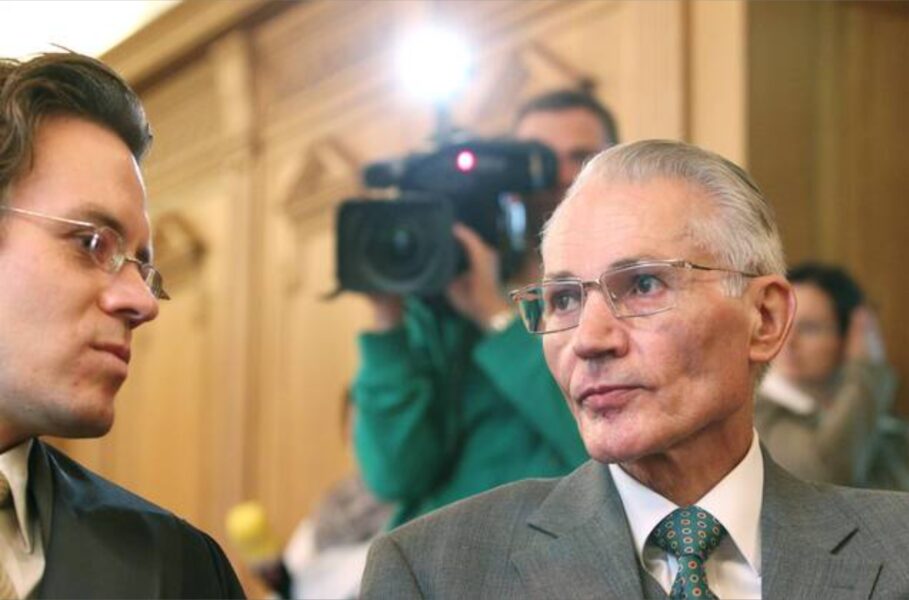
On 5 July 2007, a very politely-mannered retiree entered the civil registry office in Staufen, a small wine-growing village in the Black Forest, and filled out the form to leave the Church. In the box for religious affiliation he wrote: “Roman Catholic Church, public-law corporation.” He was neither an anticlerical nor a disgruntled ex-member. He was Hartmut Zapp, professor emeritus of Canon Law at the University of Freiburg, forty years devoted to the law of the Church, a practising Catholic. And he had just lit the fuse of the most awkward lawsuit in the recent history of German Catholicism: he wanted to prove that one can be Catholic without paying the tax, and he forced the bishops and Rome to show their true colours.
A canonist against the tariff of faith
Zapp never concealed his intention. Shortly after his declaration he wrote to the nuncio to record that he remained a faithful believer in the Catholic Church: his exit affected only the legal-state wrapper, the “public-law corporation” through which the tax office collects the Kirchensteuer, between 8 % and 9 % of the income-tax liability. The portrait published by the Stuttgarter Zeitung after the hearing describes the human profile of this canonist:
“The man who is shaking the German church-tax system is no revolutionary. Hartmut Zapp is a quiet, reflective, almost shy person. […] Only at the end of the nearly ninety-minute hearing, and after the judge’s explicit invitation, does the man whose departure from the Church is at issue speak. […] The seventy-three-year-old, about whom it has been written that he makes Catholic bishops tremble over their revenues, offers neither a fiery plea nor a political statement. ‘If I may have a few minutes,’ the Freiburg emeritus begins with characteristic restraint, before citing, with the same scrupulousness, an administrative instruction from the Ministry of the Interior of Baden-Württemberg and the Weimar Constitution.”
His motives, according to the same newspaper, were fundamental: “The man from Baden is indignant that the compulsory church tax contradicts the principle of voluntariness in faith. He also sees canon law violated by the fact that the money is collected, so to speak, with the whip: anyone who leaves the Church to avoid the tax is stripped of their rights. They can no longer be a godparent, receive the sacraments, or work for the Church.” He described himself with a wry smile: “I see myself as a Robin Hood of canon law.”
Rome had already given him written confirmation
The canonist was not firing blanks: he was firing with Roman ammunition. The Pontifical Council for Legislative Texts, with the prior decision of the Congregation for the Doctrine of the Faith and the express approval of Benedict XVI, had sent in 2006 a circular letter to all presidents of episcopal conferences whose doctrine was exactly Zapp’s thesis:
“The juridical-administrative act of leaving the Church cannot of itself constitute a formal act of defection in the sense intended by the CIC, because the will to persevere in the communion of faith could remain” (n. 3).
“Such a formal act of defection is not merely juridical-administrative (leaving the Church in the sense relating to its registration with the corresponding civil consequences), but constitutes a true separation from the constitutive elements of the life of the Church: it therefore presupposes an act of apostasy, heresy or schism” (n. 2).
“The sacramental bond of belonging to the Body of Christ which is the Church, conferred by the baptismal character, is an ontological union that is permanent and is not lost by any act or fact of defection” (n. 7).
The German bishops responded that same year with their own declaration asserting the opposite: the civil deregistration fulfilled the requirements of the formal act, constituted schism under canon 751 and entailed automatic excommunication. For six years the German Church maintained, against the prevailing Roman doctrine, that ceasing to pay was equivalent to excommunicating oneself. Money trumped theology, and a retired professor had set out to prove it in court.
Five years of litigation and a six-day manoeuvre
The Archdiocese of Freiburg did not accept the move and sued the municipality of Staufen to have Zapp’s certificate of departure annulled. The administrative court of Freiburg ruled in the canonist’s favour in 2009; the higher court in Mannheim reversed it in 2010; and the case reached the Federal Administrative Court in Leipzig, the court of last resort, with the hearing set for 26 September 2012. The bishops, the Süddeutsche Zeitung wrote at the time, “awaited the date with dread: if Zapp wins, the German church-tax system will be shaken. They had long been negotiating with the Vatican on how to prevent this, but the talks dragged on. In the Curia many look upon the tax with scepticism: in their view it has made the Church in Germany rich, but also complacent and comfortable.”
The solution arrived with clockwork precision. On 20 September 2012, six days before the hearing, the Episcopal Conference published its General Decree on Leaving the Church, agreed with Rome and furnished with the recognitio of the Congregation for Bishops. The bishops yielded on the wording: the automatic excommunication that Rome had never accepted disappeared. And they collected everything in practice: anyone who signs the deregistration, “for whatever reason,” commits “a grave offence against the ecclesial community,” is deprived of penance, Eucharist, confirmation and anointing of the sick except in danger of death, of all office, sponsorship and ecclesial suffrage, and “if before death no sign of repentance has been shown, ecclesiastical burial may be denied.” The Süddeutsche’s analysis gave the operation its title:
“The Germans accommodate Rome’s wishes by sending a letter to the person who has deregistered. And they abandon their position that leaving automatically entails excommunication. The factual consequences remain the same: from excommunication one moves to light excommunication. […] The judges in Leipzig will hardly rule in favour of the tax objector Zapp any longer, because he can no longer claim that the Pope, in essence, is on his side. […] But the theological question remains: does only he who pays believe?”
Leipzig returns the ball
On 26 September 2012 the Federal Administrative Court handed down its judgment (BVerwG 6 C 7.12). Under German state law there is no partial exit: anyone who declares their departure before the registry ceases to be a member of the religious community for all civil purposes, “whatever the motives that move them.” Zapp’s declaration was valid, however, as a full exit and his certificate was legitimate, so the archdiocese’s lawsuit against the municipality was definitively dismissed; both sides emerged proclaiming victory. The president of the court, Werner Neumann, summed up the ruling with a phrase that says it all: “We have returned the ball to the Church.” The State does not care whether internal membership subsists; that faith and the counter go together is a decision for the bishops, not for the judges.
Zapp, at seventy-three and having essentially lost the case, did not flinch. He declared that he would wait to see what the diocese did with him: “If they excommunicate me, the next day I will sue in Rome.” He called the Episcopal Conference “a dissident church” and concluded: “I am a member of the Roman Catholic Church of the rite.” No one dared to excommunicate him. The decree, precisely, had been drafted so as not to have to do so: to punish without naming the punishment.
“A soulless collection agency”
The reactions of those days anticipate, word for word, the debate that is reopening today. Matthias Matussek signed in Der Spiegel one of the angriest texts ever recalled in the German press about the official Church:
“It is now official, with ecclesiastical seal and the greatest possible arrogance: no church tax, no sacraments. First pay, then to the communion rail and the confessional. […] Canonist Hartmut Zapp has left the Catholic Church in its German version. Not because he had lost the faith, but because he wanted to keep it, in the face of a Church that increasingly understands itself as a soulless collection agency. […] I have seen the Church flourish in other parts of the world without any church tax: a Church that trusts in its faithful and in their solidarity, that lives on voluntary donations and collections. […] What a lamentable image our German episcopate gives here with its declaration that tax rebellion is ‘a grave offence against the ecclesial community.’ It does not care about those who leave, wrote the review Christ in der Gegenwart, but about the salvation of the Church’s finances.”
From the progressive wing, the movement Wir sind Kirche coined the formula that caught on, reported by Die Zeit: “‘Pay and pray!’ is a completely wrong signal at the wrong moment,” said its spokesman Christian Weisner, convinced that “the German bishops and the Vatican have enormous fear of new losses of income.” When conservatives from Spiegel and progressives from the Kirchenvolksbegehren coincide in the diagnosis, the patient is gravely ill.
What the Zapp case demonstrated
Almost three lustra later, the dossier retains its full evidentiary value. It showed that the Roman doctrine of 2006 and German practice are incompatible, and that when a choice had to be made, doctrine was sacrificed. It showed that the 2012 decree was not born of pastoral reflection but of the procedural urgency to close the Zapp route before a ruling that could topple the collection. And it showed that the system does not fear the apostate—the one who leaves because he no longer believes is left alone—but the believer who stops paying: the only German the Church took to court for five years was a professor of Canon Law who wanted to remain Catholic.
The question the Süddeutsche left hanging in 2012—does only he who pays believe?—never received a theological answer, only an accounting one: 6.751 billion euros last year. Today, with three hundred thousand departures annually, 6.8 % Sunday practice and a party approaching an absolute majority in Saxony-Anhalt with the abolition of the state collection of the tax in its programme, the old canonist of Staufen seems less an eccentric than a prophet. He wanted the German Church to live from the faith of its faithful and not from the payroll of its baptised. They answered him with a decree. Time is answering with something else.