


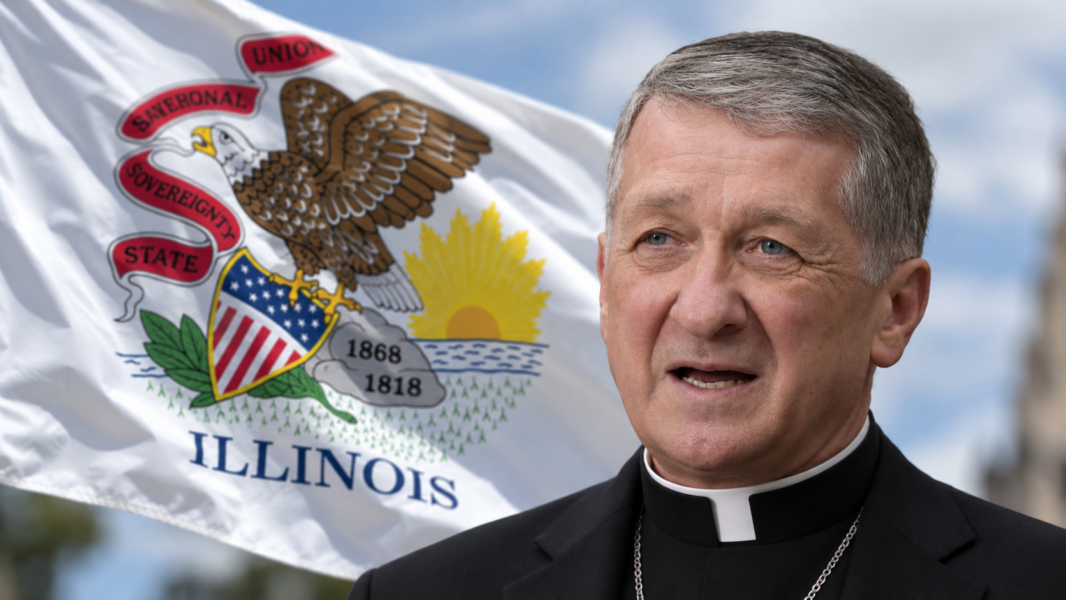
Cardinal Blase Cupich, Archbishop of Chicago, the Carmelite Sisters for the Aged and Infirm, and the Little Sisters of the Poor have sued the state of Illinois (United States) to prevent the new assisted suicide law from forcing them to participate in the process leading to the death of their patients. The lawsuit comes just days before the law takes effect on September 12.
Pharmacist Luke Vander Bleek, a Catholic and owner of Fitzgerald Pharmacy in Morrison, Illinois, has joined the case. The plaintiffs argue that the legislation places them in the dilemma of acting against their convictions regarding the inviolability of human life or facing fines and other penalties.
The lawsuit was filed on September 3 in the United States District Court for the Northern District of Illinois, represented by Becket, an organization specializing in the defense of religious freedom.
“Illinois cannot ask us to help them end their lives”
The conflict is not limited to the possibility that Catholic physicians might have to directly prescribe substances intended for suicide.
According to the lawsuit, healthcare professionals who refuse to participate on grounds of conscience must still inform patients about the possibility of assisted suicide, help them meet certain requirements to access lethal substances, and connect them with professionals willing to provide them.
In the case of pharmacists, Becket maintains that they must dispense the substances intended for suicide or refer the patient to another pharmacy that will do so.
The religious congregations consider that these actions involve cooperation incompatible with their mission of caring for and accompanying the sick until their natural death.
“Our residents come to us at one of the most vulnerable moments of their lives,” explained Mother Mary Rose Heery, Prioress General of the Carmelite Sisters for the Aged and Infirm.
The religious sister notes that their vocation consists of showing these people, through everything they do, “that their lives remain precious and that they will never be abandoned.”
“Illinois cannot ask us to replace that promise with helping them end their lives,” she states.
The Carmelite Sisters have cared for the elderly since 1964 at St. Patrick’s Residence in Naperville, Illinois, where they offer long-term care, rehabilitation, and palliative care.
The Little Sisters of the Poor have carried out their apostolate with the elderly in Illinois since 1876. Mother Julie Marie, Provincial of the congregation in Chicago, recalled that those who come to their homes seek “a place where they can be loved and cared for until natural death.”
The lawsuit also challenges restrictions on deterring suicide
The plaintiffs also question provisions of the law that could affect what physicians, religious sisters, and caregivers say to patients who express their intention to resort to assisted suicide.
According to Becket, the definition of “coercion” or “undue influence” contained in the law is broad enough that a caregiver could face legal consequences for attempting to convince a patient not to take their own life.
The organization cites as an example that religious sisters or healthcare professionals might tell a patient that their life continues to have value or encourage them to reject suicide.
The lawsuit argues that forcing Catholic institutions and professionals to inform, refer, or facilitate access to assisted suicide, while simultaneously restricting their ability to speak against it, violates the religious and expressive freedoms protected by the First Amendment of the U.S. Constitution.
Cupich stated that “the Gospel calls us to defend the dignity and inviolable value of the human person, from the first moment of life until its natural end.”
“As Catholics, we oppose efforts to undermine human dignity by pushing our brothers and sisters toward suicide. We pray that the courts will protect our freedom to continue defending and caring for the sick and dying as our faith requires,” added the Archbishop of Chicago.
Mark Rienzi, President of Becket and lead counsel for the plaintiffs, maintains that “the State should stop trying to make Catholic nuns help patients commit suicide.”
In his view, the sick must retain the freedom to go to institutions that offer them “healing, hope, and accompaniment” without the government forcing assisted suicide into that relationship.
A law already opposed by the bishops of Illinois
Catholic opposition to the legislation began during its passage in 2025. The so-called End-of-Life Options for Terminally Ill Patients Act allows adults with a terminal illness and an estimated life expectancy of less than six months to request medications intended to cause their own death.
Bishop Thomas Paprocki of Springfield denounced after the parliamentary approval of the law that “the forces of the culture of death” had succeeded in passing assisted suicide and recalled that “taking one’s own life is not dying with dignity.”
Cupich had also rejected the bill during its passage: “It is not compassionate to help someone take their own life,” he stated.
Democratic Governor J. B. Pritzker ultimately signed the law on December 12, 2025.
Read also: United States: Bishop Paprocki denounces passage of pro-euthanasia law in Illinois
Leo XIV asked Pritzker to veto the law
The passage of the law also prompted intervention from Leo XIV, who was born in Chicago.
The Pontiff later explained that he had personally addressed the issue with Pritzker during an audience they held at the Vatican in November 2025, when the bill was pending the governor’s decision.
“I spoke very clearly with Governor Pritzker about this matter,” Leo XIV explained after the law was signed.
The Pope noted that during that conversation he had insisted on “the need to respect the sacredness of life, from beginning to end,” and expressed his disappointment at the governor’s final decision.
Cupich also participated in that meeting.
Read also: Leo XIV asked the Governor of Illinois to veto the euthanasia law
Paprocki already took the law to court
The lawsuit now filed by the religious congregations is not the first legal battle against the obligations imposed by the new legislation.
In August, Bishop Paprocki joined four physicians and the Lutheran Care Center to sue the state of Illinois. The plaintiffs argued that the legislation abandoned nearly two millennia of medical practice opposed to intentionally causing the death of a patient and forced professionals who are morally opposed to it to participate in the procedure.
Illinois later agreed not to temporarily enforce certain provisions against the plaintiffs while that litigation continues. However, that protection was limited to the parties in that proceeding and did not automatically extend to the rest of the Catholic institutions and professionals in the state.
For this reason, the Carmelite Sisters, the Little Sisters of the Poor, Vander Bleek, and the Archdiocese of Chicago are now seeking their own judicial protection before the law takes effect on September 12.
The conflict has also arisen in other states. In New York, several Catholic religious congregations and Bishop John Barres of Rockville Centre went to court against similar obligations and obtained temporary protection while the proceedings continue.
Organizations defending people with disabilities have also challenged assisted suicide laws in several states, arguing that they introduce specific risks of discrimination against the sick and disabled.
The lawsuit now filed in Illinois will determine how far the state can go in applying an assisted suicide law to institutions, religious sisters, and healthcare professionals who reject any cooperation with the intentional death of their patients on religious grounds.