


Barbastro has given us saints, martyrs, founders, and today an ultimatum to the Pope in the form of a press release.
Ángel Pérez Pueyo, who has spent five years fighting the Opus Dei over a sanctuary he has already acknowledged he will not manage, has reduced his war to a Romanesque statue and a baptismal font, and has announced that if they do not return home, he will leave his own. Forty-eight hours later, two handwritten letters from Francis appeared in El País, with verified handwriting and the detail, very much of this pontificate, that the previous Pope put “mafia intrigues” in quotation marks as if repeating an expression someone had whispered to him. That the bishop had the letters in his possession we already knew because he himself had said so; that they reached the newspaper just now is one of those coincidences that Providence ignores and communications consultants handle.
What is striking is not the maneuver but its modesty. A bishop who asked for the entire sanctuary would be a bishop defeated in advance; one who asks for an eleventh-century wooden Virgin is a bishop no one can refuse without looking like a scoundrel. The smaller the demand, the more expensive the refusal. And on top of that he brings the dead man as witness: “¡No cedás!”, with a Buenos Aires accent and dated July 2023. Leo XIV, who until now had managed Torreciudad by letting a plenipotentiary commissioner gradually become, without anyone deciding it, an amiable mediator, suddenly has three options and none of them comfortable: side with the bishop and force the Opus to return the image, sending the message that Rome listens to whoever shouts loudest; accept the resignation and explain why the letters of a dead Pope are worth less than a 1966 notarial deed; or continue doing nothing, which is his specialty, and discover that this time the nothing has a stopwatch, a headline, and a photographer.
And this is where the matter ceases to be Aragonese. Because what Pérez Pueyo has set up, whether he intended to or not, is the first controlled experiment of the pontificate: a Pope under pressure with the result already priced in the press and without any of the fog that usually protects Rome. There is no pontifical secret here, no reserved process, no abuse victims whose privacy justifies silence. There is a statue, a bishop, a softened commissioner, and an Opus Dei that, according to sources El País does not identify, already considers the sanctuary recovered. Everything one usually has to guess in other cases is visible here.
And it is worth seeing, because until today the Prevost pontificate has accumulated a series of decisions, or absences of decision, that only make sense if one accepts an uncomfortable hypothesis: that this Pope does not decide against anyone who has the capacity to harm him. Jordi Bertomeu remains at the same time investigator, drafter of sanctions, judge, and commissioner of the Sodalicio, with an open lawsuit in a Spanish court and a ceremony with coca leaves in Cusco behind him, and Leo has not moved a comma. Víctor Manuel Fernández remains at the head of the Dicastery for the Doctrine of the Faith, publicly endorsed in January, tasked in February with the dialogue with the Priestly Fraternity of St. Pius X, shielded from every criticism with a diligence that Prevost does not devote to almost anything, when anyone with half a brain knows that this Pope would neither have chosen nor kept him if he had started from scratch. Neither case is explained by affinity. They are explained by cost: by what it would cost to dispense with someone who knows too much, has signed too much, or represents too well that part of the conclave that has not yet given up on succeeding Francis.
Torreciudad is the small, legible, and verifiable version of that pattern. The pressure does not come from a cardinal with a file but from a provincial bishop with two handwritten pages and a national-circulation newspaper, and precisely for that reason it serves as a measuring stick. If Leo yields to the bishop, he will have shown that public pressure works and that coherence with Francis weighs more than the relationship with the Work, which makes it even more inexplicable that he has never spent half that energy on Bertomeu. If he accepts the resignation, he will have shown that the letters of a dead Pope do not bind the living, and it will remain to be explained why, on the other hand, the signatures of an Argentine cardinal in office bind so much. And if he chooses the third way, letting the commissioner continue mediating until the bishop tires, falls ill, or turns seventy-five, he will have confirmed that evaporation is the method of government, only this time with a date on the calendar and a newspaper counting the days.
Let no one dismiss the case with a “we’ll see.” We are already seeing. What is at stake in Torreciudad is not a statue; it is a method. And if the method consists in whoever can make the most noise and has the least to lose wins, then Pérez Pueyo has just discovered something that Bertomeu and Fernández knew from the beginning. The only novelty is that he has done it in the light of day.
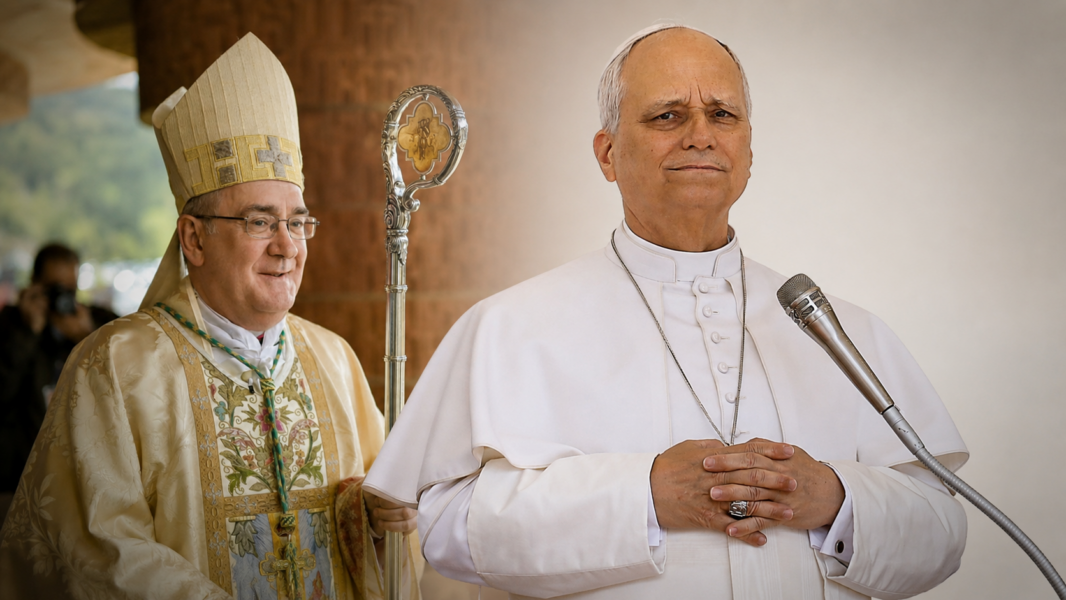
It remains to be seen, in short, what a Pope who in little more than a year has built a reputation for firmness without supporting it with a single firm decision will do with this. He relies on the mozzetta, on calculated hieraticism, on economy of gestures, on a face that betrays nothing, and on the comparison, always favorable, with the previous disorder. Prevost’s silence has been read as character and immobility as governance by a part of the Church that mistook relief for proof. With that image, what anyone would expect from a Pope to whom a bishop plants an ultimatum in the press is what John Paul II did with Gaillot in 1995: a titular see in the Algerian desert and a decree without adjectives. That is what the logic of the character demands. And precisely for that reason Torreciudad is a stress test: if the ultimatum succeeds, or if it is simply not answered, many of those who have spent a year celebrating the restoration of pontifical dignity will discover, with some discomfort, that the firmness was wardrobe and that the lion in the mozzetta was, when it came down to it, a lamb with a very good tailor.