


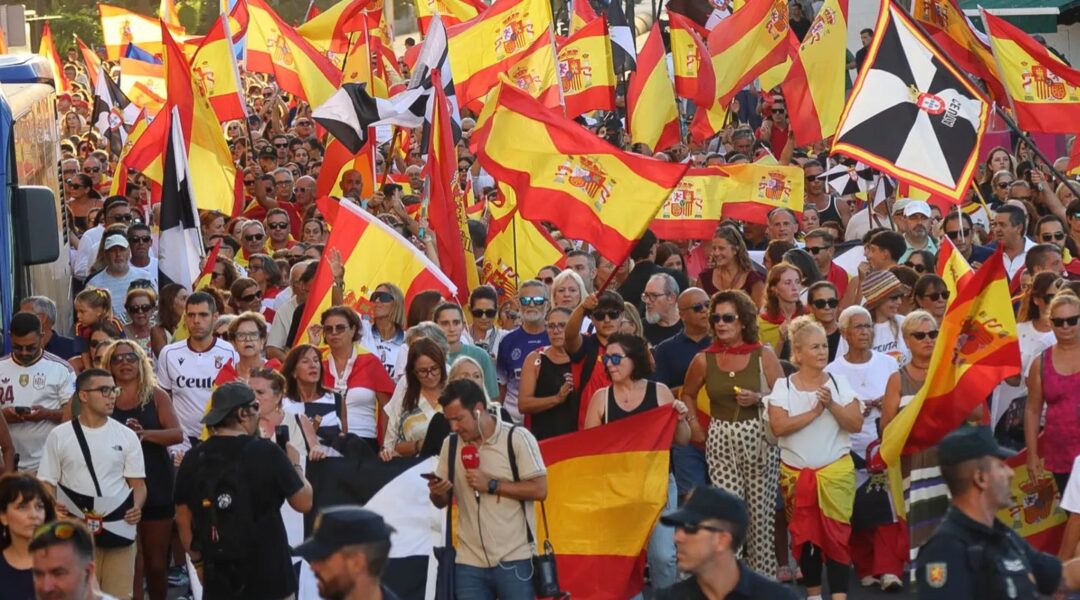
One thousand squares filled at the same time, a forest of Spanish flags from Cibeles to the Pilar, and a single cry from north to south: “Ceuta is not for sale, Ceuta defends itself.” Nothing like it had been seen since the autumn of 2017, when the separatist challenge brought a seemingly dormant nation into the streets. The Spanish people are slow to react. But when they are put in check, they react. Yesterday they did so again — alone, without their shepherds.
There are images a country only produces when it feels its very existence is threatened. The red-and-yellow tide covering Cibeles and spilling over Alcalá, Gran Vía and the Castellana. Plaza del Pilar too small, with streams of people flowing down Alfonso Street. Seville packed to the side streets. Elderly people with the flag around their necks alongside families with children on their shoulders. And the most eloquent of all: Ceuta itself —a city of 83,000 souls put more than 25,000 in the street— marching from the Royal Walls, those walls that for five centuries have been saying the same thing the banners said yesterday.
The last time Spain looked at itself in the mirror like this was in October 2017. Then it was separatism that put the nation in check; the squares filled with flags that many had kept in the closet for years, almost with embarrassment. Yesterday, the check came from the south: a hybrid aggression that, on the very day of the mobilization, was spelled out in black and white in the police report sent to the National Court, pointing to a planned operation with the involvement of Moroccan forces. And the response was the same. Because this is the character of this old people: they endure, they stay silent, they take it for weeks —a month and three days this time—, they seem anesthetized, and suddenly they rise as one. As in 2017. When Spain is in check, Spain reacts.
Where the Church was
In that mirror of 2017, however, there is an absence that yesterday became deafening. No chronicle of the day records any episcopal presence at any of the more than one thousand gatherings. Not in Cibeles, not in the Pilar, not even in Ceuta. The bishops, who this summer have not spared statements, did not find an afternoon to be where their people were.
Because they have spoken. The diocese of Cádiz and Ceuta spoke on July 30 itself, with the avalanche still underway, to announce that the collections of all the parishes in Ceuta would go entirely to the Migration Delegation. Not to the shopkeepers who lowered their shutters in fear, to the families locked in their homes, to a city whose sovereignty had just been overrun. They later tried to correct it, but fear, complexes and dependence on the lucrative welfare structures of this failed migration model are already indelible to the Spanish episcopate.
Father Ángel spoke, landing at the CETI to proclaim before the cameras of laSexta that those who had just entered illegally “are saints,” because “we would do any barbarity in their place.” Not a word about the mafias, about the role of the Alawi regime, about the dead the operation left in the water or about the people of Ceuta. Four weeks after the express canonization, the Army patrols in that same city received authorization to carry live ammunition after three ambushes —stones in Benzú, a sergeant wounded in the Foso Real, bottles of corrosive liquid—, and the Police charged in Loma de Colmenar.
The apostolic administrator, Mons. Ramón Valdivia, spoke, describing the arrivals as “missionaries of hope who enlarge our hearts” —while his own flock counted losses and asked for protection.
And above all, the Migration apparatus spoke. The CEE Department, Cáritas and the Jesuit Migrant Service spent August demanding that the crisis not be “politicized” and denying —before any investigation— any link to the mass regularization that the Church itself had sponsored. The police report now before the National Court refutes them. The only one who called things by their name was the president of the Episcopal Conference, Mons. Luis Argüello —“the invasion of Ceuta is a test. Demography is a weapon”— and his own apparatus rushed to bury the diagnosis under notes of the opposite tone.
The pedagogy that has brought us here
That the operation was coordinated with Morocco does not exempt anyone on this side of the Strait. Rabat provided the logistics —the police who looked the other way, according to the Cenif report—, but the lure that mobilized tens of thousands of young people toward Tarajal was the real and well-founded expectation that whoever enters Spain stays. That expectation was not manufactured by Morocco: it was manufactured by a migration policy that the Spanish Church signed, promoted and celebrated as its own —the extraordinary regularization born of a Popular Legislative Initiative sponsored by the Episcopal Conference, Cáritas and the ecclesial migration network—, capped by a Supreme Court ruling on hot returns whose manipulated dissemination the Defense Minister herself acknowledged. Up to 22 European Union countries have pointed to that regularization, expressly backed by the Catholic Church, as a direct precedent of the crisis; and even the archbishop of Tangier, hardly suspected of harshness, admitted the pull effect. Morocco pulled the trigger, but the ammunition had been loaded for years from the desks of the managers in clerical collars and pectoral crosses in their inside pockets who today lack the courage to accompany the people in the street.
None of this is an August accident. It is the fruit of years of ecclesial pedagogy that has romanticized migration routes —the cayuco as an exploit, the patera as an epic, the border as sin—, refusing to see that this narrative fattens the mafias that charge for the passage and fill the sea with corpses. Nearly 200 dead have been left by this single operation, according to figures the Episcopal Conference itself has acknowledged. Whoever for years has presented the border jump as a quasi-martyrdom act bears a share of responsibility for each of those bodies.
And that pedagogy continues, in prime time and on the bishops’ own media. Last week, days before the mobilization, COPE moved ‘La Linterna’ to Ceuta promising to put “names, surnames and faces” to the crisis, and the format chosen was the edifying testimony: Mohamed, from Castillejos, telling Ángel Expósito’s microphone that he is “an electrical engineer,” that “Spain has always been my dream” and that he will stay “until death”; Osman, from Senegal, recounting from the diocesan Casa San Antonio itself that his dream “is to work in Europe.” On TRECE, the episcopal television, ‘El Cascabel’ seated Andalucía Acoge and Luna Blanca at its table to analyze the eviction of El Trampolín. And what is striking is that Expósito himself acknowledged on the ground that it was “invasion plus humanitarian catastrophe” and that the official figures of those who remain were “a lie”: even when its reporter calls the invasion an invasion, the house does not renounce the moving individual case, the European dream in the first person —exactly the narrative the mafias monetize on the other side of the fence and that has cost two hundred corpses. Moving prime-time audiences with the engineer from Castillejos, while remaining silent that his expectation was manufactured by a law sponsored by the owners of the station.
That pedagogy also has a particularly macabre judicial arm. This same year, in March, the Jesuit Migrant Service completed seven years exercising popular prosecution against ten residents of Melilla until the Supreme Court sent seven of them to prison for messages published in a Facebook group following an assault by an unaccompanied minor —messages the high court classified as incitement to hatred. A work of the Company spending seven years and ecclesial resources to put residents of an overwhelmed border city in the dock, and celebrating it in an official note, while no one in the ecclesial apparatus has exercised any prosecution against the mafias, against the instigators of the avalanche or against those who ambushed Spanish soldiers. For the neighbor who writes on Facebook, the full weight of the law demanded from the Church; for those who organize an invasion, the Sunday collection.
The same Migration Pastoral expressed its “absolute rejection” of the clashes involving desperate Ceuta residents, with a force it never used regarding the ambushes against the Armed Forces. Selective condemnation, one-way indignation.
When the people are in check
On the ground, the honor of the Church has been saved by the usual ones: the Brotherhood of the Patroness, the rank-and-file priests who attend to their faithful while the city holds on, and voices like Father Jesús Francisco Molina, who dared to say on television what doctrine has taught for centuries: that well-ordered charity attends first to the neighbor.
In 2017, that popular reaction ended up twisting the arm of separatism. Yesterday, the same people —younger but more chastened, equally patient— once again showed that their silence is not submission but waiting. They are slow to react, yes. But when the game puts their king in check, they move.
The problem is that yesterday’s photo portrays a Church that lives dancing in a synodal classroom, listening to itself in processes, assemblies and documents, while the real world —its own people, with their flags and their fear and their faith— was shouting at the doors. Yesterday Spain went out. The day the hierarchy dares to open that door and go out to meet it, perhaps it will discover that outside the Spirit is also blowing.