


By Joanna Bogle
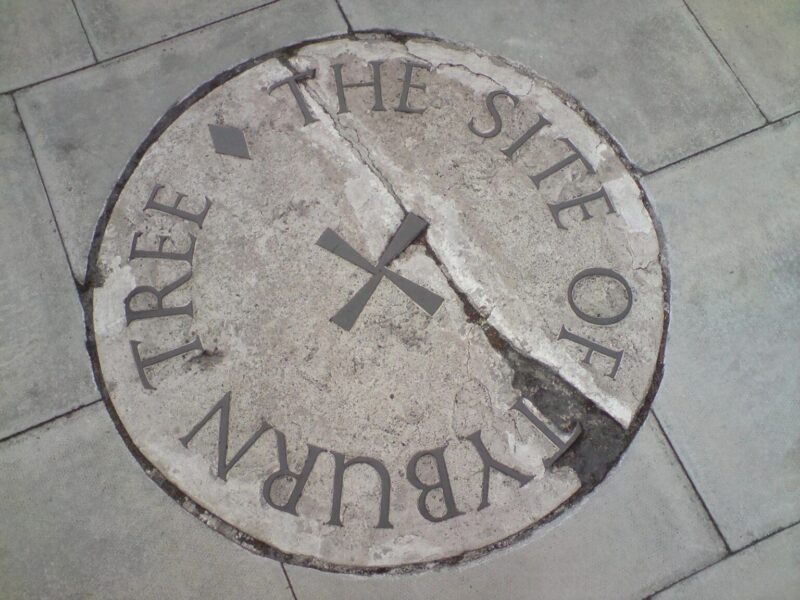
In London, at the corner near Marble Arch, there is a notable medallion on a traffic island that commemorates the Tyburn Tree. When English Catholics think of Tyburn, they think of the martyrs who died there: dragged through the streets after torture in the Tower of London, hanged, drawn and quartered, mercy denied unless they were willing to renounce their loyalty to the Catholic Church and the successor of Peter in Rome.
Their names have come down to us with honour: Edmund Campion, Ralph Sherwin, John Stoughton, and more. Today there are churches and schools that bear their name, and pilgrims steadily flow to Tyburn, where the nuns of a flourishing nearby convent keep a 24-hour vigil before the Blessed Sacrament.
The shrine, and the very site of the gallows, have undergone a remarkable change in the course of my lifetime. From being a somewhat obscure shrine, known to devout Catholics but not to the general public, they are now widely publicised, not least with an official Transport for London sign at the underground station (Marble Arch).
The English Martyrs, as they are collectively known, were canonised by Paul VI in 1970. It was done with wisdom and tact: the pope briefly and generously referred to those Protestants who also lost their lives in the sombre years of the English Reformation. And Catholic devotion to the 40 Martyrs (there were many more, of course, and it seems likely that there will be future canonisations as historical research is completed and miracles are reported) has grown steadily. Today their stories are spread through new websites, videos and television reports, taking over from the pamphlets and leaflets of my youth.
But Tyburn is also the name of a river: one of London’s half-forgotten rivers that still flow beneath us as we hurry about our daily tasks or rest in a park or café.
There were two arms of the Ty: the old word “burn” for a river, still used in Scotland, is linked to bourn, meaning a spring (as in place-names like Eastbourne or Bournemouth). One arm flowed through what is now called Marylebone (Mary-le-bourne); the other, through what is today Hyde Park, along Park Lane and Bayswater Road.
I say “flowed,” but, of course, a river never really ceases to exist. You can still hear the Tyburn if you stand over the Thames Water Authority manhole cover in the park; and from time to time the water rises to flood, and the river makes a brief reappearance as a large, spreading puddle.
London is full of lost—or rather, forgotten—rivers. Their names remain with us: the Falcon, which descends from Clapham Junction to Battersea, giving its name to the street that now covers it, and to the local pub; the Beverly Brook, which flows through the suburbs of New Malden and Raynes Park, partly through local public gardens, partly between the backs of houses and blocks of flats.
The Westbourne flows through Kensington and Paddington. The Fleet, which famously gave its name to the street of newspapers, emptied into the Thames at Blackfriars and fed a large Dominican monastery still honoured in the name of the pub and the underground station.
The hidden or half-forgotten stream is not a bad analogy for the extraordinary resurgence of the Catholic faith in England in modern times. St John Henry Newman spoke of the “Second Spring” in 1852, when he addressed the gathering of newly appointed bishops after the restoration of the Hierarchy in 1850. He was speaking, of course, of the season rather than of bubbling water, but both offer an interesting analogy for the events unfolding.
“Ah yes,” you will say, with the sad shrug of the modern Western Catholic, “there was a revival in the nineteenth century, and it lasted into the twentieth… but what about now?” And it is true that the fastest-growing religion in Britain is Islam, and that the Catholic Church is desperately short of priests, has merged many parishes and runs schools notable for producing students who no longer practise much before they finish.
And yet, and yet… Almost 800 people—average age 35–40—were received into the Catholic communion in Westminster in 2026, a 60-per-cent increase on the previous year, which itself broke earlier records. The Dominicans have expanded their Cambridge house to accommodate the growing number of novices. This summer’s “We Believe” festival drew vast crowds to Oscott, where Newman preached in 1852.
Rising again from what seems the grave is a central feature of the Faith.
By the nineteenth century, some of London’s rivers, fresh and sparkling in medieval abbeys and village wells, had become sources of filth and cholera in an overcrowded industrial landscape.
After the “Great Stink” of 1858, Parliament voted to fund a proper system of water pumping and sewage. The rivers were channelled and found new life. It was, by coincidence, the era of that “Second Spring” of which Newman spoke.
Eamon Duffy’s book The Stripping of the Altars is a fresh look at the Catholic centuries, including the waterways of old London with the shrines and wells and abbeys linked to them. Today, channelled beneath us by quite impressive nineteenth-century engineering, and therefore not really lost, the old rivers of London carry away our filth and supply our needs as they did when they flowed through the old medieval city and the villages that preceded today’s massive urban sprawl.
The Tyburn martyrs could not have imagined the rather splendid imperial city of the nineteenth century, nor the London of the twenty-first. And yet, from Heaven they hear our prayers, as do the London-born Newman and the older saints of our very ancient city: Erkonwald and Ethelberga and Elphege, Mellitus and Anselm and Becket. And the rivers of London continue to flow, and so does the Faith that was already ancient when the martyrs died for it, and that is ever young.
About the author
Joanna Bogle is the author of some twenty books, including several historical biographies and A Book of Feasts and Seasons, with information on traditions and customs that mark the liturgical year. Her most recent book is John Paul II: Man of Prayer, with her colleague Clare Anderson, which explores the spiritual life of St John Paul the Great. She broadcasts regularly on EWTN and launched the popular “Catholic History Walks” around London.