


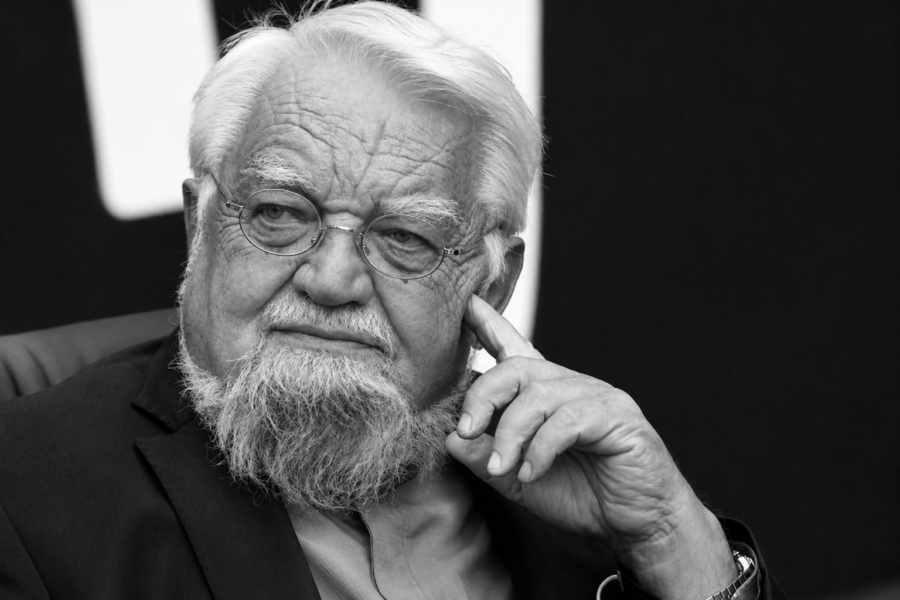
Enzo Bianchi, founder of the Monastic Community of Bose and one of the best-known figures of Italian progressive Catholicism in recent decades, died this Tuesday, September 1, at the age of 83 at the Molinette Hospital in Turin, in the Italian region of Piedmont.
Bianchi had been hospitalized for several days, and his health had worsened due to kidney failure that ultimately led to metabolic coma. His funeral will be held next Thursday at 4:30 p.m. in the parish church of Castel Boglione, his hometown, where he will be buried according to his own wishes.
Born on March 3, 1943, in Castel Boglione, in the province of Asti, Bianchi was a writer, biblical popularizer, and founder of Edizioni Qiqajon. His career was closely tied, above all, to the Community of Bose, the monastic and ecumenical experience he began developing in 1965 in Magnano, in the province of Biella.
Founder and Prior of Bose until 2017
Bianchi settled in Bose in 1965, while still a student. Over the years, others joined, and that experience eventually became a community made up of men and women from different Christian denominations.
The initiative made Bianchi a well-known figure in Italian ecclesial circles, particularly for his defense of ecumenical dialogue, his interpretation of the renewal following the Second Vatican Council, and his intense activity as a writer and lecturer.
He served as prior of Bose until January 2017, when he stepped down from the community’s leadership. However, his final departure took place three years later and was marked by a conflict that led the Holy See to intervene directly.
The Holy See’s Intervention and His Departure from Bose
In January 2020, the Vatican ordered an apostolic visitation to the Community of Bose after receiving “serious concerns” about the internal situation. The investigation examined, among other aspects, the founder’s exercise of authority, the governance of the community, and the fraternal climate.
Following the process, the Holy See issued a singular decree on May 13, 2020, signed by then-Secretary of State Cardinal Pietro Parolin and specifically approved by Pope Francis. The resolution ordered Bianchi and three other members—Goffredo Boselli, Lino Breda, and Antonella Casiraghi—to leave Bose and move elsewhere, relinquishing the positions they still held.
The community itself acknowledged at the time that the initial rejection by some of those affected of the measures taken had caused “a situation of greater confusion and difficulty.”
Read also: Pope Francis removes Enzo Bianchi
Bianchi ultimately distanced himself from the community he had founded and later launched a new initiative, the Casa della Madia, a monastic fraternity established in Albiano d’Ivrea, also in Piedmont.
One of the Voices of Italian Progressive Catholicism
For decades, Bianchi maintained a significant presence in Italian religious and cultural debate through books, articles, conferences, and collaborations with the media. His thought was especially linked to the reception of the Second Vatican Council, ecumenism, biblical interpretation, and dialogue with secular society.
He also participated in debates on issues such as sexual morality, bioethics, ecclesial discipline, and liturgy.
His Recent Approach to the Traditional Mass
One of his last public interventions related to the life of the Church took place this summer. On July 19, Bianchi attended a Mass celebrated according to the 1962 Roman Missal at the Church of Mercy in Turin.
His presence drew particular attention due to the historical identification of the founder of Bose with the progressive sector of Catholicism and with the liturgical reform following the Second Vatican Council.
At the end of the celebration, Bianchi reaffirmed his adherence to the Council and the liturgical reform, but at the same time expressed his desire for the two forms of the Roman rite to coexist and called for progress toward a “liturgical peace” within the Church.
Bianchi had also recently defended the need to overcome liturgical divisions and had positively assessed the tone adopted by Leo XIV on this issue, which he interpreted as an invitation to greater understanding among the different sensibilities present in the Church.
His death marks the end of a trajectory spanning more than six decades, characterized by the founding of and subsequent break with Bose, an extensive intellectual output, and a constant presence in the debates that shaped the Italian Church after the Second Vatican Council.