


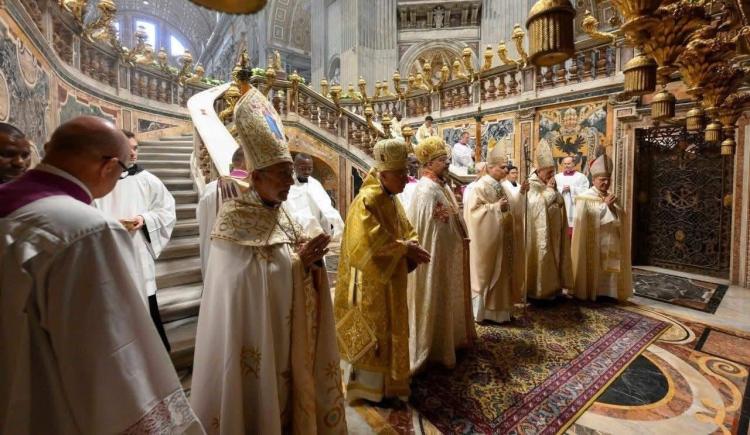
Pope Leo XIV has introduced this Saturday an important change in the governance of the Eastern Catholic Churches: their synods of bishops may remove a patriarch for grave cause, through a secret ballot requiring a majority of at least two-thirds. The decision, however, will only make the removal effective upon receiving the assent of the Roman Pontiff.
This faculty did not previously exist in the Code of Canons of the Eastern Churches (CCEO), promulgated by Saint John Paul II in 1990. Canon 126 provided only two causes for a patriarchal see to become vacant: the death or resignation of the patriarch. There was no specific procedure for the Synod to remove him if a serious rupture occurred with the bishops of his Church and the patriarch refused to resign.
Leo XIV now fills this gap through the motu proprio Mutua Concordia, published on August 29 and entering into force immediately, which amends canons 106 and 126 of the Eastern Code.
Until now, only death and resignation were provided for
The scope of the change becomes clear when comparing the new regulation with the canon in force until this Saturday.
The former canon 126 consisted of only two paragraphs. The first established that the patriarchal see became vacant “by the death or resignation of the patriarch.” The second granted the Synod of Bishops of the patriarchal Church the authority to accept that resignation, after consulting the Roman Pontiff, unless the patriarch himself had addressed the Pope directly.
The Code therefore regulated what was to be done when a patriarch resigned voluntarily, but it did not provide a procedure for an exceptional situation: a serious and irreparable rupture between the patriarch and his Synod, with the patriarch refusing to leave office.
Leo XIV himself acknowledges in Mutua Concordia that “there is no provision in the Code of Canons of the Eastern Churches indicating how to intervene in such cases” and explains that he considered it necessary to establish “an orderly procedure for the removal from office of a Patriarch by the Synod of Bishops.”
The Pontiff also reveals that the need to find a solution for an irreparable rupture between a patriarch and his bishops had been raised by “numerous Eastern prelates.”
First, the Synod must ask him to resign
The new canon 126 establishes a step-by-step procedure.
When a “grave cause” exists, it is the responsibility of the Synod of Bishops of the patriarchal Church itself to recognize that circumstance and formally request the patriarch to resign.
If the patriarch accepts, the see will become vacant by resignation.
The new faculty of removal comes into play if he refuses to leave office voluntarily.
In that case, the bishop with the right to vote who has the greatest seniority by episcopal ordination must proceed to elect a new president of the Synod. In this way, the patriarch ceases to preside over the body that must decide on his own continuity.
The new president will then submit the removal to a secret ballot. For approval, the favorable vote of at least two-thirds of the members of the Synod with the right to vote will be required.
The patriarch will retain during the procedure the right to a “full defense” before the Synod itself.
The Pope retains the final assent
The bishops’ vote will not by itself remove the patriarch.
If the Synod reaches the required majority, its president must inform the Roman Pontiff as soon as possible. It is the Pope who grants the assent to the removal, and it is that assent that legally renders the patriarchal see vacant.
Leo XIV expressly explains why he has retained this intervention by Rome: he intends to guarantee “the full freedom of the Fathers in expressing their choice,” protecting them from “any possible undue internal or external pressure.”
The reform thus establishes a new distribution of competencies. The Synod determines the existence of a grave cause, requests the resignation, conducts the procedure, and votes on the possible removal; the Roman Pontiff retains the assent necessary for that removal to take effect.
The motu proprio itself also expressly safeguards recourse to the Roman Pontiff and the prerogatives of the Apostolic See.
The patriarch cannot block the Synod by refusing to convene it
The amendment to canon 106 completes the new system and allows the procedure to proceed even in the face of the patriarch’s opposition.
Ordinarily, it is the patriarch himself who convenes the Synod. This would create an obvious obstacle if it were precisely his conduct that the bishops wished to examine.
The new canon 106 §3 therefore provides that, if the patriarch fails to fulfill his duty of convocation, the bishop with the right to vote who has the greatest seniority by episcopal ordination may legitimately convene the Synod.
If this bishop also fails to convene it, the faculty will pass successively to the next bishops in order of seniority who are willing to do so and have the right to vote.
The patriarch will thus be unable to paralyze the mechanism introduced by Mutua Concordia simply by refusing to convene the Synod.
Leo XIV invokes the autonomy of the Eastern Churches
The Pope presents the reform as a way of giving “a fuller expression to the internal autonomy” of the Eastern patriarchal Churches.
In them, the patriarch is the Pater et Caput —“Father and Head”— of a Church sui iuris and is elected by the Synod of his own bishops. The Eastern system grants this body considerably greater governing powers than those belonging, for example, to an episcopal conference of the Latin Church.
Leo XIV maintains that the primatial ministry of the patriarch possesses an “intrinsic vocation to collegiality” precisely because his authority is embedded in an ancient synodal tradition.
“Although he is constitutively the First and not merely the President of the Assembly of Bishops, the Patriarch cannot be considered independently of it,” the Pontiff affirms.
With Mutua Concordia, the same Synod that participates decisively in the election of the patriarch now receives the competence to promote his removal when it considers that a grave cause exists, always with the procedural guarantees provided and the final assent of the Pope.
An express reference to the Orthodox Churches
Leo XIV also introduces an ecumenical consideration to justify the expansion of synodal competencies.
The motu proprio notes that recognizing and expanding the faculties of the synods is also opportune in light of “interconfessional relations” and, specifically, of “the theological sensibility and praxis of the Orthodox Churches”.
The reference is especially significant because of the historical, liturgical, and ecclesiological proximity between the Eastern Catholic Churches and the Orthodox Churches, in which episcopal synodality occupies a central place in the exercise of ecclesial governance.
At the same time, the reform maintains the intervention of the Roman Pontiff in the final phase of any possible removal.
It also applies to the Major Archiepiscopal Churches
The new regime is not limited to Churches that formally possess patriarchal rank.
Leo XIV provides that it shall apply by analogy to the Major Archiepiscopal Churches, in accordance with canon 152 of the Eastern Code.
The modification thus affects the governance model of the Eastern Catholic patriarchal Churches —among them the Maronite, Coptic, Syriac, Armenian, Chaldean, and Greek-Melkite Churches— and the Major Archiepiscopal Churches, such as the Ukrainian, Syro-Malabar, Syro-Malankara, and Romanian Churches.
With the entry into force of Mutua Concordia, any serious rupture between a patriarch and his bishops will no longer depend solely on whether he agrees to resign. From this Saturday, the Synod has its own procedure to request his resignation and, in the event of refusal, to approve his removal by a two-thirds majority, while the Pope retains the final assent necessary to make the removal effective.