


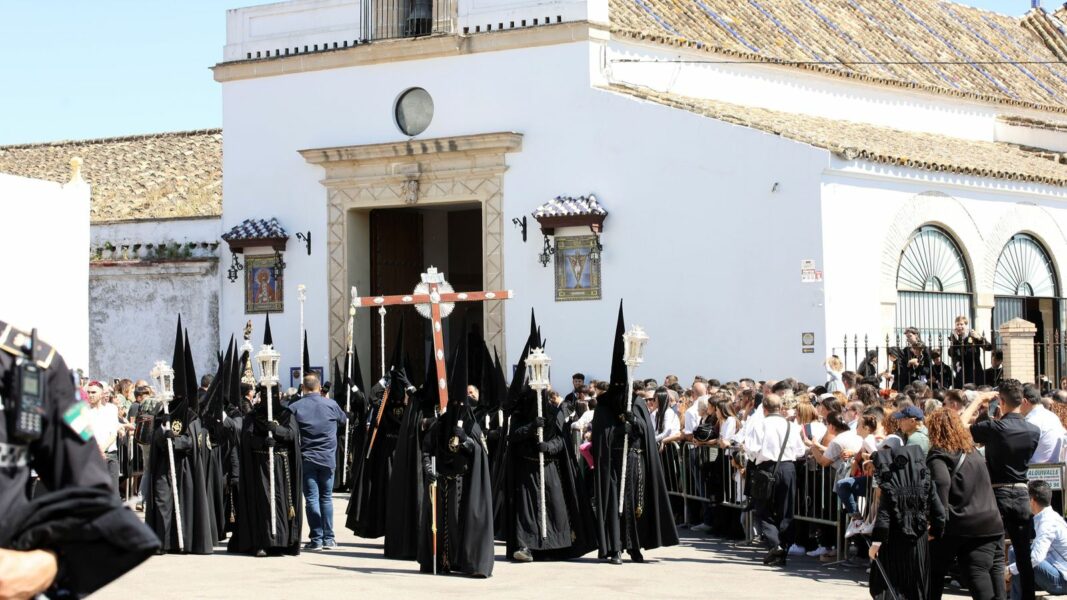
The Diocese of Asidonia-Jerez, in Andalusia, has promulgated a new Diocesan Regulation on Popular Piety and Confraternities and Brotherhoods that will replace the so-called “Green Book,” in force since 2004. The text maintains the requirement that those who govern the confraternities be practicing Catholics and lead a coherent Christian life, but develops this principle through new controls and declarations regarding doctrine, morality, and the personal situation of candidates. It also doubles to ten years and 200 members the requirements for establishing a new confraternity.
The regulation was made public on August 24 by the diocese governed by Most Rev. José Rico Pavés and will come into force on the upcoming September 24, the solemnity of Our Lady of Mercy, patroness of Jerez de la Frontera, initially ad experimentum for one year. Its drafting began in December 2023, and some of its provisions had already been anticipated in recent months through episcopal decrees.
From “practicing Catholic” to concrete requirements
The requirement of coherence with the Catholic faith does not originate with the 2026 regulation. The 2004 Green Book already established among the conditions for being a candidate for a Board of Directors that one be a “practicing Catholic, with a recognized Christian life in personal, family, and social spheres.”
The new regulation preserves this requirement but develops it considerably. Article 97 establishes that candidates must have completed Christian initiation—Baptism, Confirmation, and Eucharist—and be practicing Catholics, with a recognized Christian life in the personal, family, and social spheres.
It further adds explicitly that they may not be “in a situation of irregular cohabitation, contrary to the teaching of the Catholic Church”, referring to numbers 2331-2398 of the Catechism, corresponding to the teaching on the sixth commandment and sexual morality.
The novelty lies especially in the manner of verifying these conditions.
Candidates must provide different documentation depending on their marital status. Single persons will present, among other documents, a sworn declaration of single status and, where applicable, another regarding the way they understand and live a premarital relationship. Married persons must declare that they understand and live marriage in accordance with the teaching of the Church.
The regulation also expressly contemplates cases of widowhood, separation, and divorce and establishes the documentation and declarations that candidates must provide in each case.
Profession of faith under oath
Candidates must also submit a “Profession of Faith and Acceptance of Catholic Doctrine and Morality”, through a written document signed under oath before the ecclesiastical assistant.
They must also prove that they have no criminal or sexual offense records and submit a responsible declaration rejecting the abuse of minors and vulnerable persons and accepting the corresponding diocesan protocol.
The suitability of the candidate does not depend exclusively on the confraternity itself. The ecclesiastical assistant must issue a report, and the documentation will be submitted to the Ordinary, who may request additional information from the pastor of the confraternity’s church, from the pastor of the parish where the candidate resides, or from other persons.
These requirements follow a line that Rico Pavés had already developed through previous decrees. In April of this year, for example, he established similar requirements for candidates for the presidencies and permanent members of local confraternity councils.
Political incompatibilities are expanded
Nor is the incompatibility between certain political responsibilities and the governance of confraternities entirely new.
The previous regulation already prevented persons with certain political and institutional responsibilities from holding positions on boards of directors. The new text maintains that incompatibility and expands its scope.
Those who hold leadership or spokesperson positions in political parties, or who serve as civil executive authorities at the national, regional, provincial, or municipal levels, may not be candidates.
Furthermore, the prohibition now extends to other confraternal responsibilities: those in such situations may not serve as float masters, dressers of the titular images, sacristans, or stewards.
Politicians affected by these incompatibilities may also not serve as town criers or orators.
Town criers and speakers must accept Catholic doctrine
Control of Catholic identity extends to persons who speak publicly on behalf of a confraternity.
Those proposed to deliver a lecture or town crier address dedicated to a feast or sacred patron, as well as to publish in the name of a confraternity, will require prior approval from the ecclesiastical assistant and the Diocesan Delegation of Confraternities and Brotherhoods.
Once the assignment is accepted, they must sign a sworn declaration of knowledge and acceptance of the doctrine and morality of the Church.
The form included in the regulation commits the signatory to remain in communion of faith, worship, and discipline with the Pope and the bishop and not to say or teach anything contrary to Catholic doctrine and morality during their assignment.
Ten years and 200 members to establish a new confraternity
Another substantial change affects the creation of new confraternities.
Until now, the Green Book established a minimum period of five years as a parish association before advancing in the process and required at least 100 full members of legal age.
The new regulation doubles both requirements: ten uninterrupted years as a temporary parish association and a minimum of 200 full members of legal age over 18 will be necessary to request canonical erection as a confraternity and brotherhood.
A new limitation also appears regarding the canonical seat. A confraternity may not change it until 30 years have elapsed since its erection, although the corresponding ecclesiastical authorizations remain necessary.
Four-year term and a maximum of two consecutive terms
The reform also unifies the duration of boards of directors.
Terms will be four years. Until now, there were confraternities whose statutes provided for five-year periods. Members of the boards may be re-elected to the same office for only a second consecutive term.
Electoral processes must begin five months before the end of the term, compared to the four months previously established.
To be a senior brother or deputy senior brother, one must be over 25 years of age and have at least five uninterrupted years of seniority in the confraternity.
Greater economic and disciplinary control
The regulation also strengthens the economic supervision of confraternities and local councils.
Accounts must be submitted to the diocesan authority and made public in the terms established by the new regulation. Local councils that exceed certain budgetary volumes must also have external professional assistance for their fiscal and accounting management.
The disciplinary regime acquires special importance. Electoral irregularities may lead to the repetition of elections and the disqualification for four years of those responsible who have benefited from them. If anomalies persist, the bishop may appoint a commissioner.
The celebration of extraordinary devotions without authorization may leave a confraternity without new extraordinary devotions for four years, accompanied by the disqualification of the Board of Directors and the appointment of an episcopal commissioner.
Sanctions are also provided for economic irregularities and for non-compliance related to processional exits. In certain cases, infractions may result in the suspension of external devotions for one year or of the next penitential station.
The regulation also introduces economic penalties for unjustified delays in processional schedules, linked to income from chairs and boxes on the official route.
Processions and external devotions
The new regulation devotes an extensive section to processions, transfers, Stations of the Cross, and other acts of popular piety, also incorporating provisions that Rico Pavés had previously approved through specific decrees.
Processions must be celebrated with a “spirit of piety, recollection, and faith,” and it is the pastor’s responsibility to correct abuses “however ancient they may be.”
Stations of the Cross and public rosaries with images must use simple platforms. They may be accompanied by a choir or chapel music, but not by brass bands, and their duration may not exceed one and a half hours.
In Eucharistic processions, no floats with images may be incorporated, thus distinguishing the worship of adoration reserved to God from the veneration paid to the saints and their images.
One year “ad experimentum”
The new regulation will replace the Green Book approved in December 2004, after more than two decades as the general framework for the confraternities of Asidonia-Jerez.
It will come into force on September 24, 2026 and will initially be applied ad experimentum for one year. During that period, corrections and suggestions may be made before the bishop determines its definitive entry into force with the modifications he deems appropriate.
Once it enters into definitive force, confraternities, brotherhoods, and local councils will have two years to adapt their statutes and internal regulations to the new provisions.
Rico Pavés’s reform does not, therefore, start from a vacuum regarding the Catholic identity of the confraternities. The Green Book already required that their leaders be practicing Catholics and lead a recognized Christian life. The 2026 regulation goes a step further by translating that general principle into concrete requirements, sworn declarations, documentation, and verification procedures, while broadly reforming the electoral, disciplinary, economic, and processional regime of the confraternities.