


By Robert Royal
We recently reached the 250th anniversary (a quarter millennium) of the dominant nation and culture of our time—and of one of the greatest countries in world history. And yet, just a few weeks later, it would hardly be noticed. And only a month ago, everyone was talking—even here—about a film adaptation of Homer’s Odyssey, a foundational cornerstone of three thousand years of our civilization. That too passed quickly and is unlikely to become a classic. The Church keeps time better: there is the recent feast of the Assumption. But we need to pay much more attention to what is important, deep, constant, and (relatively) enduring, even in our fleeting world.
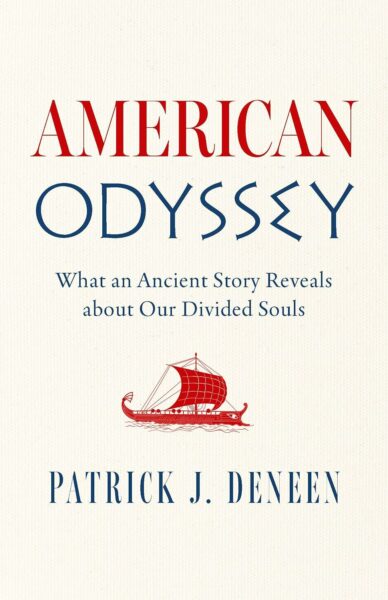
From time to time we manage it; for example, Patrick J. Deneen’s new book, American Odyssey: What an Ancient Story Reveals about Our Divided Souls. Many know Deneen as the author of Why Liberalism Failed and one of the brightest lights at Notre Dame. But he has long been interested in the Odyssey and its links to the American experience. And he deliberately timed the book’s release for this moment.
At first glance, connecting modern America with Bronze Age Greece may seem a stretch. But in this brief, lively, and accessible treatment, Deneen brings several valuable truths to light. To begin with, as the book’s subtitle indicates, Deneen sees a deep division above all in American souls, and one that has existed from the beginning.
The Pilgrims, he notes, crossed the wide Atlantic on their “errand in the wilderness,” but also in search of a true home. They were not mere explorers, like Columbus or Amerigo Vespucci (who gave America its name), but also something like Odysseus in the quest for their own place. At the same time—and here is the divided soul—in a certain sense they were explorers, leaving home in search of a better life, “a city upon a hill.”
Deneen traces this paradox through American culture. We are, more than most nations, a people at once restless and in search of rest: but a rest that lies beyond the horizon. The Augustinian echoes are evident here, in that all human beings are seekers, of course, often without knowing that the only real rest is in God. But in America that perennial search has also had personal and social dimensions in this world.
As an Italian friend of America wrote decades ago, we are the only people on earth whose own Constitution confesses to seeking a “more perfect union,” as if mere perfection were not enough for us.
Deneen explores this ambivalence of the American soul through several milestones of North American popular culture. In The Wizard of Oz, for example, especially in the film version, Dorothy longs for “Somewhere Over the Rainbow.” And she finds it in Oz, where—like Ulysses—she encounters strange beasts and multiple adventures. But it is precisely those experiences that help her understand that “there’s no place like home,” even a flat Kansas farm.
In a later chapter, Deneen points to a similar division in the film It’s a Wonderful Life. Young George Bailey (Jimmy Stewart) wanted to see the world, do great things, escape the “limits” of small-town life. But forced to take over the family business, he never has the chance. And yet—as the moving Christmas ending makes clear—he did achieve great things, and even had adventures in his own way, by not leaving and thus living the heroic life of “ordinary people.”
Several of Deneen’s comparisons are surprising. Laura Ingalls Wilder’s “Little House on the Prairie” series, set in Mankato, Minnesota, may seem as distant from the Odyssey as a story can be. But Deneen traces exactly what must have been the attitude of many settlers who ventured into the vast American West: an odyssey and an errand in the wilderness, to be sure, but also a search for and finding of a new home.
These readings can sometimes also feel a bit forced. Field of Dreams, a great film about America’s quintessential sport—baseball—certainly shows elements of travel and nostalgia. But it takes no small amount of shoehorning to fit it into the general paradigm of American restlessness and rest.
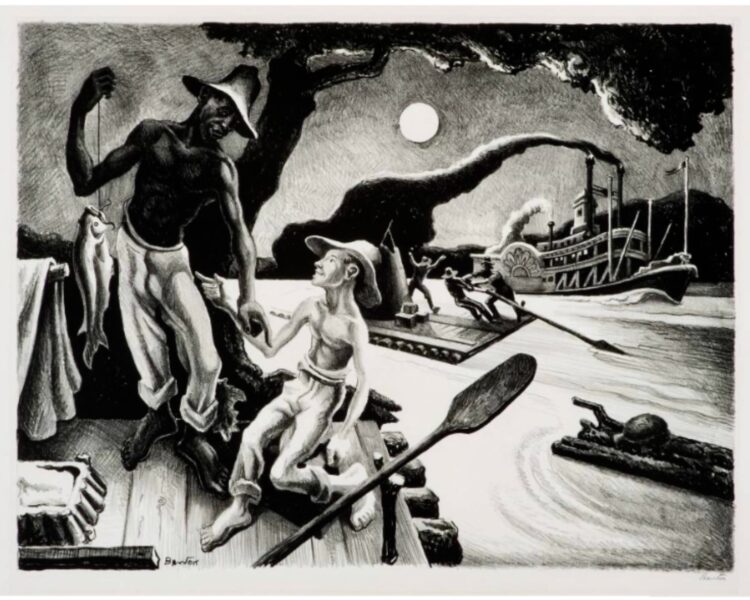
A major intersection with the Odyssey, for Deneen, is in Mark Twain’s The Adventures of Huckleberry Finn. Many consider it the greatest American novel, and one that can be read young and old, laughing and learning from it each time Huck and Jim drift down the Mississippi on a raft.
At the outset, the purpose of the journey was for Jim to reach Cicero, Illinois, a free state where he would no longer be a slave. It is not Odysseus in the Aegean, and the resolution is somewhat contrived. But along the way there are its own monsters, shipwrecks, swindlers, kind-hearted people, and recoveries: for us still more moving and, all the same, in an American key.
And in the end, Huck can “light out for the Territories,” where—like so many highly mobile Americans—he hopes to be free and also, to the extent that an American figure like Huck can be, at home.
Throughout these chapters runs a central question: what does it mean to be human? Our divided souls since the Fall compel us to pass between two extremes as through the eye of a needle. The temptation (Calypso) to become a god, but at the price of indifference to everyday human things. Or the danger of becoming a beast (Circe) by pursuing mere material pleasures. And in America, in particular, that has meant finding a path between the road and home.
Remaining human in a fallen world is an effort, for all of us, and being a good human is the hardest thing of all. As we see in Homer and also in modern works, goodness is not a matter of social status. There are good and bad in all classes and circumstances. That is one of the lessons that a certain restlessness, well pursued, which puts us face to face with the full range of human life, can teach us. And, if we are very lucky, those many wanderings may lead to true rest—and to home.
Robert Royal is editor-in-chief of The Catholic Thing and president of the Faith & Reason Institute in Washington, D.C. His most recent books are The Martyrs of the New Millennium: The Global Persecution of Christians in the Twenty-First Century, Columbus and the Crisis of the West and A Deeper Vision: The Catholic Intellectual Tradition in the Twentieth Century.