


By Kristen Ziccarelli
Few things are stranger to the modern imagination than the idea of a Christian king. We are accustomed to separating the sacred from the political, faith from public life, and the Church from the ordering of society. But for much of Christian history these divisions would have seemed almost impossible.
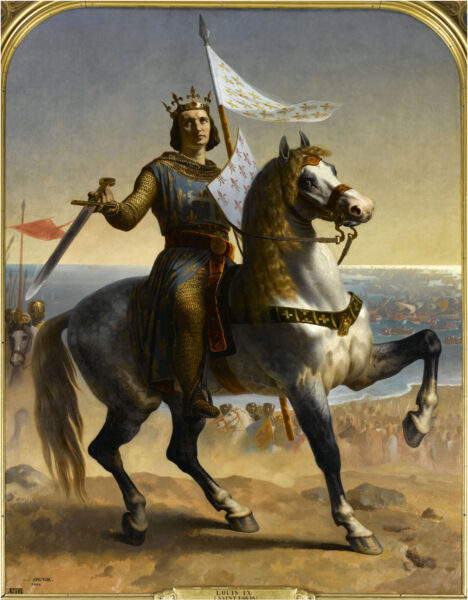
Today’s feast of King St. Louis IX of France (August 25) offers us the occasion to recover a jewel of medieval wisdom: the perspective that political authority can be truly ordered toward Christ. King St. Louis IX, who ruled France from 1226 to 1270, is considered by many the greatest medieval king and the only true saint-king of France. His reign is an enduring model of Christian kingship, so much so that later generations of French monarchs were expected to emulate him.
In his reign lies a sophisticated and holy understanding that his kingship belonged to Christ.
In his kingdom there was no secular State lurking beneath religious trappings, waiting to be separated from them. The kingdom itself was ordered around the sacraments and the vision of the faith concerning man, justice, authority, family, worship, and the common good. The categories of “religious” versus “secular,” so familiar to us, did not structure medieval society.
By contrast, King St. Louis IX ruled with the salvation of his subjects’ souls as his priority. He ruled for France, acquiring the Crown of Thorns, a large fragment of the True Cross, and the Holy Lance, and commissioning the magnificent Sainte-Chapelle in Paris to house these relics. The Crown of Thorns became the sacred treasure of the French monarchy itself, placed at the heart of the royal court: thus, his own crown existed beneath the crown of Christ.
What is the meaning of Christ’s social kingship? As Catholics, we understand Christ as Priest, Prophet, and King. His kingship extends over individuals, families, nations, and peoples. Pope Pius XI expressed this forcefully in Quas primas, his 1925 encyclical that instituted the feast of Christ the King. Christ possesses kingship not only in his divinity, but also as man, having received from the Father “power, glory, and kingdom.”
Pope Pius XI explicitly connected the salvation of individuals with the ordering of society, arguing that Christ’s kingship cannot be confined to the private sphere. At the conclusion of Quas primas, he expressed the hope that the annual celebration of Christ the King would remind rulers and princes that they too owe public honor and obedience to Christ, and that the State should take into account the commandments of God and Christian principles when making laws, administering justice, and educating the young.
This is not a call for the State to force its citizens to convert, nor to legislate Catholicism. It is the recognition of what we all know: that political communities cannot exist without moral foundations. Every society rests upon assumptions about what man is, what constitutes justice, what rights and duties belong to families, and what constitutes the common good.
Catholic Christianity has never considered Christ’s authority as something that ends at the doors of the church. And yet, many people today are content to relegate faith to the private sphere.
In the life of King St. Louis IX one can observe how seriously he took his primary responsibility to administer justice. And, because justice cannot be separated from love, the Christian ruler was called not merely to administer a bureaucracy, but to cultivate a society ordered toward the good.
His holiness, too, was inseparable from his kingship.
Louis gave generously to the poor and served them in person. He disguised himself as a beggar and left the palace to serve the poor and meet his subjects. He was a devoted husband and father of ten children, and took seriously his responsibility to raise them in the Faith.
His letter to his son Philip III states: “The first thing I advise you is to fix your whole heart on God and love Him with all your strength.” Without this, “no one can be saved or be of any worth.” Blessed himself by having been raised by a devout Christian woman, St. Louis instructed his son to avoid mortal sin, confess frequently, love the Church, practice virtue, seek justice, avoid unnecessary war with other Christians, and refrain from unjustly taxing his subjects.
For him, personal holiness and the justice of the realm were inseparable, and therefore he saw no other option than the pursuit of love and virtue. St. Louis and the other saintly monarchs of Europe show us how discernment can be applied concretely to leadership: that a Christian can rule with magnanimity, build, legislate, administer justice, raise a family, serve the poor, and pursue holiness as one integrated vocation. St. Louis finally died on the Eighth Crusade, giving his last years to the service of the Christian faith he had spent his life defending.
There are good Christians in the public sphere today who perceive that something has been lost, especially in the way politics has gradually moved from denying the spiritual supremacy of the Church to removing governments from God altogether.
The vision broad enough to unite these concerns and prescribe a solution is the social kingship of Christ. It is a supra-political vision because it transcends politics, yet directly implies it. It does not depend on the fortunes of any particular party, election, movement, or regime. It begins with the nature of Christ himself, and can be practiced because Christ’s kingship can shape concrete institutions and the people who inhabit them.
And this is perhaps the greatest lesson of King St. Louis IX for our own fractured age: Christ does not cease to be King even if our elected leaders do not recognize Him. We Christians are a people of miracles. If we seek a vision capable of renewing the soul of Europe, we might begin with the conviction that Christ is King in every sphere of our lives.
About the author
Kristen Ziccarelli is a writer living in Washington, D.C.