


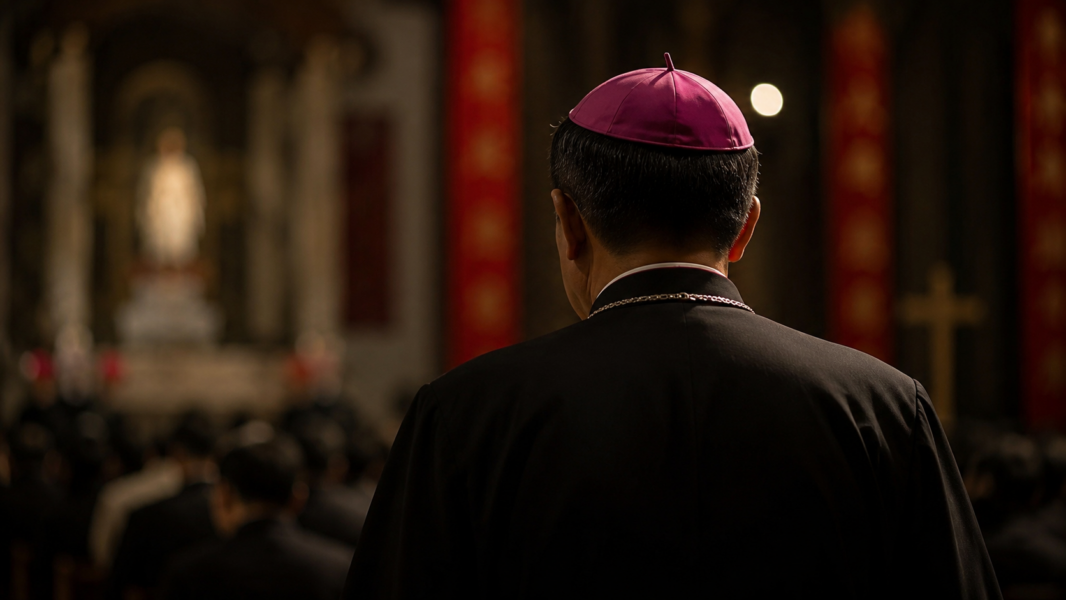
A Chinese Catholic bishop who remains outside the Chinese Catholic Patriotic Association, the state-controlled body, claims that at least ten new bishops would have been consecrated secretly in Fujian province, in southeastern China, due to the fear of underground communities that increasing government control over the Church could compromise its continuity. The testimony is part of a wide-ranging report published by Catholic World Report on the current situation of Catholics under the Xi Jinping regime.
The author, historian and sinologist Anthony E. Clark, keeps the prelate’s identity confidential to protect his safety. According to his testimony, after the signing in 2018 of the Provisional Agreement between the Holy See and the People’s Republic of China on the appointment of bishops, the situation in Fujian would have reached a state of “emergency” for Catholics who remain outside the official structures.
“At least ten new bishops”
The bishop cited by Clark states that among the faithful of the underground Church there is fear that, as government influence over bishops increases, “the integrity of the Catholic faith will suffer.”
According to his account, in order to “guarantee the survival of the Church in China,” secret episcopal consecrations have been carried out.
The prelate estimates that there would be “at least ten new bishops” in Fujian alone, although he does not provide their names, the dates of the ordinations, or the identities of the consecrating bishops.
The province holds special importance in relations between Rome and Beijing. It is home, among others, to the archdiocese of Fuzhou, where for decades government-recognized communities and underground Catholics have coexisted.
“Chinese first”
The testimonies gathered by Clark also describe the advance of the policy of “sinicization of religions”, promoted by Xi Jinping to adapt religious confessions to Chinese culture and, in the regime’s political practice, to socialism and the leadership of the Communist Party.
During a recent meeting, a Chinese religious sister told those present that she admired the Belgian missionary Vincent Lebbe (1877-1940) because, according to her, he would have understood that it was necessary to be “Chinese first and Catholic second.”
“We are Chinese first,” she stated.
Clark notes that other Chinese Catholics he later spoke with were scandalized by those words and maintains that they do not correspond to Lebbe’s thought.
The episode comes as Catholic structures recognized by Beijing have reinforced political adherence requirements for the clergy. The new code of conduct for priests, bishops, deacons, and religious sisters of the official Church requires support for the leadership of the Chinese Communist Party, backing the socialist system, and advancing the sinicization of Catholicism.
The regulations also establish that Catholic doctrine and discipline must be interpreted under the guidance of “core socialist values” and traditional Chinese culture.
Political formation in seminaries
Clark also includes the testimony of a Chinese seminarian with whom he recently spoke outside the country.
The young man described a formation in which, according to his experience, he received virtually no spiritual direction, while courses required by the government occupied a considerable portion of the time meant for prayer and study.
He also said he barely saw a bishop and claimed that some priests are members of the Communist Party.
“Everyone in China knows that the Party penetrates the Christian community,” he told the author.
In recent years, authorities have developed various political formation campaigns also applied to religious communities. Among them are programs aimed at promoting the national flag, the Chinese Constitution, socialist values, and traditional culture within religious spaces.
Another campaign requires fostering patriotism, “love for the Party,” and “love for socialism.”
The situation of the underground bishop of Wenzhou
The report also pays attention to Bishop Peter Shao Zhumin, bishop of Wenzhou, in Zhejiang province, recognized by Rome but not by the Chinese government.
Shao has repeatedly refused to join the Patriotic Association and has suffered numerous detentions and periods of “reeducation.”
The prelate was appointed by Benedict XVI in 2007 as coadjutor bishop and succeeded Bishop Vincenzo Zhu Weifang after his death in 2016.
Shao’s difficulties predate the Sino-Vatican agreement. Already in 2021, a Catholic from Zhejiang was fined 200,000 yuan for hosting a Mass celebrated by the bishop in a private chapel. The authorities classified the celebration as an illegal religious activity and described the prelate, appointed by the Pope, as someone ordained by a “foreign institution.”
Clark now states that authorities continue to detain Shao around major liturgical celebrations and that priests, religious sisters, and laity from Wenzhou have also suffered repressive measures.
According to information received by the author, up to 90% of the underground chapels in Wenzhou could have been seized and closed in campaigns against those who refuse to join the Patriotic Association. This too is an estimate conveyed to the author and not an officially verifiable figure.
Priests detained for making pilgrimages or distributing religious books
The report further states that some priests, religious sisters, and faithful who leave China on tourist visas and take advantage of the trip to make pilgrimages are later detained under the charge of “illegal border crossing”, as authorities consider that the religious purpose of their travel does not match what was declared on the visa.
Among the few positive developments is the recent release of priest Ma Xianshi, from Wenzhou, after serving an 18-month sentence related to the public sale of religious books.
According to AsiaNews, more than a hundred people came to greet him upon his release from the detention center. The priest has returned to his diocese and to his pastoral work.
Restrictions on minors
Another issue described is the ban applied in many areas of China preventing minors under 18 from receiving religious formation or participating in activities inside places of worship.
Clark clarifies that this prohibition does not appear in that form in a general national law, but states that local authorities apply it with varying intensity depending on the region.
Priests and religious sisters have developed mechanisms to maintain the formation and sacramental life of young people. One religious sister explained to the author that, since the instructions specifically refer to church facilities, some Masses and gatherings for minors are held in other locations.
“The government keeps one eye open and the other closed,” another religious sister summarized.
Episcopal appointments under Leo XIV
The report also addresses one of the most delicate issues in relations between Rome and Beijing: the selection of bishops.
The Provisional Agreement signed in 2018, most recently renewed in 2024 for four years, remains confidential. Its full content has never been published.
During the vacant see following the death of Francis, official Chinese structures elected Ignatius Wu Jianlin for Shanghai and Francis Li Jianlin for Xinxiang. Leo XIV later approved both candidacies.
Wu’s case was especially singular: he had been elected by Chinese structures on April 29, 2025, during the vacant see, and Rome later announced that Leo XIV had accepted his appointment on August 11.
In Xinxiang, Li Jianlin was finally consecrated in December 2025 after the Holy See accepted the resignation of Joseph Zhang Weizhu, the reference bishop of the underground community who had endured years of detentions and pressure from the authorities.
Read also: Xinxiang: the case that reveals the hidden tensions of the Vatican-China agreement
This summer two other appointments were made within the mechanism agreed between Rome and Beijing. Leo XIV approved on June 15 the candidacies of Giuseppe Chang Yanfeng, later ordained bishop of Chifeng, and Francisco Javier Duan Yongkun, coadjutor bishop of Bameng, both jurisdictions located in Inner Mongolia.
In Chang’s case, the communication from Chinese authorities omitted any reference to papal approval and instead highlighted that he had been elected by official bodies and authorized by state authorities.
The memory of those who refused to join the Patriotic Church
Clark explains that Chinese Catholics continue to pass on the memory of priests who suffered persecution during the Maoist period and refused to join the ecclesiastical structures controlled by the regime.
Among them he recalls Jesuit Zhu Hongsheng (1916-1993), from a Catholic family for more than three centuries. Ordained a priest in 1944, he was first detained in 1953 and spent, through successive imprisonments, more than 31 years in Chinese prisons without renouncing his faith.
He also mentions Jesuit Stanislas Shen Baishun (1903-1985), accused by the authorities of belonging to a “counterrevolutionary” group linked to foreign forces, a reference the regime used to point to the Vatican.
Both are remembered, Clark notes, among other reasons for having refused to join the patriotic structure.
The author qualifies, however, that the boundary between the so-called official and underground communities is much less rigid on the ground than it may appear from outside China. Catholics from both spheres recognize priests and bishops from the other, and according to his experience, there is practically no idea among the faithful that members of the official structure belong to “another Church.”