


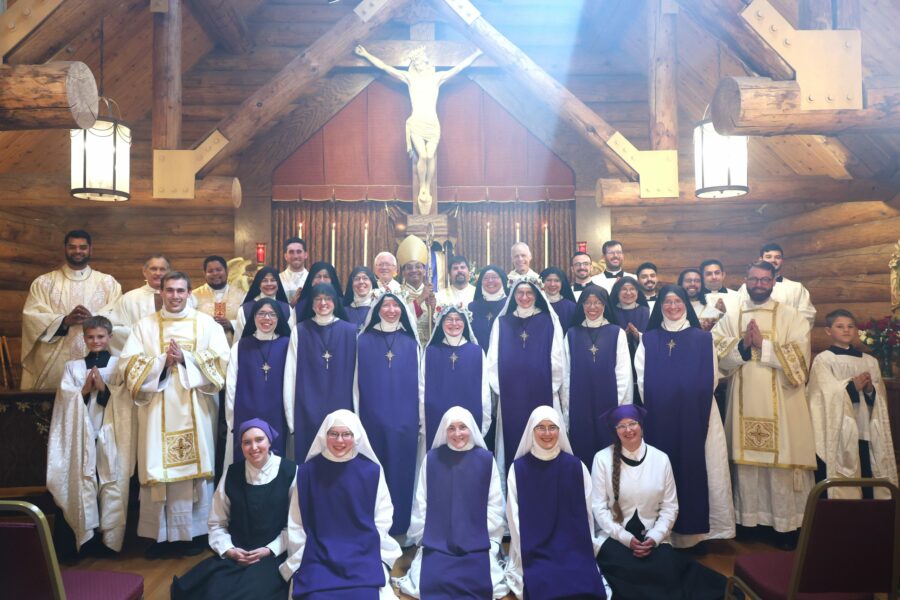
The Daughters of Mary (Children of Mary) will cease to exist as a community in October 2026 after the Dicastery for Institutes of Consecrated Life and Societies of Apostolic Life rejected their recognition as an institute of diocesan right “neither now nor in the future.” The bishop of Columbus, Ohio (United States), Bishop Earl Fernandes, decided to suppress the public association of the faithful after receiving the communication from Rome.
Fernandes outlined the reasons for the decision in a letter dated August 10, released together with another communication from the Daughters of Mary themselves. The bishop points to problems in the formation of the members and even “abuses associated with the evangelical counsels” and with the separation between the internal and external forums. The community has accepted the suppression “in a spirit of faith, humility, and filial obedience to the Church.”
More than 25 years of history
The Daughters of Mary trace their origins back more than 25 years. The community was canonically established in the Archdiocese of Cincinnati, also in Ohio, in 2016 and in 2022 moved to the Diocese of Columbus, with its headquarters in Newark.
Its charism is centered on “quenching Jesus’ thirst to be loved in the Most Blessed Sacrament.” Its apostolate has been carried out through eucharistic adoration, prayer that others may love and adore Christ in the Eucharist, and evangelization. Fernandes also highlights the community’s Marian devotion and its prayer for priests.
The Daughters of Mary were constituted as a public association of the faithful and were working toward recognition as an institute of diocesan right.
As part of that process, the community sought to reform and clarify its Constitutions, define its charism more precisely, resolve issues related to the ownership of its goods, and improve the formation of its members.
According to Fernandes, the sisters provided “in good faith” to the Dicastery for Institutes of Consecrated Life and Societies of Apostolic Life the documentation necessary to begin the procedure.
“Despite the sisters’ best efforts, these reforms proved difficult,” he states.
Problems of formation and “abuses associated with the evangelical counsels”
Fernandes explains that in recent years difficulties related to formation within the community came to his attention.
The bishop specifically mentions “certain problems of formation and even abuses associated with the evangelical counsels and the right to the separation of the internal and external forums.”
The evangelical counsels are poverty, chastity, and obedience. The distinction between the internal and external forums preserves the sphere of personal conscience with respect to the external exercise of authority. Fernandes describes it in his letter as the separation between “the forum of personal conscience” and “the forum of external and observable actions.”
The bishop’s letter provides no further details about the nature of those abuses or identifies the persons involved.
Fernandes assures that “sincere attempts” were made to address the difficulties and that he kept the Dicastery in Rome informed throughout the process.
The Dicastery rejects recognition
According to Fernandes, an official of the Dicastery finally informed him that the formation difficulties had been present in the community’s life from its beginnings and had persisted despite the reforms undertaken.
“Even with the reforms attempted, because of the formative problems in community life from its beginnings and the persistence of these problems, the Daughters of Mary would not be approved now or in the future for erection as an institute of diocesan right,” the bishop states.
The sisters confirm that communication in their own letter.
“We have recently been informed that the Dicastery for Institutes of Consecrated Life and Societies of Apostolic Life has decided that our community will not be considered for approval as an institute of diocesan right, neither now nor in the future,” they explain.
The Daughters of Mary note, for their part, that during the process “unforeseen formative problems” arose because it was a relatively new community and state that Fernandes conveyed the Dicastery’s concerns to them.
Three members professed perpetual vows in May
Last May, three members of the Daughters of Mary made their profession of perpetual vows during a Mass presided over by Bishop Fernandes himself.
According to The Catholic Times, the newspaper of the Diocese of Columbus, priests, religious, and seminarians attended the celebration. The three sisters promised to “persevere until death.”
The superior of the community, Mother Philomena Maria, described that day as “a beautiful flowering in the vocations of three of our sisters, who have come to this community to give their lives out of deep love for Jesus, truly present in the Most Blessed Sacrament.”
One of them was Sister Cecilia Grace, a native of Russellville, Ohio, who had entered the convent in 2019 at the age of 18.
“Suppression was the only option”
Once the Dicastery’s decision regarding the community’s canonical future was received, Fernandes decided to suppress the association.
The bishop explains that recognition as an institute of diocesan right would have provided the members with “greater stability and the guarantee of permanent spiritual and physical care.”
“Knowing that this would not be possible and recognizing that some of the women of the Daughters of Mary may have a genuine vocation as consecrated religious in an order recognized by the Church, I determined that suppression was the only option,” he states.
Fernandes notes that the decision will allow the members to discern their vocation afterward “in a new association or institute or in the world.”
Rome’s intervention in new religious institutes
Since 2020, the erection of a new institute of consecrated life of diocesan right requires prior written authorization from the Holy See.
That year, Francis amended Canon 579 of the Code of Canon Law through the motu proprio Authenticum charismatis. Until then, the diocesan bishop could validly erect an institute after consulting the Apostolic See. Since the reform took effect, he must first obtain a written license from Rome.
The decision communicated by the Dicastery therefore prevents the Daughters of Mary from completing the process to become an institute of diocesan right.
“Faith, humility, and filial obedience”
The Daughters of Mary have announced that their existence as a community will end in October 2026.
“Although this decision is painful to accept, we receive it in a spirit of faith, humility, and filial obedience to the Church we love,” they state.
The sisters acknowledge that the decision “may seem abrupt,” but add that “much has happened to reach this point,” without providing further details.
“As each one continues to discern the path the Lord now places before us, we do so with confidence that He is faithful and that His providence never fails,” they write.
The community recalls “the friendships formed, the lives touched, and the love of Christ shared” during their years of apostolate and trusts that the seeds sown will continue to bear fruit.
Fernandes also acknowledges the work carried out by the Daughters of Mary and asks the faithful to pray for their members.
“A suppression of this kind is neither common nor rare in the Church,” the bishop notes. “It is felt more deeply when it occurs at the local level and among people we know personally.”
The prelate concludes by quoting the First Book of Samuel: “God does not see as man sees, for man sees the appearances, but the Lord looks at the heart.”