


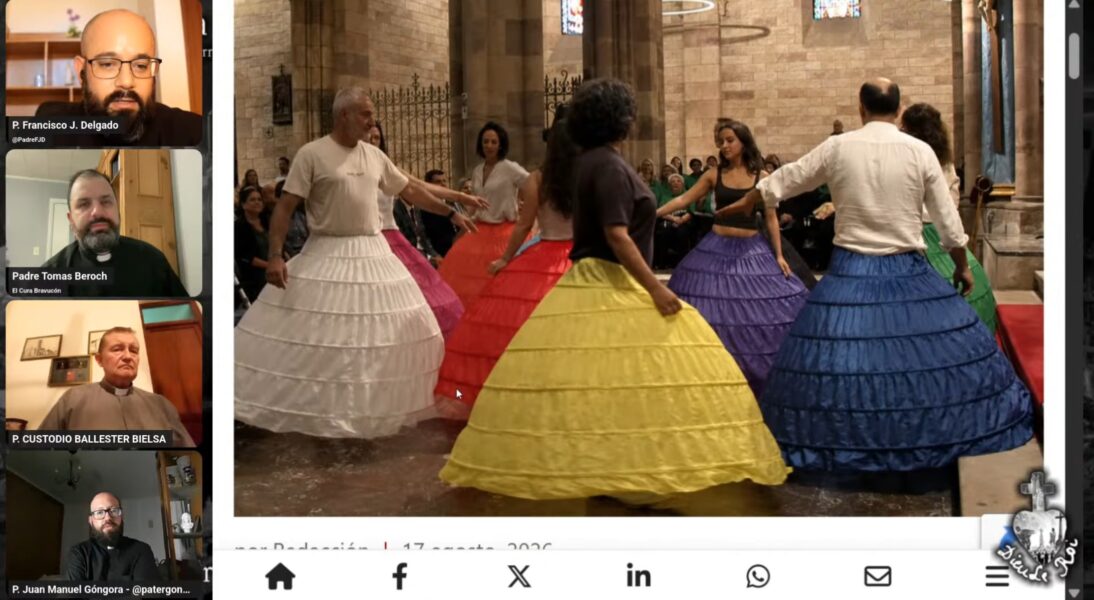
The priestly counter-revolutionary round-table devoted its latest program—two long hours under the title “Heresies, Abuses and Silences”—to taking stock of a fortnight especially rich in ecclesiastical scandals and, above all, to answering the question that served as the program’s subtitle: what can Catholics do? It was hosted by Father Francisco José Delgado from the Peruvian jungle—he is currently staying at the Moyobamba seminary—accompanied by Father Juan Manuel Góngora (Almería), the Argentine priest Tomás Agustín Beroch, a diocesan priest in the United States, and Father Custodio Ballester (Barcelona), who left the round-table halfway through the broadcast. Delgado warned at the outset that the plan was not “simply to be indignant”: in the face of things that harm the faith “the evil one is circling to make souls be lost, and we must also get the response right.”
The appointments: Longo and Murray
The review began with the appointments. The Vatican bulletin of 13 August included the designation of Umberto Longo, director of the Istituto Storico Italiano per il Medio Evo, about whom “quite clear” reports circulate—said Delgado—of links to Freemasonry, with documented presence at Masonic events, without the Holy See having said a word. He added the appointment of the Irish religious sister Patricia Murray, former executive secretary of the International Union of Superiors General and a figure in the synodal sector most favourable to feminist and LGBT demands—Delgado displayed her interview in Vida Nueva under the headline “The clergy fear losing power”—as consultant to the Dicastery for Institutes of Consecrated Life.
Beroch confessed he would not have known she was a nun had he not been told: “The habit does not make the monk, but it helps.” He distinguished between the homosexual who seeks to live in chastity, like those in the Courage group, and the lobbies that defend “abortion, gender ideology and all those anti-Catholic filth,” and went to the heart of the problem: “When you put someone in a position of power you are saying that person is capable of carrying out the Church’s mission”; the message the faithful receive is that “all that is not so bad.” He cited Paul VI’s smoke of Satan and wolves in sheep’s clothing, and expressed the hope that Leo XIV would resemble Leo XIII, the pope who renewed the condemnations of Freemasonry, liberalism and socialism. Delgado, for his part, commented on the photograph of the meeting of religious superiors watching the Pope’s message: “It looks like a lady playing bingo, a gathering of the elderly.”
Torrelavega: the Assumption denied from the ambo
The main course came with Torrelavega. At the Mass of the Assumption, celebrated for the 125th anniversary of the basilica title of the church, there were liturgical dances with men in skirts—“a clownish spectacle if it were not for the pain it causes to see it in the middle of Mass”—a blue chasuble outside the privilege of the Immaculate Conception and, above all, the homily of the parish priest, whose audio was played live: “No human being is going to rise to heaven in body and soul. Heaven is not a physical place; it is a state of the soul.” For Father Custodio, “an ignorant, uninformed, poor man” who “has made a complete fool of himself before the whole world” and who must be looked upon “with compassion and commiseration.”
Delgado moved to the canonical ground: the public denial of a proclaimed dogma is heresy, and heresy is punished with latae sententiae excommunication. Five days after the solemnity the bishop of Santander had said nothing, and the host recalled the comparative grievance with his own case: “Within twenty-four hours my bishop had sent out a communiqué throwing us to the wolves, endorsing all the manipulations of the most disgusting religious press. We had asked forgiveness twelve hours earlier.” And a more uncomfortable comparison: if the Society of Saint Pius X is declared excommunicated in a single day, “this also carries excommunication, and here nothing is done.”
Suesa: the consecration reinvented
In the same Cantabrian diocese they placed the second case, in Góngora’s view the most serious: the Mass broadcast by a regional television station from the monastery of the Trinitarian sisters of Suesa, where the celebrant reinvented the consecration in the feminine plural: “Take and drink from it, all of you […] it will be poured out for you and for all humanity […] to remember that I am in your midst as one who serves.” The priest from Almería pointed out that not only are the words of consecration arbitrarily altered, but the nuns simulate concelebration with their gestures, a matter listed in canon law among the delicta graviora. “The cup is overflowing,” he said, and rejected the slogan of trusting and praying in silence: to remain silent would be to join “an ominous, acquiescent and complicit silence with a true anti-God.” Delgado read the presentation the nuns themselves make of their liturgy on the monastery’s website—“a circular monastic choir without hierarchical spaces […] an inclusive language”—and noted that here too there has been no episcopal communiqué.
La Paloma: the consecration of Cardinal Cobo
A separate chapter, lesser in gravity but of international reach, was given to the consecration by Cardinal Cobo at the Mass of the Virgin of La Paloma: the host held over the paten outside the altar, without the inclination required by the General Instruction of the Roman Missal and with a theatricalisation directed at the assembly. The words, Delgado admitted, were well said, but the Eucharistic Prayer is addressed to the Father, not to the public; it is memorial and anamnesis, not dramatisation, Góngora added, for whom the gravity “is not in what is done, but in who does it”: the archbishop of Madrid and member of one of the most important dicasteries of the Holy See.
Fátima: the blessing of Cristiano Ronaldo and Georgina
From Madrid to Fátima. After the civil marriage of Cristiano Ronaldo and Georgina Rodríguez, celebrated at their home—“invalid for baptised Catholics; it serves no purpose”—a priest offered them Mass in a private chapel of the Portuguese shrine with a blessing “in the style of Fiducia supplicans.” Delgado, document in hand, showed that not even the controversial declaration—which he himself had signed against at the time—authorises what happened: the blessing must be spontaneous and “never performed at the same time as civil rites of union, nor in connection with them, nor even with the vestments, gestures or words proper to a marriage.” Here there was a reserved chapel, preparation and, apparently, the same outfits as the civil wedding.
Góngora placed the main blame on the complicit priests who did not explain what the Church teaches, “whether it is Cristiano Ronaldo or whoever,” and warned of the opening of a loophole: the ordinary faithful have the right to ask why they are not given what the footballer is given, reviving the old reputation of annulments for the rich. Beroch summed it up in Argentine style: “The fault is not the pig’s, but the one who feeds it,” and “money makes the monkey dance.” He recounted that to a local celebrity who asked for something similar he proposed turning that Mass into their Church wedding, and recalled the divorced and remarried man who offered him a five-thousand-dollar cheque for a godparent role: “I do not sell my soul; I accept that cheque and lose the cheque of eternal life.” Delgado closed with the joke about the dog a lady wanted to baptise for a thousand-dollar stipend: “Ah, you hadn’t said the dog was Catholic.” Custodio contributed his own casuistry—the widowed pensioners who asked to bless rings without marrying so as not to lose the widow’s pension—and Beroch set the biblical backdrop with Ezekiel 3:18: the watchman answers to God for the souls in his care. At bottom, he said, the fear of God has been lost and, worse still, shame: “What young man is going to want to be a priest with that kind of grotesque spectacle? That is why progressives are sterile.”
Bertomeu and Pachamama
The last case in the inventory was that of Monsignor Jordi Bertomeu, an official of the Dicastery for the Doctrine of the Faith, taking part in Peru in a “payment to the earth,” a shamanic offering to Pachamama, within a macro-regional meeting—“Interweaving voices for dignity”—publicised by Vatican News as preparation for the visit of Leo XIV. Custodio, who knows him and has spoken with him, asked that he be looked upon “with a little compassion”: in a brilliant ecclesiastical career “any slip becomes a very grave matter,” and “he is a doctor in Canon Law and knows what it is about.” Góngora was harsher: to comment on the case exposes one to being accused of defending the Sodalitium and the abusers—referring to Alejandro Bermúdez’s article—but “Caesar’s wife must be and appear to be”: if any of them did something like this “we would end up in a charterhouse at the 48th parallel.” The message transmitted, he said, is that “he who has a godfather” can do anything, and he recalled the threats of excommunication to two Peruvian faithful. Delgado conceded that one may be caught in an alien act, “but one thing is not having the guts to raise one’s voice against idolatry and another is to do it oneself.”
What to do? The canonical itinerary
The second hour was devoted to “what to do.” Custodio, before signing off, evoked Lenin’s title and the see-judge-act of the old life-review groups, and transferred the method to the civic sphere: if in every town in Spain a group planted itself every Thursday at seven in the town-hall square against Pedro Sánchez, “they would fall like the walls of Jericho”; the problem is the Spanish education of “let someone come and do something.” His ecclesial recipe: approach the priest and tell him to his face; if he does not rectify, write to the bishop “so that at least for three minutes he feels uncomfortable”; and if the bishop pays no attention, to the Dicastery for Divine Worship, “because the elites think all humanity is stupid except themselves.” With a final warning: “We are the first who need to be converted.”
Delgado later systematised the canonical itinerary. Canon 212 establishes the obedience due to pastors, but also the right of the faithful to manifest their needs to them and “the right, and sometimes even the duty,” according to their own knowledge, competence and prestige, to express their opinion on what pertains to the good of the Church. The instruction Redemptionis Sacramentum (nn. 183-184) charges everyone—including bishops—to defend the Most Holy Sacrament from all irreverence and recognises any Catholic, whether priest, deacon or layperson, the right to lodge a complaint about a liturgical abuse before the diocesan bishop or the Apostolic See, “with truthfulness and charity.”
On that basis the host spelled out the practical steps: the models of denunciation that Father Javier Olivera Ravasi published on his blog “Que no te la cuenten”—public scandal, liturgical abuses, denial of communion on the tongue or kneeling, preaching contrary to faith or morals—; private correction for the young priest who puts his foot in it, a formal letter for the veteran who “will tell you to go fry asparagus”; describe facts and only facts, without giving the bishop “a Twitter ecclesiology lesson” that will end up, “with good reason,” in the bin; request acknowledgement of receipt and, since Spanish dioceses have taken to not giving it—“a terrible abuse” that he denounces in vain—spend thirty euros on a burofax, or its notarial equivalent in each country. If within a reasonable time there is no response, to Rome: Divine Worship for liturgical abuses, Doctrine of the Faith for preaching against the faith and public scandal, Clergy or Bishops according to the case; even double notification is possible, denouncing before the Dicastery for Bishops the inaction of the ordinary. The most effective channel, the nunciature, which files a copy and forwards to Rome without losing anything; the new norms of the Curia require some kind of response within ninety days. And a note of the times: artificial intelligences “are very useful” for drafting these complaints with the applicable canons, “and even, if you get heated, they tell you: this tone does not seem correct.”
“Cause a little trouble”
Beroch railed against ecclesial occultism: the logic of “washing the dishes at home” was what covered up the abuses, and “the problem with sweeping dirt under the carpet is that at some point the carpet explodes, and it explodes badly.” The private is settled in private—if he were to argue with Olivera Ravasi he would call him on the phone, not open Twitter—but public sin that scandalises demands public speech: “Progressives are like rats: they fear the light,” the press, YouTube. Hence his slogan to the laity: “Cause a little trouble.” To the priest face to face after Mass, letters to the bishop, to the Dicastery for the Doctrine of the Faith, to that of the Clergy, to the nuncio, and to the police if there is abuse of a minor: “If several letters arrive, afterwards they will think twice.” With a caveat he repeated several times: whoever rectifies deserves the embrace—“brother, welcome back”—; the problem is pertinacity, because canonical penalties are medicinal and seek the conversion of the offender, not his destruction. The synodals, he ironised, preached mercy for all “except for the priests of the Vendée,” crucified “for a joke that was not even a sin.”
The counterweights: prudence, charity and one’s own conversion
The counterweights were not lacking. Góngora insisted on prudence: act with evidence, without rash judgments, facing up “with name and surname” and without the chiacchiera condemned by Pope Francis; and he countered those in the chat who opposed love and fear of God: fear is one of the seven gifts of the Holy Spirit, not a substitute for love. Delgado warned against those who use scandal as a pretext for their own agendas, and gave a thorny example: concluding from Torrelavega that the Society of Saint Pius X “did well” with the Écône consecrations, an act he still considers “erroneous and unnecessary”; asked by the chat, Góngora confirmed that replacing the reading of the pontifical mandate with a series of arguments read by a layperson is, “evidently,” a liturgical abuse. And against the “ideological solutions” that take advantage of troubled waters: “It’s all the Jews’ fault. What does that have to do with this?”
The host also recalled that canon 210 precedes 212 not by chance: first the duties—leading a holy life and building up the Church—then the rights. “If I become an expert in controversial theological matters but then do not pray, my family is a mess and at work I am immoral, we have a problem.” His model of reform, that of Saint Teresa in the face of the Protestant revolution: not a complaints office, but a community dedicated to living perfection. “Our mediocrity is also to blame for these things happening.” Beroch, back after the blackout caused by an electrical storm, drove the point home with an anecdote from his seminary years with the Incarnate Word: they criticised this or that bishop and a superior asked them if they were keeping the seminary schedule properly; “if we do not fulfil our state of life, how much less would we do in that bishop’s place.” And to a commenter who accused him of hating progressives he replied that no one there hates anyone: if the parish priest of Torrelavega took the microphone and repented, “we would applaud him.”
Vote with your wallet
There was also an economic chapter. The fifth precept of the Church obliges one to help her in her needs, Delgado recalled, but with intelligence: where the system allows it—United States, whose parishes live from the collection plate, and not so much Spain or Germany with state subsidies, where the faithful have hardly any voice—voting with one’s wallet is possible, and above all communicating it: “I send a little letter: I cannot in conscience collaborate with this.” As with telephone cancellations, sometimes that makes them listen.
The tone: judging facts, not persons
On the tone of denunciation, the host projected the scene from the film about Padre Pio in which the saint, denounced by the bishop of Manfredonia, explodes against the friar who calls the prelate an “unworthy and shameless priest”: “Who are you to speak like that of a bishop of the Church? Learn humility.” Malignity, Delgado recalled, is a sin even if what is said is true, when the defects of others are aired to gloat or foster hatred. Beroch qualified that the same video has been thrown at him to silence all criticism, and drew the decisive distinction: facts are judged, never persons or intentions; one may say that denying the Assumption is an aberrant heresy, not that that father will go to hell; without judging facts, “a father could not educate his children nor a policeman arrest the thief.” For those who wished to delve deeper into the dogma—there was someone in the chat who defended that the parish priest was only asking to understand the body “metaphorically”—the panellists concluded that speaking of mythology already denies it, that the glorified body is material—“Christ ate a piece of fish”—and referred to the videos of Olivera Ravasi and Father Francisco Torres on his channel Clama Ne Cesses.
Against the YouTubification of the faith
The final stretches addressed the YouTubification of the faith, following a comment that asked not to turn lay YouTubers into “our priests and bishops.” Delgado vindicated the grace of state of the priest to preach and counsel—without absolutising it: the one from Torrelavega must be corrected—recognised the service of the laity, more sheltered from episcopal arbitrariness than some priests have suffered, but asked them to recognise their limits: videos proliferate of laypeople, “some who the day before yesterday were Protestants,” correcting priests with decades of academic formation in the harshest terms. Along the way he defended himself from those who murmur that after the sanction he has become tame: “It will happen to me again, don’t worry; we will bear it again.”
Góngora preferred to speak of restoration rather than reform: “It is not adding a bell-tower to the tower; one must replaster from the foundations and draw out the damp and all the bad that has been seeping in,” and he warned the faithful against anyone who tells them what they want to hear. Beroch called for intellectual humility in all directions—memorable his only written reply to a know-it-all YouTube commenter: “Excuse me, it is question 23 of the Summa, not 56”—and quoted Perón, “who is not a saint of my devotion, but the truth is the truth whoever says it”: “The brute is worse than the wicked, because the wicked can be converted.” Delgado added the scholastic distinction between opinion and demonstration, against those who label as a heretic anyone who disagrees on what is debatable, and lamented the hotheads who lose friendships over these disputes: “a ridiculous thing.” There was still time to laugh at the YouTuber who promises to warn his audience when there is a schism, “even if the Pope says there is.”
The close was the usual one of the house: recommendation of the Homo Legens audiobook app—narrated with artificial intelligence; Delgado uses it daily on his walks through the Moyobamba seminary—and of the Barcelona tax office VCR, “Viva Cristo Rey,” a blessing in Latin and the same Cristero hymn that had opened the broadcast: “War, war against Lucifer.” Until next Thursday.