


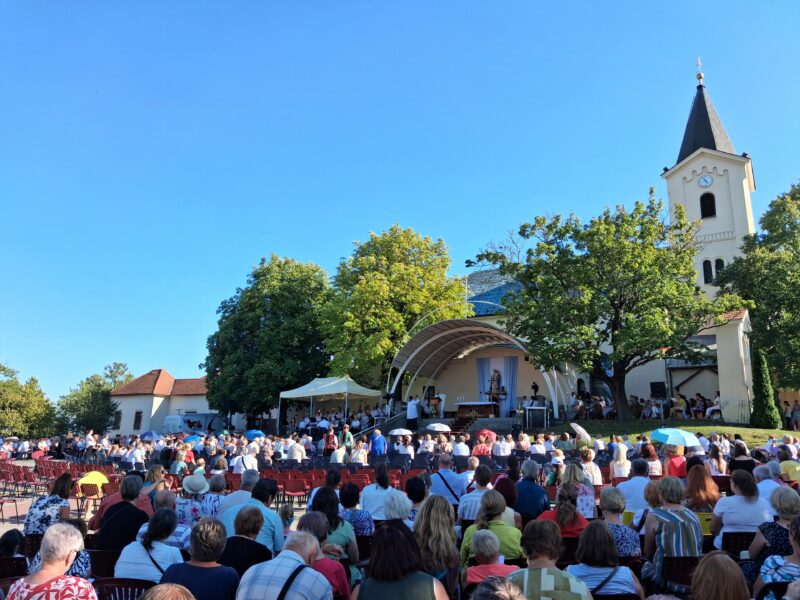
Thousands of Catholics took part this weekend in the traditional Marian pilgrimage of Nitra, in Slovakia, on the occasion of the solemnity of the Assumption of the Virgin Mary. Three bishops joined the celebrations of one of the main expressions of popular religiosity in the region, whose origins date back to the 18th century and which survived decades of restrictions during the communist regime.
The pilgrimage took place at the Calvary of Nitra, a city located about 90 kilometers east of Bratislava and home to one of the oldest dioceses in Central Europe. According to the diocese, this year marked the 250th annual thanksgiving pilgrimage to the shrine, a tradition whose first records date back to 1766.
Three bishops among the thousands of pilgrims
Among the participating prelates were Bishop Viliam Judák of Nitra; Bishop Jozef Haľko, auxiliary bishop of Bratislava; and Bishop František Rábek, emeritus military ordinary of Slovakia.
During the two days, several Masses were celebrated, along with confessions in both Slovak and Hungarian, as well as Eucharistic adoration and an organ concert. The three bishops celebrated the Eucharist and administered the sacrament of Penance.
Haľko, who presided over one of the Masses in Hungarian, explained to EWTN News that during the pilgrimage he had reflected on the relationship between the Marian dimension and the Eucharist. When pronouncing the “amen” before God, he noted, the Christian in some way makes the Virgin’s “yes” their own and surrenders themselves to Him.
The presence of celebrations in Hungarian also reflects the historical and cultural reality of Slovakia, a Central European country with a significant minority of Hungarian origin.
Mary as a model for families
Bishop Rábek, who previously served as a priest in the Nitra-Calvary parish and currently resides at the pilgrimage site, directed part of his preaching to parents.
The bishop urged them to seek a “healthy balance” in the education of their children, so that they may develop their talents without neglecting the Word of God.
Rábek presented the Virgin as a simple woman who was willing to accept the divine will and who, precisely because of that response, became a model for Christians. “Show me a woman who is as famous, glorified, and respected as Mary,” he said.
Marian devotion holds a unique place in Slovakia’s religious history. Our Lady of Sorrows is the country’s patroness, and her national shrine in Šaštín is one of its main pilgrimage centers. In September 2021, Pope Francis concluded his apostolic journey to Slovakia there, with a large-scale celebration on the feast of the national patroness.
Read also: Francis: “When the Church stops, it gets sick”
“Do not lose sight of the noble goal of our life”
The pilgrimage culminated on Sunday with a Mass presided over by Bishop Judák, also attended by the mayor of Nitra and other local political representatives.
In his homily, the bishop recalled the Assumption of the Virgin as a reference for humanity’s ultimate destiny and asked Mary to help those present move toward the goal of Christian life: love understood as self-giving.
“If we strive to live according to our conscience, that is, to fulfill the will of God as she did, our life and the events of our life, all that we do well, will not perish even with death,” he said.
Judák invited the faithful to look toward what the Virgin leads to and asked that the pilgrimage serve so that, “tomorrow, in a week, in a month, in a year, at least until the end of our lives,” Christians do not lose sight of “the noble goal of our life” and persevere in it with God’s help.
The bishop also exhorted those present to fulfill their responsibilities as Christians in public life and to defend and profess Christian values ahead of the local elections scheduled for this autumn.
A pilgrimage that survived communism
The pilgrimage to the Calvary of Nitra began in the 18th century. The faithful first climbed the hill in pilgrimage in 1766, and the tradition eventually became one of the main religious celebrations in the area.
Its continuity was disrupted during the communist regime in Czechoslovakia, when participation in religious events was subject to restrictions and the pilgrimage was even banned during certain periods. After the fall of communism, the celebrations were able to resume freely starting in 1990.
Slovakia still preserves important public expressions of Marian piety and popular pilgrimages. During his visit to the country in 2021, Pope Francis highlighted this tradition, describing the Slovak people as one whose devotion to the Virgin is also expressed through pilgrimage.
Read also: The Pope: “adore, pray, walk, make pilgrimage, and do penance”
Fifty pilgrims walked 20 kilometers on foot
The organization of the days was handled by the Nitra-Calvary parish, entrusted to the Missionaries of the Divine Word, whose Slovak province is based on the hill itself.
The parish priest, Father Ján Štefanec, highlighted the vitality the place gains during the feast and admitted he would like to see a similar presence of the faithful more often throughout the rest of the year.
Although most attendees now arrive by car or bus, some still maintain the pilgrimage on foot. This year, a group of 50 pilgrims walked about 20 kilometers to the shrine despite temperatures reaching 36 degrees.
Other faithful complete part of the journey by bicycle, while former parishioners return each year to take part in the celebration. A tradition begun more than two and a half centuries ago that, after surviving the bans of communism, continues to bring together thousands of Catholics around the Virgin.