


By Michael Pakaluk
Why debate how doctrine developed in remote periods of Church history when we have three examples right before us, two of which were witnessed and commented on by that great Saint of Development, John Henry Newman?
By “right before us,” I mean the extended present of the Church’s self-awareness, stretching back to the definition of the Immaculate Conception by Pius IX in 1854, the definition of papal infallibility by the First Vatican Council in 1870, and the definition of the Assumption by Pius XII in 1950.
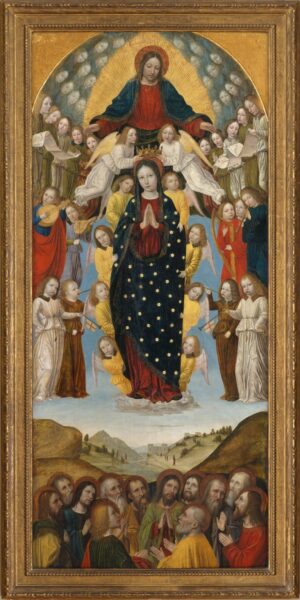
These are three examples of the Church developing her doctrine. That is why today’s feast can be seen not only as the teaching of a truth—that Mary was assumed body and soul into heaven—but also as the embodiment of a truth about what development entails.
More than examples, they are paradigms; that is, examples that serve as normative models. We hear certain clerics speak a great deal about “paradigm shifts” in the Church’s teaching. These people use the term “paradigm” in the sense of the conceptual framework proposed by Thomas Kuhn. When such a paradigm is replaced by another, Kuhn said, there is no continuity between the earlier and the later framework. What Newton meant by “force,” for example, is not the same as what Einstein meant by “force,” even though the words are identical.
Yet the classical and original meaning of a paradigm is an example that serves as a model or rule, as when (perhaps) you learned amo, amas, amat as the paradigm of first-conjugation verbs in Latin. “Want to parse laudamus?” the teacher says: “Look at your paradigm.”
These paradigms of development point to continuity and identity, not to rupture or difference, in the Church’s teaching. They teach that the crucial step in development is not “we used to believe this, but now we believe that,” but rather: “we recognize that we have always believed this.”
To develop, in the first instance, is to define explicitly and precisely what was held implicitly and, to some extent, incipiently. It is to give uniformity to what had remained sketched out and to make binding for all what was previously maintained in the form of a loose “consensus.” In the second instance, it is to understand clearly that a doctrine not yet defined belongs to the same family as those already defined.
In a letter to J. D. Dalgairns dated January 22, 1855, Newman recounts that he received a copy of Pope Pius IX’s Bull on the Immaculate Conception. He quotes the key words in Latin (translated here), underlining some: “We declare, proclaim, and define that the doctrine which holds that the most Blessed Virgin Mary, in the first instant of her conception, by a singular grace and privilege granted by Almighty God, in view of the merits of Jesus Christ the Savior of the human race, was preserved free from all stain of original sin, is a doctrine revealed by God and therefore to be believed firmly and constantly by all the faithful.”
He notes that the words seem to leave open the precise question of how she was so preserved: he does not consider the definition to endorse Scotus’s view that the work of Redemption was applied to Mary retroactively. And then he adds: “It is remarkable that the Bull does not define the doctrine, but defines that it is revealed and therefore of faith.”
That is, all the Pope does is move a truth from the state of “believed” to that of “to be believed.” In various passages he states that, upon reflecting on the matter, he discovers that he has always believed this truth: “It really seems to me inseparable from the doctrine of the Fathers that Mary is the second Eve,” he writes in his Letter to Pusey.
Newman’s problem, then, is to explain why well-intentioned Anglican Christians no longer hold the same. And he finds two reasons.
The first is that they confuse active conception with passive conception: the doctrine does not hold that Anne conceived Mary in such a way that she would not have transmitted original sin to her (active immaculate conception, a heresy), but that original sin would have been transmitted to Mary had there not been a singular grace (passive immaculate conception, the orthodox view).
The second is that they fail to perceive that the doctrine is rooted in a family of truths they already profess: “they regard it as a substantive and independent doctrine more than we do.” And they proceed in this way because they conceive of original sin as an alteration of human nature, so that to affirm that Mary lacked it would be to divinize her. (Letter to Arthur Osborne Alleyne, June 15, 1860).
Newman’s stance regarding papal infallibility was identical. He wrote to a friend, just a few days after the event, that the conciliar definition “expresses what, as an opinion, I have always held along with a multitude of other Catholics.” (Letter to O’Neill Daunt, August 7, 1870).
Pope Pius XII expressed himself in the same way as Newman when defining the Assumption. The Church has received from Christ the mission “to keep pure and entire through the centuries the truths revealed, so as to transmit them without adulteration, without adding anything and without taking anything away.” And he quotes the First Vatican Council: “The Holy Spirit was not promised to the successors of Peter so that they might manifest a new doctrine by his revelation,” but so that the Spirit might assist the Pope in guarding the deposit of faith.
If in a “development” what is defined was already believed, what sense does it make to define it? It serves to manifest a truth more clearly and to protect it against contrary errors. But, perhaps above all, because when we love something ardently, we desire to commit ourselves to it. True lovers do not merely seek to remain in love, but to bind themselves to love one another forever. They desire that ceasing to love become a fault.
That is why Pius XII rejoiced at being able “to adorn the brow of the Virgin Mother of God with so bright a diadem and to leave a testimony more lasting than bronze of our most fervent love toward the Mother of God.”
You may also be interested in: Saint John Paul II, Pope: On the Solemnity of the Assumption Benedict XVI: Why Mary Is Glorified by Her Assumption into Heaven © 2026 The Catholic Thing. All rights reserved. For reproduction rights, write to: info@frinstitute.org The Catholic Thing is a forum for qualified Catholic analysis and reflection. The opinions expressed by the authors are their exclusive responsibility.
About the author
Michael Pakaluk, a specialist in Aristotle and an ordinary member of the Pontifical Academy of St. Thomas Aquinas, is professor of Political Economy at the Busch School of Business at The Catholic University of America. He lives in Hyattsville, Maryland, with his wife Catherine, who is also a professor at the Busch School, and their children. His collection of essays, The Shock of Holiness (Ignatius Press), is now available. His book on Christian friendship, The Company We Keep, has been published by Scepter Press. He contributed to Natural Law: Five Views, published by Zondervan last May, and his most recent book on the Gospel was published by Regnery Gateway in March: Be Good Bankers: The Economic Interpretation of Matthew’s Gospel. You can follow him on Substack at Michael Pakaluk.