


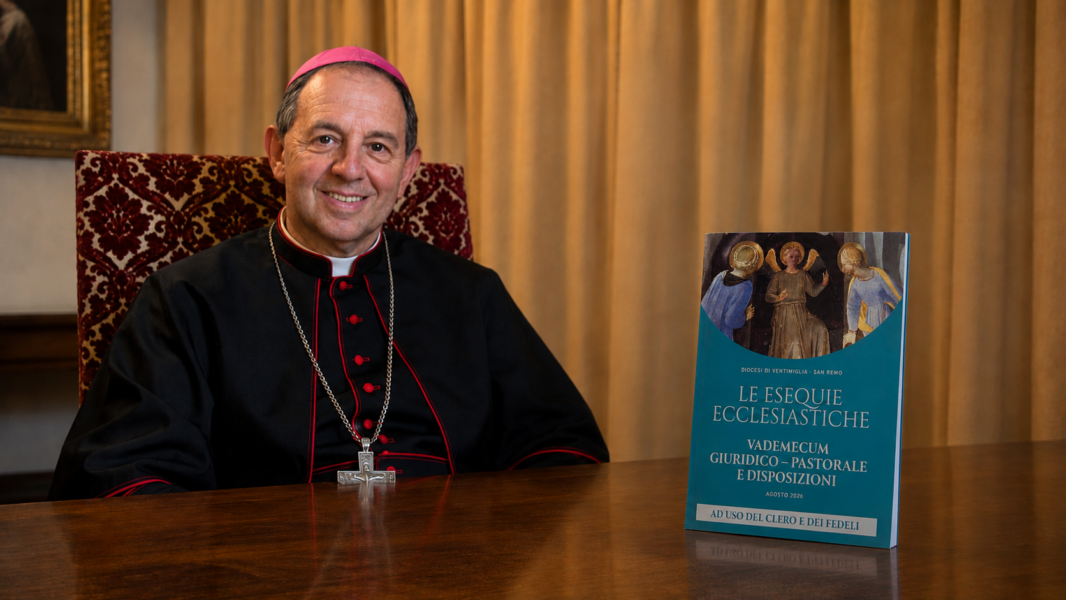
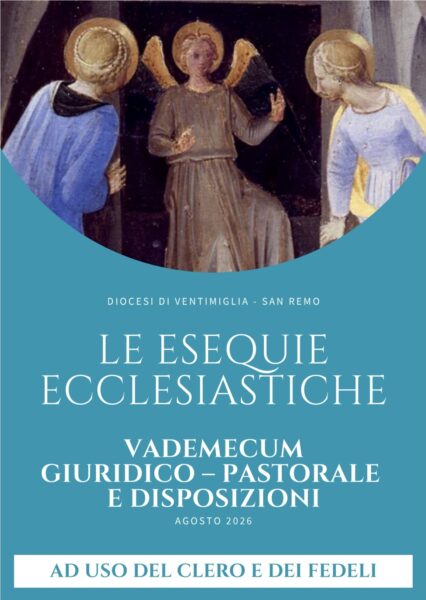
The bishop of Ventimiglia-San Remo, Monsignor Antonio Suetta, has published a juridical-pastoral vademecum to regulate Catholic funerals in his diocese, located in the Italian region of Liguria, near the border with France. The document, signed on August 15, recalls who has the right to receive an ecclesiastical funeral and establishes provisions on the celebration of Mass, funeral eulogies, music, objects placed beside the coffin, cremation, and offerings given on the occasion of funerals.
The publication comes after Suetta prevented the celebration of Catholic funerals for a well-known member of Freemasonry at the beginning of August. After his membership in a lodge became publicly known, the prelate announced the preparation of pastoral and canonical guidelines. The new document devotes an entire section to explaining the incompatibility between the Catholic faith and Freemasonry and its consequences for funerals.
The Catholic funeral is not a tribute to the deceased
The starting point of the document is the supernatural nature of funerals. Suetta recalls, citing canon 1176 of the Code of Canon Law, that through them the Church asks for spiritual help for the deceased, honors their bodies, and offers the living the consolation of hope.
The bishop identifies three main purposes: to pray for the deceased, to honor their body—destined for resurrection—and to bring Christian consolation and hope to those who remain alive. The document further specifies that the spiritual good of the deceased takes precedence over the function of consolation for family and friends.
From this conception, Suetta warns against the “secularization” of funerals and their transformation into acts centered primarily on the memories and emotions of family and friends. The risk, he points out, is replacing the reference to God’s mercy and the last realities—death, judgment, hell, and paradise—with a celebration of the memory of the deceased.
Neither football jerseys nor political symbols
The vademecum specifies this warning in aspects common to funerals. Excessively earthly references to the musical, sporting, or political interests of the deceased, Suetta notes, can distort the meaning of spiritual accompaniment.
For this reason, he considers it inappropriate to use decorations or garments with the colors of the deceased’s football team, a political party, or certain opinion movements. The document distinguishes these elements from professional or institutional references, which may soberly express recognition of the role played by the deceased person.
The final provisions also establish that objects foreign to the celebration and the spirit of Christian funerals should not be brought into the church or placed around the coffin. During the rite, recorded texts or images should not be used, nor should songs or music foreign to the liturgy be performed.
Limits on eulogies and speeches by family members
Suetta pays special attention to the interventions of family and friends. The document notes that these remembrances can be excessively long, numerous, or emotional and occur at inappropriate moments during the celebration. It also rejects the use of the ambo for such speeches.
The diocesan provisions do not authorize farewell interventions during the rite. Exceptionally, the parish priest or rector may allow a few brief words at the end of the celebration, provided that a written text has been prepared in advance and approved. Even in that case, the ambo may not be used.
The ordinary indication is to arrange with the family a time outside the church or at the cemetery for farewell speeches.
Suetta reaffirms that Freemasons may be deprived of funerals
A substantial part of the document is devoted to determining who has the right to receive funerals. The bishop reproduces canon 1184, which contemplates their denial, when there is no sign of repentance before death, to notorious apostates, heretics, and schismatics; to those who have chosen cremation for reasons contrary to the Christian faith; and to other manifest sinners when it is not possible to grant funerals without public scandal.
In developing the last case, the vademecum expressly mentions deliberate membership in Masonic associations. Suetta recalls that a sign of repentance before death is sufficient to presume the desire to abandon the state of manifest grave sin. He also specifies that the deprivation of funerals does not constitute a judgment on the eternal destiny of the deceased.
The bishop subsequently devotes an entire chapter to Freemasonry. There he reproduces the 1983 declaration of the Congregation for the Doctrine of the Faith, approved by Saint John Paul II, according to which the Church’s negative judgment remains unchanged because the principles of Masonic associations are incompatible with Catholic doctrine. Catholics who belong to them, the text recalls, “are in a state of grave sin and cannot receive Holy Communion.”
Suetta also includes the response of the Dicastery for the Doctrine of the Faith of November 2023, approved by Francis, which once again confirmed the prohibition. Based on these provisions, he concludes that a person whose membership in Freemasonry is notorious and who has not withdrawn from it or expressed repentance must be denied ecclesiastical funerals in accordance with canon 1184.
Nor the blessing of the body
The document goes a step further and addresses what happens when a person cannot receive ecclesiastical funerals. Suetta maintains that the blessing of the deceased is also not appropriate when the person has died in the situation that determines exclusion from the Catholic funeral.
The vademecum argues that proceeding otherwise would contradict the meaning of the blessing itself and would risk reducing it to a mere external formality or, in the words of the document, assimilating it to a “magical action.”
A Mass does not always have to be celebrated
Another aspect addressed is the common identification between a Catholic funeral and a funeral Mass. Although the funeral is normally celebrated within the Mass, Suetta recalls that certain circumstances may make it advisable to dispense with the Eucharistic celebration and hold only a Liturgy of the Word.
Among the reasons he points out is the risk that people who do not meet the required conditions may receive Communion during a funeral. The document therefore reminds priests of the advisability of explaining the conditions for licitly receiving the Eucharist: state of grace, Eucharistic fast, and proper awareness of what is received.
The provisions establish that, when it is considered appropriate or necessary to omit the Mass and celebrate the funeral through a Liturgy of the Word, the parish priest must consult the bishop and follow his instructions.
The Church prefers burial to cremation
Suetta also addresses cremation. The document recalls that the Church permits it provided it has not been chosen for reasons contrary to Christian doctrine, but maintains the recommendation to preserve “the pious custom of burying the bodies of the deceased.”
It also reaffirms the prohibition on scattering ashes in the air, earth, or water and converting them into commemorative objects or pieces of jewelry.
The diocesan provisions also indicate that, as a rule, funerals should be celebrated before cremation. If, exceptionally, cremation has already taken place and the family requests the funeral with the urn present, the priest must consult the bishop.
Funeral homes may not charge on behalf of the Church
The vademecum concludes by regulating a practical matter related to funeral companies. The diocese warns that these companies are not authorized to request, on behalf of the Church, any offering or to set an amount for the liturgical service.
The contribution made on the occasion of a funeral must be a free act of the faithful according to their means and given directly to the parish priest, who may specify whether it is intended for the needs of the parish, the church, the celebrating priest, or works of charity.
The document, dated in San Remo on August 15, the solemnity of the Assumption of the Virgin Mary, is signed by Monsignor Antonio Suetta himself and is expressly addressed to the clergy and faithful of the diocese.