


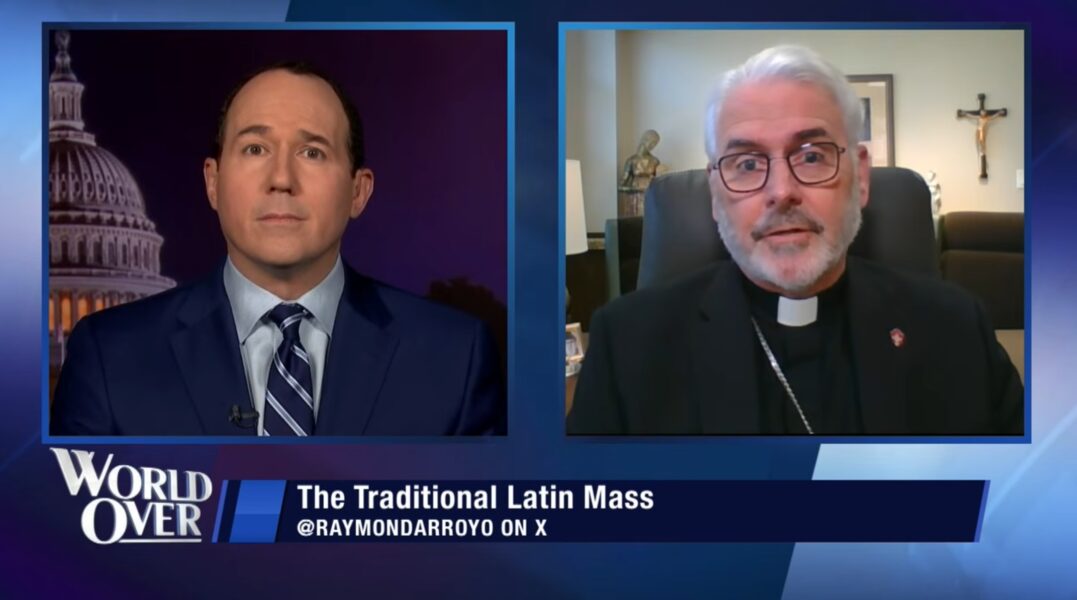
Archbishop Paul Coakley, Archbishop of Oklahoma City and president of the United States Conference of Catholic Bishops, has said on television what a good part of the American episcopate thinks in private: that the question of the traditional Mass remains open and that Leo XIV has not yet spoken his word. The statement, apparently prudent, is in reality of remarkable eloquence: the president of the largest episcopal conference in the Western world publicly admits that he expects—and perhaps desires—a papal pronouncement that would modify the current regime.
In an interview granted on August 13 to Raymond Arroyo on The World Over (EWTN), Archbishop Coakley addressed without hesitation the situation of the faithful attached to the traditional liturgy. “It is a dilemma that many people attached to the traditional Latin Mass are facing,” he acknowledged. And then he uttered the phrase that has circulated through American Catholic circles: “I’m not sure we’ve heard the last word of this pontificate on Traditionis custodes.”
The nuance he added immediately afterward is even more significant: “Cardinal Roche has spoken, but until Leo XIV speaks, I’m not sure we’ll know with certainty what the path forward will be.” The distinction is not innocent. Coakley carefully separates the voice of the prefect of the Dicastery for Divine Worship—the architect of the most restrictive application of Pope Francis’s motu proprio—from the voice of the Pope, who has so far remained silent on the matter. When the president of an episcopal conference says that what Roche has said does not settle the issue, he is saying that the final authority remains vacant. And that it is expected to speak.
The bishops are deliberating, and some are already moving
Coakley also confirmed that the matter is being discussed among the bishops themselves: “I think the bishops are going to be discussing this among themselves and within their own dioceses.” There will not be, he said, a single American policy imposed from above, but rather a diocesan discernment. In other words: the American episcopate does not consider the matter closed.
And he cited, as an example, what happened that same week in Texas, where a diocese has relaxed restrictions to make the traditional Mass more accessible. Although the archbishop did not identify it, the Diocese of San Angelo has just announced an expansion of the provision of the ancient rite. The movement is not isolated: it comes as several American bishops test the limits of the margin that the new pontificate, with its silence, seems to be granting.
Asked by Arroyo whether the restrictions might be stifling a real evangelizing force—the interviewer specifically cited Archbishop Salvatore Cordileone of San Francisco, who has openly questioned whether Traditionis custodes can be sustained in light of the number of young people and young families drawn to the traditional liturgy—Coakley did not deny it: “Yes, it could be.”
Cordileone, again
The mention of Cordileone is not coincidental, and the events of these hours underscore it. The Archbishop of San Francisco shared on his social media yesterday the proposal that the Abbot of Solesmes made public last March for liturgical pacification. That one of the most prominent American prelates in defense of the traditional liturgy—promoter of the Benedict XVI Institute and a regular celebrant of pontificals in the ancient rite—now revives that proposal, in the same week that the president of the USCCB declares that Leo XIV has not yet spoken, outlines a coordinated movement or, at the very least, a convergence of expectations that no one bothers to disguise anymore.
Because that is the truly newsworthy aspect of all this: the expectation itself. Five years after Traditionis custodes, the document has pacified nothing. The bishops who applied it rigorously find themselves with wounded communities; those who sought formulas for survival look to Rome expecting cover; and the president of the most influential episcopal conference in the world acknowledges in prime time that the matter remains pending the Pope’s word. A liturgical regime that needs to be confirmed at each pontificate is not a settled regime: it is a prolonged state of exception, and everyone—beginning with those who must apply it—knows it.
Who Coakley is and why it matters that he says it
Paul Stagg Coakley, 71, has governed the Archdiocese of Oklahoma City since 2011 and was elected president of the United States Conference of Catholic Bishops at the plenary assembly of November 2025. He is not a trench bishop on liturgical matters: his profile is that of a doctrinally solid pastor with measured manners, known for episodes such as his public response to the “black Mass” that a satanic group attempted to celebrate in Oklahoma City in 2014—opposed by a massive hour of reparation—by the construction of the shrine of Blessed Stanley Rother, the first martyr born in the United States, and by his opposition to the death penalty in his state.
His trajectory with the traditional Mass is revealing of the position of the average American bishop. When Francis promulgated Traditionis custodes in 2021, Coakley did not carry out a suppression: he granted temporary permissions so that competent priests could continue the already scheduled celebrations while the new norms were studied. In other words, he applied the motu proprio with the least possible harm to the faithful.
In a pastoral letter dated August 6—following the episcopal consecrations in Écône on July 1 and the declaration of schism by the Dicastery for the Doctrine of the Faith—Coakley addressed the situation of the chapel maintained by the FSSPX in Bethany, within his archdiocese. The letter describes the consecrations as a “grave wound to ecclesial communion” and warns that, according to the Holy See, the confessions and marriages of the Fraternity’s priests are now considered invalid. Those seeking the traditional Mass in full communion are directed to St. Damien of Molokai Parish in Edmond, served by the Priestly Fraternity of St. Peter.