



On Mile End Road, opposite the London Hospital, there was… an empty greengrocer’s shop for rent. The entire storefront, except for the door, was hidden by a canvas hung with an announcement that inside one could see the Elephant Man… – from The Elephant Man and Other Reminiscences by Frederick Treves (1923)
I am not concerned here with moral questions, such as the beauty of virtues: of love or of honor. This is about the human experience of physical objects and sensory impressions: of faces and bodies; of art and music; and of tastes and smells. And about the sensory differences between the beautiful and the ugly.
My first observation is that the perfect is the enemy of the good. That phrase was popularized by Voltaire, who took it from an earlier Italian source of the seventeenth century, Il meglio è l’inimico del bene, which is more plausible: “The best is the enemy of the good.” Better, because perfection exists only in God.
Saint Augustine saw beauty as the materialization of the good. On the sixth day of Creation, “God saw all that he had made, and it was very good.” Saint Thomas Aquinas agreed with Saint Augustine and, especially, with Aristotle in conceiving beauty as integritas (integrity), consonantia (harmony), claritas (radiance). For me, however, integritas, which is also understood as “perfection,” is problematic.
Many still accept that formula. I do not, but not because I deny the classical conception. I believe that proportion, radiance, balance, etc.—all this passion for symmetry and order—is fine, because when one sees that in a face, for example, one viscerally recognizes beauty. Or ugliness when those qualities are lacking. I will take this to a personal level.
This holds true whether we contemplate a beautiful human face or an ugly skyscraper.
I live just north of the borough of Manhattan, in New York City, which has been (and seems always to be) experiencing a construction boom, and some of the new buildings are not beautiful and suggest a revival of brutalist architecture. Manhattan embraces ugliness in part because buildings must be tall and straight to house the millions of people who live and work there. Much of Washington, D.C. and Paris, France, remain beautiful because laws protect their predominantly horizontal skylines, despite the Washington Monument and the Eiffel Tower. And they are the only exceptions.
Speaking of height and straightness in New York City, consider 111 West 57th Street. It falls just 90 meters short of being as tall as One World Trade Center (1WTC) in lower Manhattan, which is the tallest building in the Western Hemisphere. My friend George Marlin, former executive director of the Port Authority of New York and New Jersey a few years before the September 11 attacks, told me that in his office, high up in the North Tower, one could feel the building sway in strong winds.
Imagine what it is like at 111 West 57th, where the width-to-height ratio is 1:24. The old North Tower was 1:6.5, and the current 1WTC is 1:8.88. 111 West 57th is ugly and terrifying.

There is a Japanese concept that is interesting in this regard: Wabi-sabi. The etymology of Wabi is rooted in the rustic simplicity of a life lived close to nature, through the observation of simple things: a smooth stone worn by time, though irregular in shape, shining in the rippling water of a stream. It is “the serene and discreet beauty found in humble and irregular things.”
Sabi is “the beauty and serenity that come with age, wear, and weathering,” as in the face of an elderly woman, whose white hair and lines of expression make her even more attractive.

It should be noted that art does not need to be beautiful. Just as there is ugliness in the world, there will be ugliness in art, and that is far from a profound statement; it is simply a fact.
Yes, but sin is ugly because it distorts beauty and, therefore, ugliness is everywhere, which is why certain modern art celebrates the ugly.
Classically, ugliness was also defined as the privation of beauty, but that seems to me a short-sighted view.
I began with the quotation from Treves’s book about Joseph Carey Merrick, the “Elephant Man.” Mr. Merrick suffered primarily from Proteus syndrome, a genetic disorder that left his head and body severely deformed. His story was poignantly told in the 1980 David Lynch film, with Anthony Hopkins as Dr. Treves and John Hurt as Mr. Merrick.
Is there beauty in heartbreaking pain? Perhaps, because there compassion is found.
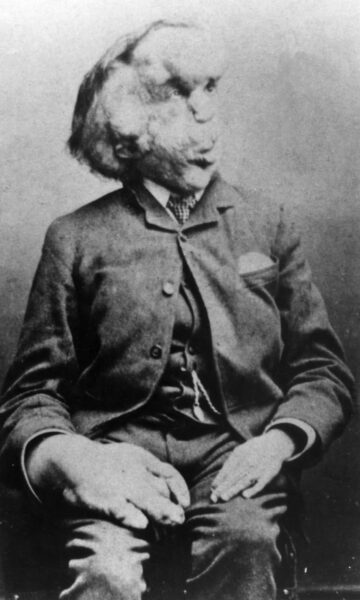
Note that I am not among those who stubbornly insist that everyone is beautiful. If everyone is beautiful, no one is. And human beings have an innate repulsion toward the ugly: images, sounds, and smells. In certain situations I cannot help but look away, cover my ears, or hold my nose. Such reactions are organic, immediate, and universal. There is even a science of ugliness, and it has discovered that repulsion, such as one might feel in the presence of Mr. Merrick, is not necessarily a moral verdict issued by looking away; it is more like a reflex such as blinking. In essence, it is fear of contamination. The problem, which has manifested horribly in recent history, arises when the reflex hijacks moral judgment and leads to the search for scapegoats.
Dr. Treves noted that the Elephant Man’s left hand was well formed. It was “a beautiful hand that any woman might have envied,” and Merrick was very proud of it. Love rearranges what the eye does with what it (love) sees, and does not require the eye to lie.
Near the end of his book, Treves writes:
[Merrick], no doubt, imagined himself as the hero of more than one passionate episode. His bodily deformity had not dulled the instincts and feelings proper to his years. He was affectionate. He would have liked to be a lover, to have walked with his beloved under the languid shadows of some beautiful garden and to have poured into her ear all the ardent expressions he had rehearsed in his heart.
And there lies the hidden beauty in ugliness.
Brad Miner, husband and father, is senior editor of The Catholic Thing and a senior fellow at the Faith & Reason Institute. He was literary editor of National Review and had a long career in the book publishing industry. His most recent book is Sons of St. Patrick, written with George J. Marlin. His best-seller The Compleat Gentleman is now available in a third revised edition and also as an audiobook on Audible (read by Bob Souer). Mr. Miner has served on the board of directors of Aid to the Church In Need USA and also on the Selective Service System recruitment board in Westchester County, New York.