


By Robert Royal
I have been in Central Europe for the past few weeks for two educational projects: one that will celebrate its twenty-fifth anniversary in 2027 and another that is just beginning. Both, though I left Washington thinking I was too tired to continue and that I really should take a vacation, gave me—put simply but truthfully—hope.
I have been teaching and directing the Slovak Summer Seminar on the Free Society for about twenty years. My friend Michael Novak founded it and entrusted it to me when his health problems began to make the work difficult for him. We both share family ties with Slovakia, and the purpose of the project from the beginning was, after the fall of communism, to help form students from Central and Eastern Europe—as well as American students who make up half of each course—in the ideas necessary to preserve a free political, economic, and moral/cultural order: the threefold division of Novak’s classic, The Spirit of Democratic Capitalism.
A quarter of a century later, with the strange rise of the Democratic Socialists of America and similar aberrations in the comfortable but precarious societies of Western Europe, the need is, if anything, of renewed urgency. It may seem discouraging in the face of increasing partisan polarization throughout the West, but in such circumstances we must bet on the long term: continue reminding people that the founding principles closely tied to the Judeo-Christian tradition are the only thing that truly underpins our freedom and our dignity. Not charismatic politicians, not political parties, not even sheer military power.
And sometimes the long term—as happened with St. John Paul II, with the help of Ronald Reagan and Margaret Thatcher—can turn into the short term and bring about the sudden fall of powerful tyrannies, like the end of the Soviet Union, something that no one, humanly speaking, could have predicted.
The great Czech writer and dissident Václav Havel—later president of the Czechs after communism—wrote a frequently cited article on “The Power of the Powerless.” But that article could also be refocused to affirm that, in the long run, in the face of the power of truth, power itself is powerless. This was demonstrated in the failure of Soviet power when confronted with moral and physical virtue during the Cold War.
Our former European students have gone on to hold positions of great influence in the European Union and in national governments, in business and journalism, and have even founded their own educational initiatives. And Americans usually leave with a much richer understanding of the history of our Western nations and—with my greatest hope—a deep sense of friendship with their classmates from Slovakia, Poland, Ukraine, Croatia, Portugal, Ireland, Italy, England, Canada, Australia, Latin America, and even places as distant as the Philippines.
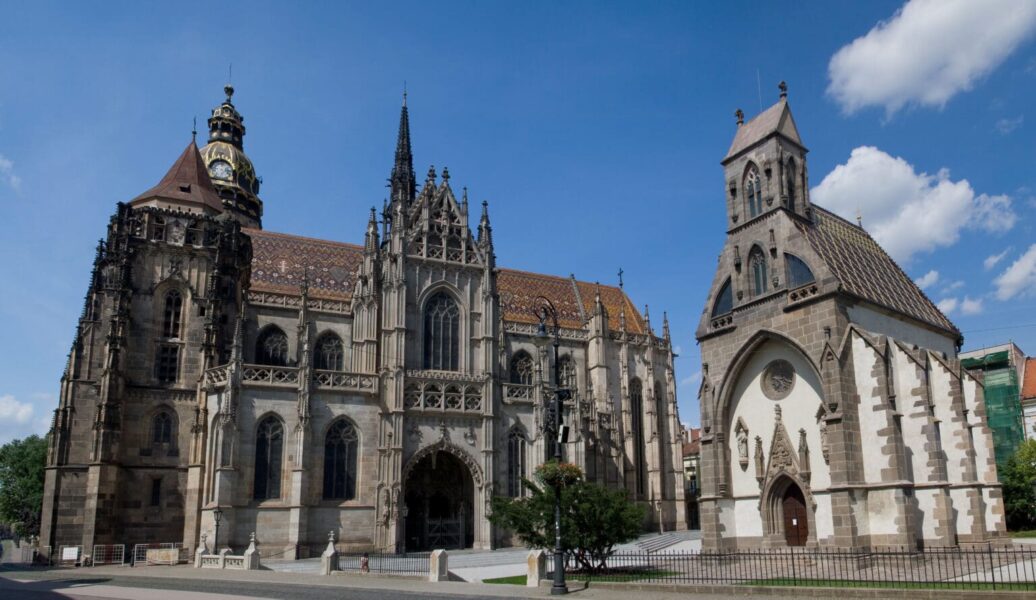
And this year we are venturing into something completely new that also has certain resonances even for people in the United States. We added a new program to the previous one, which we have called Enrichment Days, in the eastern Slovak city of Košice, not far from the confluence point between Slovakia, Ukraine, and Hungary, with the hope of exploring how Eastern and Western Catholics might enrich one another.
Several highly interesting topics emerged. We organized this in cooperation with the Greek Catholic archbishop of Košice. Greek Catholicism is faithful to Rome, in union with the Pope, but possesses its own beautiful and solid Eastern traditions of liturgy, prayer, and spirituality.
Its “Mass,” for example, is similar to the liturgy of St. John Chrysostom, like the Orthodox, but is sung in the vernacular: in Slovak, as well as in Ukrainian and Hungarian Greek Catholic parishes that celebrate the Catholic liturgy in their own languages. It is worth noting that there is none of the bitterness surrounding the celebration of the Old Rite versus the New, or about the use of Old Church Slavonic versus the vernacular, as we currently see in the Latin Church regarding the Traditional Latin Mass.
And what a liturgy! If you have ever attended a Greek Catholic or Byzantine Mass, you will know that—setting aside the language—it never fails to introduce one to a depth and a sense of the sacred that many find lacking in some of the ways the Novus Ordo Mass is celebrated.
Its repetitions and its insistence on supplicating the Almighty and imploring His mercy project a kind of holy charm. (It must be said that it also gives the impression that the structure of that liturgy reflected the concern that God might not hear us unless we say everything at least three times, or that He might have forgotten after a few minutes exactly what had already been said). But one does not perceive these repetitions as superfluous, but rather as part of a continuous deepening.
Kyle Washut, president of Wyoming Catholic College and a deacon of the Greek Catholic Church, gave an enlightening lecture on how that liturgy introduces the believer into a sacred space and then returns him to the more “secular” world filled with graces so necessary. I hope he develops these concepts in an accessible book.
As we all remember, St. John Paul II spoke, with good reason, of the need for the Church to breathe with both lungs, East and West. And Pope Leo has reiterated that call, emphasizing that the richness of Eastern liturgy and spirituality, in its differences from our Western traditions, can enrich us all. Our Western forms with their linear logic have their value, but why ignore what much more there might be there?
Our colleague Dominic Cassella, who will soon complete his doctorate in historical theology at The Catholic University of America, spoke to the group about theosis, a concept emphasized more in the East than in the West lately (although we are beginning to catch up).
In brief terms, it is about how we become “like God,” that is, as we were originally created in His image and likeness before the Fall. I consider that notion superior to that of dignitas, which is used so much in Rome these days. Human “dignity” lends itself to endless abuses, from radical individualism to “death with dignity,” that is, euthanasia. Theosis must avoid pantheism and a kind of polytheism (all of us as “gods”). Personally, at least it keeps the focus on God and on something that transcends our place in this world.
But perhaps we need both ideas, united again, in the face of everything we confront.
When one spends so much time outside the country on projects of this kind, one tends to follow the news less. Upon returning, one finds that much of what caused daily concern before leaving has not changed much. Russia still seems unable to defeat Ukraine. The United States has dealt Iran a heavy blow, but not a knockout. The midterm elections are approaching with candidates who seem increasingly senseless. There is no salvation in that.
Power has its place and its functions, certainly, but it is quite powerless over the things that are necessary. For that, something very different is required.
I always tell team members and my colleagues that we must always be thinking about finding the “new things” necessary to respond to the new realities we face. This summer we took several steps forward in that direction. And I hope to continue on both fronts in the years to come if—God willing—we manage to gather the moral and material means that are essential.
About the author:
Robert Royal is editor-in-chief of The Catholic Thing and president of the Faith & Reason Institute in Washington, D.C. His most recent books are The Martyrs of the New Millennium: The Global Persecution of Christians in the Twenty-First Century, Columbus and the Crisis of the West and A Deeper Vision: The Catholic Intellectual Tradition in the Twentieth Century.