


By K.E. Colombini
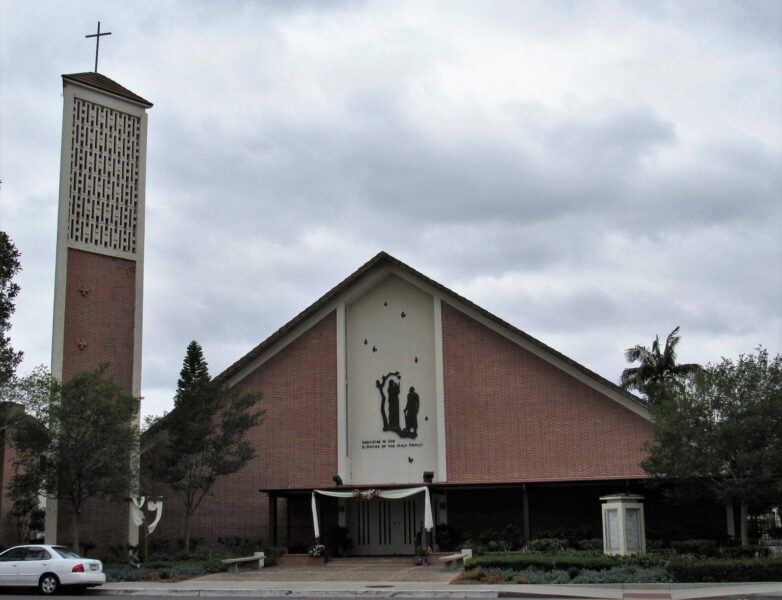
On a trip back to my home in Southern California, I had the opportunity to visit the church of my baptism, my “mother church,” as they often say. When I became Catholic at the age of twelve, in April 1976, Holy Family, in the city of Orange, had just become the cathedral of the new diocese south of Los Angeles the previous month. It didn’t seem to have changed much after nearly half a century; however, the evolution of the cathedral for the Diocese of Orange in the intervening years is itself an interesting story.
There was nothing spectacular about Holy Family, which was built in the late 1950s, and I don’t know why it was chosen as the first cathedral of the diocese. In the early 2000s, there was an attempt by the bishop at the time to build a new and larger cathedral in Santa Ana. The ambition of a worthy seat for his diocese came with a price tag of $200 million, but the timing was unfortunate, as the Church’s sexual abuse scandal was hitting the diocese hard in those days.
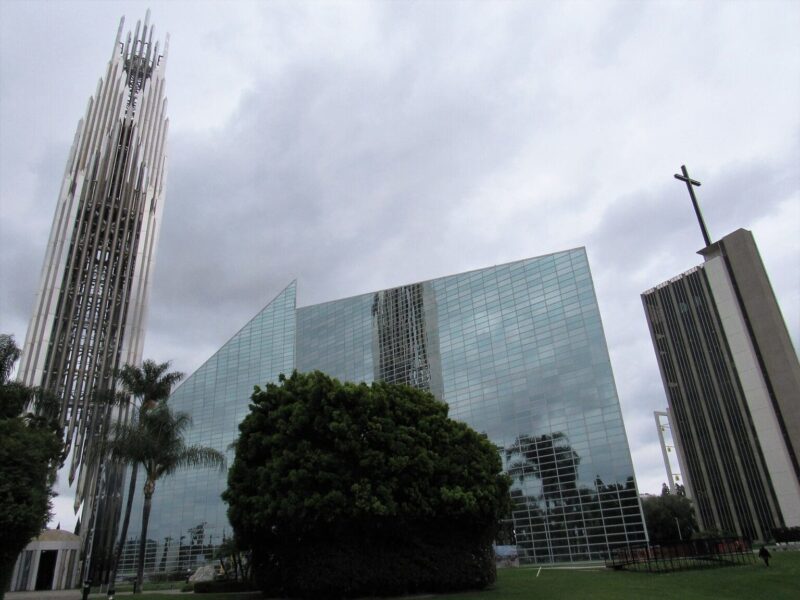
Another opportunity arose in 2010 when the Crystal Cathedral Ministries, founded by televangelist Robert Schuller, declared bankruptcy. The Diocese of Orange acquired the following year the modern Crystal Cathedral complex, designed by Philip Johnson, and after extensive renovations, the newly christened Christ Cathedral was inaugurated in 2019.
Sitting on a pew at Holy Family, now once again a humble parish church, I felt grateful for it and for what it meant and still means to me. Married and with a growing family, I moved from Orange County to Sacramento in October 1990. I will not forget Holy Family, even though I had not been there in decades.
During the 1990s, I worked in downtown Sacramento, where the Cathedral of the Blessed Sacrament, built in 1889, is located a stone’s throw from the State Capitol, City Hall, and the heart of the city. It was a frequent refuge for me, with daily noon Masses that drew a large crowd of office workers.
In those days, Bishop Francis Quinn lived in the rectory adjacent to the cathedral, and I have always thought that is a much better arrangement than, say, a house in the suburbs. A bishop should have a firm presence at his cathedral, just as Quinn admirably demonstrated when, in April 1993, an armed man killed two workers in the downtown library, a few blocks from the cathedral, before being shot by police.
Quinn was quickly there to administer the last rites himself and comfort those present at the scene, and an image of him doing so occupied several columns on the front page of the Sacramento Bee the following day. This is the kind of pastoral visibility that is important for the Church and that we rarely see in our prelates.
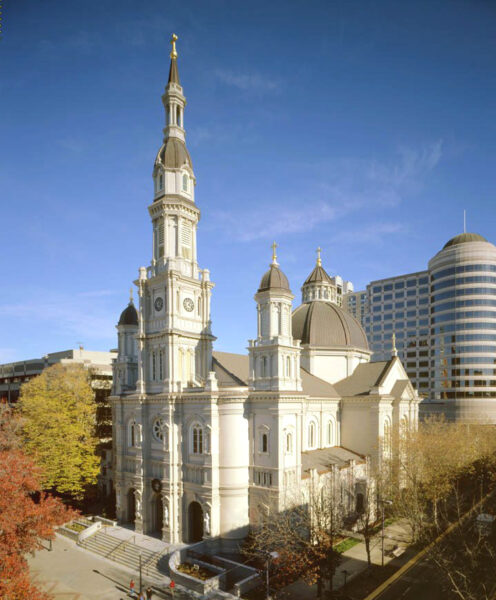
Under Quinn’s successor, William Weigand, a comprehensive renovation of the Blessed Sacrament was completed in 2005 at a cost of $34 million. From an aesthetic standpoint alone—and setting aside the necessary repairs—it was sorely needed; the interior could be dark and gloomy. This project opened it up and created a beautiful, light-filled space, as well as a sanctuary worthy of a cathedral, especially in a capital city.
When one first sees the Cathedral Basilica of St. Louis, it is easy to be impressed by the majesty of its Romanesque style, with a dome forty-five meters high that fittingly attests to the importance of a city that was once the fourth largest in the nation. What is hard to believe is that it is only half the size originally planned.
In the late nineteenth century, the Archbishop of St. Louis, John Kain, acquired land for the cathedral, but efforts were halted by a tornado in 1896 that killed more than 250 people. Funds intended for the cathedral were redirected to tornado relief, and construction plans were delayed and scaled back.
After the success of the 1904 World’s Fair, the project resumed and construction was completed in 1914. The interior mosaics of the cathedral, one of the largest collections in the world, were not finished until 1988.
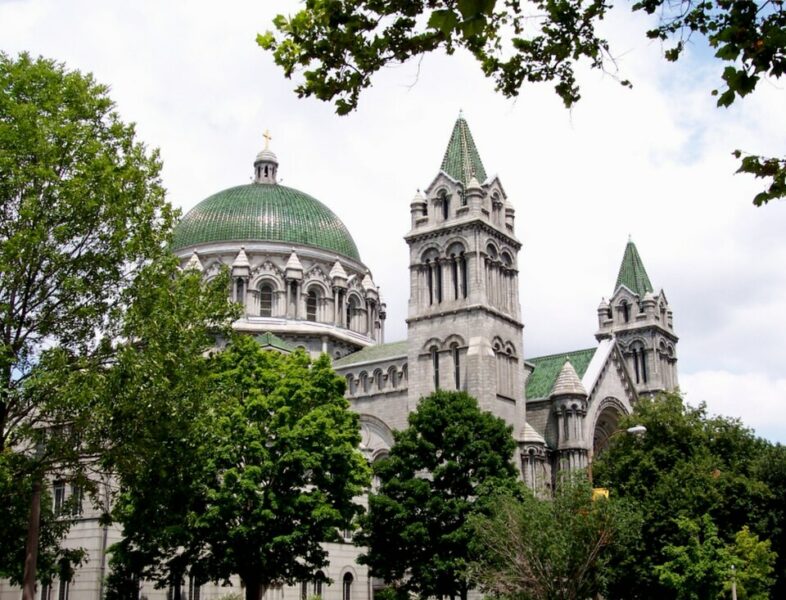
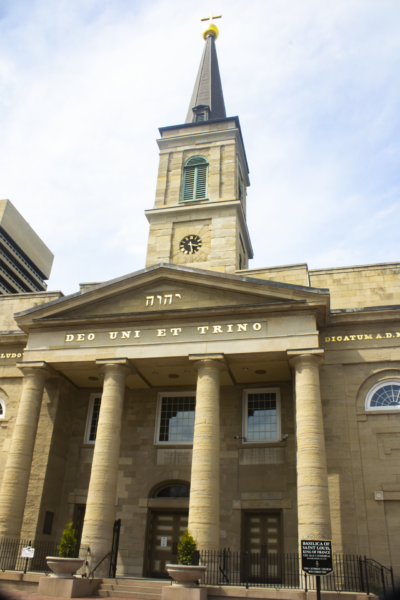
Our cathedral basilica may be more than a century old, but in St. Louis we refer to it as the “New Cathedral.” The “Old Cathedral” is now the Basilica of St. Louis, King of France, which stands near the Gateway Arch. It was the first cathedral built (1834) west of the Mississippi.
I have come to love both churches during a quarter-century of residence in St. Louis. Our cathedrals, old or new, are not meant only for the Catholics of the community, but for all the people, as a place of gathering, whether in mourning or in celebration, just as our New Cathedral does with a popular concert series. Our cathedrals must remain open and welcoming to the community, drawing people into their embrace and giving everyone the opportunity to enjoy the beauty and inspiration that only they can offer.
As the seat of local religious authority and as a church that aspires to excellence, there is—or at least there should be—something special about a cathedral. The Catholic Encyclopedia puts it this way: “Canonists compare the union of a bishop with his church to a spiritual marriage, and although this expression is truer of the Church understood in a moral sense than of the cathedral, it is nonetheless fitting. They say that the bishop must love his cathedral, adorn it, beautify it, and never neglect it.”
Therefore, one might expect cathedrals, as stone symbols of ecclesiastical authority and permanence, to be stable and unchanging. Yet in my experience as a Catholic across the country, I have found something different. Cathedrals remain earthly things and, therefore, are in a necessary state of change. Fortunately, in an era when so many churches have suffered deplorable renovations, it also happens, and not infrequently, that change can be for the better.
About the Author
K.E. Colombini writes from St. Louis, Missouri. He has published in The National Catholic Register, Homiletic & Pastoral Review, First Things, The Front Porch Republic, The American Conservative, among other outlets.