


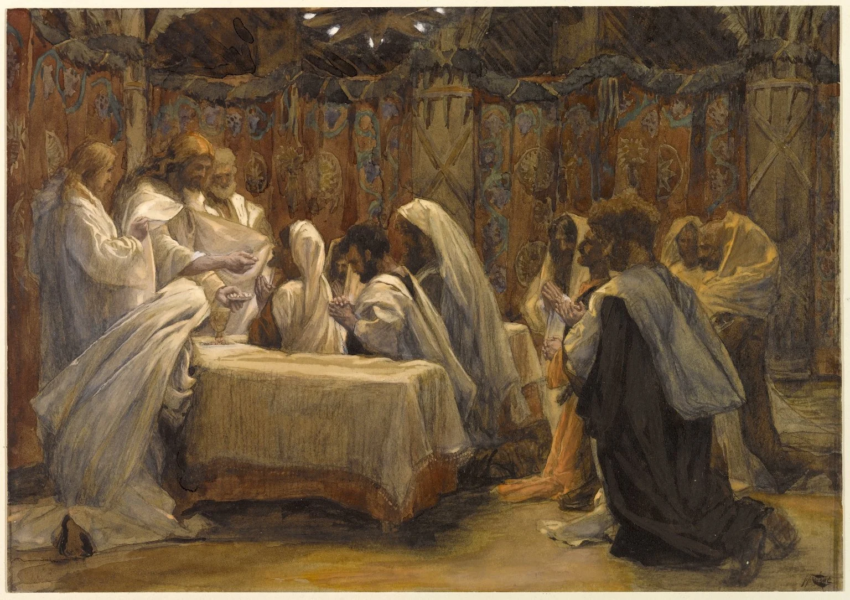
Reflecting on the “evolution” of eucharistic reverence, Pope Benedict XVI observed:
Here too we know that until the ninth century Communion was received in the hand, standing. Naturally, that does not mean that it must always be so. For what is beautiful and sublime about the Church is that she grows, matures, and understands the mystery more deeply. In that sense, the new development that began after the ninth century is fully justified, as an expression of reverence, and has a solid foundation. But, on the other hand, we must say that the Church could not have been celebrating the Eucharist unworthily for nine hundred years. [1]
This quotation encapsulates the fundamental theoretical questions surrounding the practice of Communion in the hand—precisely the issues this article addresses, among which the most important question is: do we really know this as a fact? Did Communion on the tongue really not exist until the ninth century? Was its appearance simply the result of a new development, while the usual norm throughout the Church had been that the lay faithful received the Most Holy Sacrament in their hands?
I doubt that this was really the case, for two main reasons.
The first reason, the true argument, is one that defenders of Communion in the hand generally fail to grasp. For they implicitly or explicitly assume that the unfolding of the essence of the Church’s doctrine, and therefore the understanding of the true nature of the Holy Sacrifice of the Mass, required time for a certain “development” during which entirely new elements appeared. In reality, they do not believe that the Church understood the meaning of the Eucharistic Sacrifice and of the Most Holy Sacrament from the very first moment, nor that she acted accordingly from the beginning.
Yet, since the Apostles understood the Mass from the first day, they understood it exactly in the sense in which the Church would later teach about it. They also understood the priesthood itself. Consequently, from the very dawn of the Church there existed a distinction between the ordained and the laity, not only in the administration of the sacraments in general, but also in matters concerning the Most Holy, that is, in the handling of the Most Holy Sacrament. Therefore, I doubt that the touching of the Most Holy Sacrament by unordained faithful could ever have been the norm, rather than a deviation from it; in other words, an ordinary, legally permitted practice.
According to the current scholarly consensus, the section of the Liber Pontificalis that attributes to Pope Sixtus I the prohibition against the laity touching the sacred vessels is a sixth-century compilation, dated around the year 530. Even if this were true, the fact that such a decree could be compiled around 530 from earlier texts—and, moreover, that it enjoyed authority—demonstrates in itself that a widespread and normative practice of Communion in the hand is impossible. A regulation that directly contradicted theological and liturgical evidence and practice could never have arisen in the very heart of Holy Mother Church.
Furthermore, if in the first half of the sixth century a pope, or a decree issued under papal authority, forbade the laity even to touch the sacred vessels, to what extent is it reasonable to suppose that the same prohibition did not apply to the contents of those vessels? Why would anyone consider the vessels holier than what they contained? This becomes especially clear in light of the beautiful and eloquent reasoning the author of the decree added:
It has been decreed by us, the other bishops, and the rest of the priests of the Lord, that the sacred vessels are not to be touched by anyone except by men consecrated and dedicated to the Lord. For it is most unseemly that the sacred vessels of the Lord, whatever they may be, should serve for human use and be handled by anyone other than men who serve the Lord and are consecrated to Him; lest the Lord, offended by such audacities, strike His people with a plague. [2]
And how far we still are, at this point, from the ninth century, when the “novelty” of Communion on the tongue supposedly appeared!
The second reason that exposes the flaw in the narrative of a normative and universally permitted Communion in the hand is the striking scarcity of sources that support it. I call it striking because, owing to the enormous volume of repetitive arguments used by the defenders of this narrative, the sheer quantity of their supposed clear patristic references may seem convincing. Yet that illusion lasts only until one takes the trouble to verify the citations. It then becomes clear that those citations do not say what is claimed and fail to substantiate their vehement assertions. Despite the idea that took hold from the rise of Humanism and the Reformation, we possess only a few sources—doubtful either in authorship or in meaning—that show the Church allowed the Most Holy Sacrament to be taken home exclusively in times of emergency. And yet, contrary to the presuppositions of this narrative, even those sources do not testify that the laity actually touched the Most Holy Sacrament with their hands.
When examining the patristic citations used to support the narrative of Communion in the hand, we find several highly characteristic errors.
The first is that the writings supporting this narrative are all based on citations copied from one another. As a rule, these citations lack a broader context; the only thing that unites them in an argumentative chain is a shared presupposition.
The second error also stems from the lack of context, but represents a very specific case: patristic citations are presented to justify Communion in the hand without considering whether the text in question refers to an ordained priest, a bishop, or perhaps a layperson. Since this fundamental distinction is never addressed explicitly in their works, I am inclined to regard it not as a mere accidental omission, but rather as a deliberate distortion. It is through this distortion that authors such as St. Augustine (Contra litteras Petiliani), Peter Chrysologus (Sermon XXXIII), or various Ordines Romani are cited either as authors or as examples supposedly demonstrating Communion in the hand. These distortions become even more evident when the context is deliberately removed, as when Dom Ambroise Verheul used ellipses to suppress references to the priesthood in his article “La communion dans la main,” citing a work of Tertullian in order to create the false impression that the passage applied to the lay faithful (in Les Questions Liturgiques et Paroissiales 2: 115-22).
The enormous volume of repetitive and disordered arguments constitutes a problem in itself. Guided by a preference for quantity over relevance, the text accumulates disconnected and decontextualized citations. Its defenders view—and try to make others view—every citation containing the words hands, communion, or receive (accipere, ὑποδέχομαι) through the prism of their preconceived ideas about Communion in the hand. One reason is ignorance of the ancient rite of Communion; the other, a misunderstanding of the true meaning of those terms.
The ignorance concerning the role of the hands constitutes an especially characteristic error. In these works one never finds an explanation of why in antiquity the hands could be called “adorers,” of how one can adore with the hands, simply because the authors themselves do not understand the true symbolism of the extended hands.
This lack of familiarity with the symbolic meaning is also evident in their interpretation of various patristic sermons. They present citations from the Fathers of the Church as proof of Communion in the hand that merely demonstrate the inability—or unwillingness—of the compilers of citations to understand the tropological exegesis of Scripture. Prisoners of their own ideology, they interpret the sermons strictly according to a sensus litteralis. A highly characteristic and recurring example is the parallel drawn in the sermons between Christ’s contact by the woman suffering from hemorrhages and the “contact” that takes place in Holy Communion. They are always ready to dismiss the spiritual dimension of the sensus moralis, without understanding the true meaning conveyed through the use of contrast.
However, this exploration of the narrative would not be complete without answering the question: how did the claim of its ancient normativity arise in the first place?
It is essential to recognize the extent to which the Protestant rebellion played a prominent role in this. Although Humanism intensified the desire to examine ancient sources, during the rebellion ideologically motivated and categorical claims were formulated long before the citations intended to support them were collected. Thus, the initial—and most categorical—claim lacked any patristic citations whatsoever; it rested solely on the assertion of a patristic consensus referred to as “veterum monumenta,” which supposedly demonstrated beyond all doubt the ancient practice of Communion in the hand.
It was precisely this claim that one of the first ideologues of Communion in the hand, the Calvinist reformer Martin Bucer, used to defend his position. In his Censura super libro sacrorum (1551), written as a critique of Cranmer’s Book of Common Prayer, Bucer vehemently defended the reception of Communion in the hand, while denouncing Communion on the tongue as a practice of the Antichrist. He considered a forceful assertion sufficient, which explains why his work lacks a collection of citations to support it. Nevertheless, his role in the formation of this narrative remains inescapable: he was the first to associate a particular meaning in a lasting way with unspecified patristic citations. He succeeded in manufacturing and placing upon everyone’s eyes the spectacles of the narrative of ancient Communion in the hand.
In doing so, Bucer was driven by the clear intention to eradicate the very foundations that had until then made Communion in the hand by the laity as a norm unthinkable for the Church: the priesthood and faith in the Real Presence. As he wrote:
In reality, I have no doubt that this use of not placing these sacraments in the hands of the faithful was introduced because of a double superstition; first, the false honor they wished to show to this sacrament, and, second, the perverse arrogance of the priests in attributing to themselves a greater holiness than that of the people of Christ, by virtue of the oil of consecration. [3]
Bucer’s spectacles became inescapable even among Catholics. Although the ancient texts had been known to churchmen since their composition—copied by monks, read, studied, and used by clerics throughout history—it was Bucer’s assertion that organized them within an interpretive framework. Certainly, among Catholics this did not involve a desire to alter the Church’s practice until the twentieth century, but they could not free themselves from this interpretation. As a consequence, it was Bucer’s Catholic contemporaries, not the Protestants, who ended up shaping the modern historical arsenal in favor of Communion in the hand: a corpus of citations intended to demonstrate the antiquity and normativity of the practice.
The compilation of patristic citations was established by Iacobus Pamelius’s two-volume work entitled Liturgica latinorum (1571), whose importance lay not primarily in the quantity of citations, but rather in their contextualization. In this work, the titles of the various sections functioned as summaries of their content, formulated as categorical statements. These brief summaries conveyed a message that continues to exert a profound influence to this day, shaping the debate through seemingly irrefutable commonplaces: “The Body of the Lord was delivered into the hand”; “They were also permitted to take the Eucharist to their homes”; “To men, the Body of the Lord was delivered into their hands, and to women, in a clean cloth.” [4]
Pamelius had great merit in publishing the works of certain Fathers of the Church, among them Cyprian, from whom come most of the citations that serve as the basis for Pamelius’s observations on our subject. In one of his commentaries on Cyprian, specifically regarding the problem gestari-gustari, Pamelius also played a role in the formation of a certain commonplace related to the citations. Naturally, this was not because he was a determined innovator, but because he was unaware of the actual ancient practice of administering Communion.
The line continued with Caesar Baronius, who, in his footnote (c) corresponding to August 15 in the Martyrologium Romanum (1586), already listed various citations from several ancient authors. According to him, these indicated that in former times the faithful were permitted to take the Eucharist to their homes. However, although he knew the Greek sources only through translations, as a perceptive historian he supposed a process that could be deduced from the letter written to the patrician Caesaria—attributed to St. Basil the Great—and offered an interpretation of the phenomenon on this basis. He summarized the process by stating that, after the persecutions, the Church abolished the possibility of taking the Eucharist home, and expressed his surprise that this practice could have persisted for some time: “What is even more surprising, however, is that, after the peace of the Church was established under Christian and orthodox emperors, this same custom continued in force for some time.” [5]
Ioannes Stephanus Durantus (Jean-Étienne Durant, 1534-89), in his work De ritibus Ecclesiae Catholicae (1592), incorporated not only the citations from Pamelius, but also Baronius’s contextualizing observation:
In former times, during periods of threatening persecution, when Christian faithful were not permitted to gather freely and in any place for the breaking of bread and holy communion, they received from the hands of the leaders of the churches the consecrated Eucharist, wrapped it in a clean cloth, took it to their homes, and kept it so that they could receive it when need arose. [6]
However, Durantus also considerably expanded the set of references provided by Pamelius and Baronius, to the point that in his work already appear many of the ancient citations that today are used as proof of Communion in the hand.
This series was later supplemented with some new references in a work published in 1659 by Henricus Valesius (Henri de Valois, 1603-76), in which he presented Eusebius’s Ecclesiastical History in Greek together with a new Latin translation. His annotations became the permanent commentary on Eusebius and, consequently, on the supposed citations regarding Communion in the hand. Volume 20 of the Patrologia Graeca incorporates precisely these notes in its footnotes. [7]
The corpus of Communion in the hand, which had essentially reached its maturity before the twentieth century, was gathered in chapter 17 of Book II of Cardinal Bona’s (Giovanni Bona, 1609-74) work Rerum liturgicarum (1671). Stripped of Baronius’s contextualizing observation, this work presents the set of classical citations that apparently demonstrate the widespread prevalence and normativity of Communion in the hand, opening with this emphatic declaration:
For Holy Communion, according to ancient custom, was not received in the mouth, as is done today, but in the hand; and he who received it reverently carried it to his mouth. On this matter there are innumerable testimonies from the holy Greek and Latin Fathers; but, so as not to be too tedious, I shall be moderate in enumerating them. [8]
Despite Cardinal Bona’s “moderation,” his work crowned the process by which, already in the nineteenth century, the idea about the ancient manner of receiving Communion in antiquity and the early Middle Ages, as well as its normative character, had become a taken-for-granted “knowledge.”
This work and the citations compiled in it later became the principal sources for twentieth-century liturgists. Although several researchers did study individual citations and important works on liturgical history were published, the studies that displayed this list of citations in the 1960s and 1970s were all linked to the impious battle aimed at permitting Communion in the hand. Among them were the study by Dom Ambroise Verheul OSB and Bugnini’s journalistic articles, in which the latter relies heavily on Verheul, with some additions taken from elsewhere.
Moreover, although they received these already elaborated loci—Verheul, for example, probably took the vast majority of his citations from Cardinal Bona’s work—his article, despite presenting itself as a genuine scholarly work, contained not a single mention of or reference to Cardinal Bona or his work. Of course, the scientific value of the innovators’ works does not tend toward zero primarily because of this, but because they were above all ideological combatants who dressed their desire for “profane innovations” in scientific garb (“rejoice always in profane innovations, despise the decrees of antiquity and, through the oppositions of a falsely called science, shipwreck in the faith”). [9] Their essential activity consisted in doing what no Catholic scholar, theologian, liturgist, or ecclesiastical historian had ever thought of doing until the twentieth century: they demanded the introduction of Communion in the hand, as Dom Ambroise Verheul OSB did, or presented its introduction as historically legitimate and justified as a continuation of ancient practice, as Bugnini did in his writings.
And since I began with a quotation from Benedict XVI, I shall conclude by citing Verheul’s article, which supports with citations the great claims of Jungmann’s Missarum sollemnia—one of the sources of Benedict’s knowledge—because it was precisely this article, with its compilation of references, that became the basis for most modern scholarly or apologetic writings supporting Communion in the hand and presenting it as historically normative, although, being a difficult-to-access article, few know it personally. [10]
At the beginning, Verheul writes the following:
The manner of receiving Communion by placing the unleavened bread upon the tongue, which is traditional in the Western Church, is not as ancient as many might think; certainly it was not the ancient manner of receiving Communion, for it dates only from the ninth century. In the first eight centuries, both in East and West, Communion was generally given in the hand. Throughout this entire period, no one saw any irreverence in it. On the contrary, to our surprise, the testimonies we have gathered show that this healthy and mature manner of receiving Communion went hand in hand with the respect due to the Lord present. The worship and fear of the sacred had not yet degenerated into anxiety and scrupulosity.
Regarding his own writing, Verheul modestly indicated that it “relativizes to a great extent our traditional manner of receiving Communion, against which criticisms rightly multiply,” since “compared with Communion in the hand, it seems something childish and passive.” And to support my earlier summary concerning the principal added value of twentieth-century liturgists, he presented the rebellion against the norms prescribing the traditional manner of receiving Communion as the work of the Holy Spirit:
Here we are dealing with a current that can no longer be stopped. To oppose a current that is good in itself and that, with a little common sense, can be foreseen to become universal and legally recognized shortly, would provoke unnecessary agitation; it would be fighting against windmills. Alongside obedience to the law there is also that which is aroused in the Church of God by the Spirit of the living God. What we call obedience to the law can sometimes become disobedience to the Spirit of God.
These are grave assertions; therefore, it is worth examining the citations that led him to formulate them. Due to space limitations, this is not possible here; therefore, those interested may read in detail the citations from the corpus and their comments in an online compilation I have prepared. As a friendly jibe, this collection of citations on Communion in the hand was given the name Corpus Bugninianum.
In compiling it, I followed the method I was able to learn from Matías Augé, professor at the Anselmianum. In his critique of Enrico Zoffoli’s work Comunione sulla mano? Il vero pensiero della chiesa secondo la vera storia del nuovo rito, Augé attempted to refute Zoffoli’s lines of argument—which defended Communion on the tongue—slowly and articulately, resorting to a mockery disguised as jovial kindness, typical of one who treats his interlocutor as a simpleton. His essential purpose consisted in demonstrating that Zoffoli’s citations were insufficient to prove his claims:
Our conclusion, therefore, sounds quite different: on the basis of the texts used by Zoffoli, it cannot be demonstrated that the administration of Holy Communion in Rome in the fifth and sixth centuries was performed on the tongue, nor that this practice was transferred to the regions of Gaul in the seventh century. The most striking thing about this “true history” is the omission of highly explicit testimonies from the ancient tradition that speak of Communion in the hand beyond all doubt. [11]
Augé’s method serves as a fundamental model for anyone who wishes to examine critically the citations presented by the defenders of Communion in the hand. Adopting this approach proves very fruitful, for it demonstrates that the citations of the “Corpus Bugninianum,” considered individually or collectively, fail to substantiate what Augé calls “highly unequivocal testimonies” in favor of the practice.
Indeed, it would be highly desirable for researchers to examine critically the citations of the “Corpus Bugninianum,” whether by applying Augé’s method or developing others, and to expand and perfect these comments. It is high time to overcome an era in which misunderstood or deliberately misinterpreted patristic citations are used to present as normative a practice contrary to the norm.
NOTES
[1] God Is Near Us: The Eucharist, the Heart of Life. Ignatius Press 2003, p. 70
[2] cf. Decretum 70, pdf p. 52.
[3] Martini Buceri scripta Anglicana, p.462, pdf p. 460.
[4] Tomus I. pp. 201-202, pdf.
[5] p. 366; pdf p. 366.
[6] Book I, chapter 16, 11, pdf.
[7] Annotationes in Librum VII, p.145, pdf p. 889.
[9] Vincent of Lérins; Vicentius Lerinensis: Commonitorium Cap. XXIV.
[10] pdf.
[11] link.
Note: Originally published in New Liturgical Movement by Professor Dr. Peter Kwasniewski. The present article has been translated and published in Spanish with the permission of its author, Zsolt Orbán.