


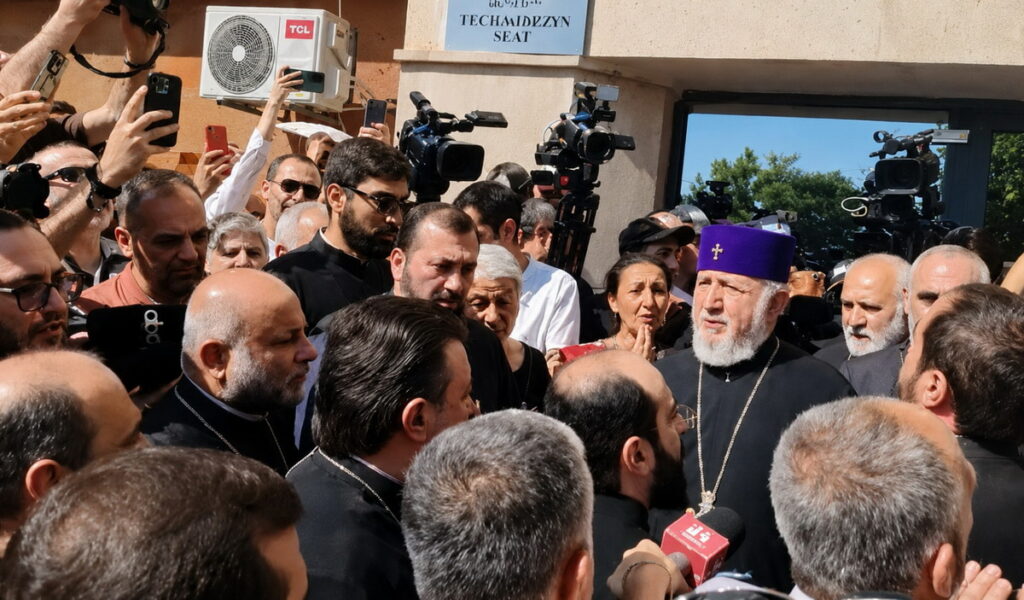
Karekin II, the highest authority of the Armenian Apostolic Church, and six other bishops have been brought before the courts accused of failing to comply with a judicial ruling that ordered the reinstatement of a prelate removed by the Church itself. The seven face possible fines or prison sentences of up to two years in a new episode of the serious confrontation between the ecclesiastical hierarchy and the government of Prime Minister Nikol Pashinyan.
The trial began this Friday in Vagharshapat, a city located about 20 kilometers from Yerevan and also historically known as Echmiadzin, where the Holy See of the Armenian Apostolic Church is located. Dozens of faithful welcomed Karekin II with applause upon his arrival at the courthouse, located just one kilometer from his residence.
The case directly affects the internal governance of the Church: the Armenian judiciary had provisionally ordered the reinstatement of a bishop dismissed by the ecclesiastical authorities, while they maintain that it is exclusively up to the Church to decide on the ministry and discipline of its prelates.
The conflict over the dismissal of a bishop
The origin of the case lies with Arman Saroyan, whose ecclesiastical name is Bishop Gevorg, who had called for the resignation of Karekin II.
Saroyan went to the civil courts on January 15 to challenge the measures taken against him. The following day, a court issued an injunction preventing the Holy See of Echmiadzin from obstructing the exercise of his episcopal functions and his control over the finances of the diocese.
Subsequently, the Supreme Spiritual Council recommended his deposition and Karekin II ratified the decision. The Prosecutor’s Office considers that the Catholicos and the other six members of this body thereby violated the court’s ruling.
The Church rejects this approach because it believes that civil courts have no jurisdiction to determine who should serve as a bishop or to intervene in matters of ecclesiastical discipline.
The case thus goes beyond the personal dispute with Saroyan. At its center is a particularly sensitive issue for the freedom of the Armenian Church: whether a state court can compel a religious authority to maintain or reinstate one of its own bishops against a decision made in accordance with its internal governance.
The first hearing is interrupted after 30 minutes
The first day of the trial ended, moreover, with an unexpected turn. Just half an hour after the hearing began, Judge Hakob Manukyan decided to recuse himself from the proceedings.
The Prosecutor’s Office had raised doubts about his impartiality due to a previous professional relationship with Ara Zohrabyan, one of the defense lawyers. The magistrate agreed to recuse himself, so the case must be assigned to another judge before it can continue.
The seven defendants must now wait for the appointment of the new magistrate and the setting of another date for the trial. In the meantime, they are prohibited from leaving Armenia.
After the hearing was suspended, Karekin II returned to the Holy See of Echmiadzin accompanied by numerous faithful. There he participated in a religious celebration and described the accusations against the hierarchy as «unfounded and false.»
The bishops denounce interference in the life of the Church
The trial has also provoked reactions outside Armenia. Serovpe Isakhanyan, bishop of the Armenian Apostolic Church in Germany, along with two other prelates from Syria and Iraq, warned on the eve of the trial that the situation is harming «the normal functioning of our Church.»
The three bishops denounced a climate of «tensions and mutual distrust» between the State and the Church and rejected that conflicts of this nature can be resolved through «legal pressure, criminal prosecution, acute confrontation or interference in the internal life of the Church.»
In their view, continuing down this path could increase social tensions, deepen existing divisions and harm Armenians’ trust in democratic and judicial institutions.
Karekin II was already prohibited from leaving Armenia
The trial against the seven prelates is not an isolated episode. Last February, the Attorney General’s Office already brought criminal charges against Karekin II and prohibited him from leaving the country, a measure that prevented him from traveling to Austria to participate in an assembly of the Armenian Church.
The action added to a series of proceedings against prominent members of the episcopate. Among them are Archbishops Bagrat Galstanyan and Mikael Ajapahian and Bishop Mkrtich Proshyan, detained or prosecuted in various cases during the escalation of tension between the Government and the Church.
Although each proceeding responds to specific accusations that must be examined individually by the courts, the accumulation of actions against members of the hierarchy has fueled accusations of state interference in the autonomy of the Church.
From Nagorno-Karabakh to the confrontation with Pashinyan
The crisis has as its backdrop the defeats suffered by Armenia against Azerbaijan and the deep debate opened in the country about the policy subsequently followed by Pashinyan.
The 2020 war over Nagorno-Karabakh —an enclave disputed with Azerbaijan and historically inhabited by a predominantly Armenian population— ended with significant territorial losses for Armenia. In September 2023, an Azerbaijani offensive allowed Baku to take full control of the territory and caused the exodus of tens of thousands of Armenians.
Pashinyan’s subsequent efforts to reach a peace agreement with Azerbaijan, including territorial and border concessions, met with strong opposition from sectors of society and the Church.
Archbishop Bagrat Galstanyan became one of the main leaders of the protests against those concessions in 2024. He was later detained on charges of participating in the preparation of an attempted coup d’état. Other prelates have been arrested or prosecuted since then.
The confrontation has ended up directly affecting the highest political and religious authorities in the country. Pashinyan has called for the departure of Karekin II, while the Catholicos has in turn called for the resignation of the prime minister.
A Church closely linked to Armenian identity
The conflict takes on a particular dimension due to the historical and social weight of the Armenian Apostolic Church. According to the 2022 census, around 90% of the country’s population belongs to it.
Armenia is traditionally considered the first nation to officially adopt Christianity as the state religion, at the beginning of the 4th century. The Armenian Church traces its origins to the preaching of the apostles Saint Jude Thaddeus and Saint Bartholomew and for centuries played a decisive role in the preservation of the language, culture and national identity.
Karekin II, 74 years old, has held the position of Catholicos of All Armenians since 1999, a title that designates the highest authority of the Armenian Apostolic Church. His see is located in Echmiadzin, the spiritual center of Armenian Christianity.
The judge’s recusal now forces a delay in a trial that had barely begun. When his replacement is appointed, the court will have to determine whether Karekin II and the other six bishops incurred criminal liability by disobeying the judicial ruling.