


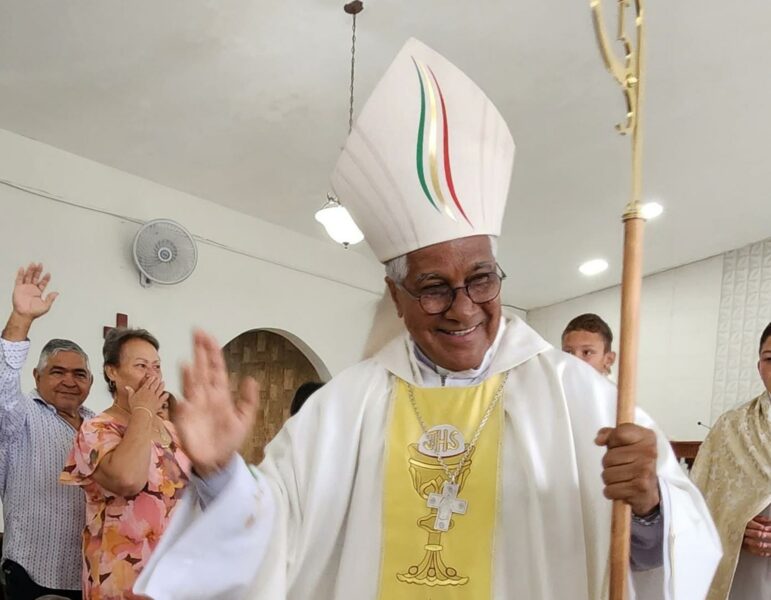
Pope Leo XIV has appointed Eusebio Ramos Morales, until now bishop of Caguas, as the new metropolitan archbishop of San Juan, Puerto Rico, the main Catholic see of the Caribbean island. The appointment comes after the Pontiff accepted the resignation due to age of the Franciscan Roberto Octavio González Nieves, who leaves the archdiocese after 27 years of pastoral leadership.
The Holy See Press Office announced both moves on August 6. The appointment also presents a notable circumstance: Ramos Morales will turn 74 next December and must submit his resignation to the Pope upon reaching 75, in December 2027, although this does not necessarily mean his immediate departure from the see.
From Caguas to Puerto Rico’s main see
Eusebio Ramos Morales was born on December 15, 1952, in Maunabo, a municipality located in southeastern Puerto Rico. He was ordained a priest in 1983 for the diocese of Caguas and has developed virtually his entire pastoral career on the island.
After serving in various parishes, he pursued further studies in Rome and earned a licentiate in Dogmatic Theology from the Pontifical Gregorian University.
Benedict XVI appointed him in March 2008 as the first bishop of the newly created diocese of Fajardo-Humacao, located in eastern Puerto Rico. He received episcopal ordination on May 31 of that year, with González Nieves himself as the principal consecrator.
In February 2017, Pope Francis transferred him to Caguas, a diocese situated in the eastern interior of the island and close to the San Juan metropolitan area. Since December 2024, Ramos Morales has also served as president of the Puerto Rican Episcopal Conference.
His transfer to San Juan now places him at the head of the most institutionally significant see of the Church in Puerto Rico.
González Nieves leaves San Juan after 27 years
The succession marks the end of one of the longest episcopal tenures in recent Puerto Rican Church history.
Roberto Octavio González Nieves was appointed archbishop of San Juan by Saint John Paul II on March 26, 1999 and took possession on May 8 of the same year. The archdiocese has expressed gratitude for his 27 years leading the see and his nearly four decades of episcopal ministry.
Born on June 2, 1950, González Nieves had already turned 76. As established by Canon Law, diocesan bishops must submit their resignation upon reaching 75, leaving it to the Pope to decide when to accept it.
Ramos Morales’s arrival also represents a transition between two closely connected prelates: it was precisely González Nieves who presided over his episcopal ordination in 2008.
A see with more than five centuries of history
The Archdiocese of San Juan has framed the appointment within an episcopal history dating back to the early 16th century.
Among its earliest figures is Alonso Manso, the first bishop of Puerto Rico and a key figure in the establishment of the Spanish ecclesiastical structure in the Americas. Over the centuries, the see has been held by prelates such as Juan Alejo de Arizmendi, the first Puerto Rican bishop, and Cardinal Luis Aponte Martínez.
Ramos Morales thus assumes leadership of an archdiocese deeply tied to Puerto Rico’s religious and cultural history and carrying particular weight within the island’s episcopate.
He must submit his resignation in December 2027
The most distinctive aspect of the appointment is the age of the new archbishop. Ramos Morales will turn 74 on December 15 and will reach 75 exactly one year later, in December 2027.
Canon 401 §1 of the Code of Canon Law stipulates that a diocesan bishop who turns 75 must submit his resignation to the Roman Pontiff. Consequently, Ramos Morales will have to do so approximately sixteen months after his appointment as archbishop of San Juan.
Submitting the resignation does not, however, imply automatic retirement. Leo XIV may accept it at that time or retain him for a longer period at the head of the archdiocese.
Age thus represents a peculiarity of the appointment, but does not predetermine the length of his pastoral leadership. Ramos Morales arrives in San Juan with extensive episcopal experience, the presidency of the Episcopal Conference, and the task of succeeding an archbishop who has led the see for nearly three decades.