


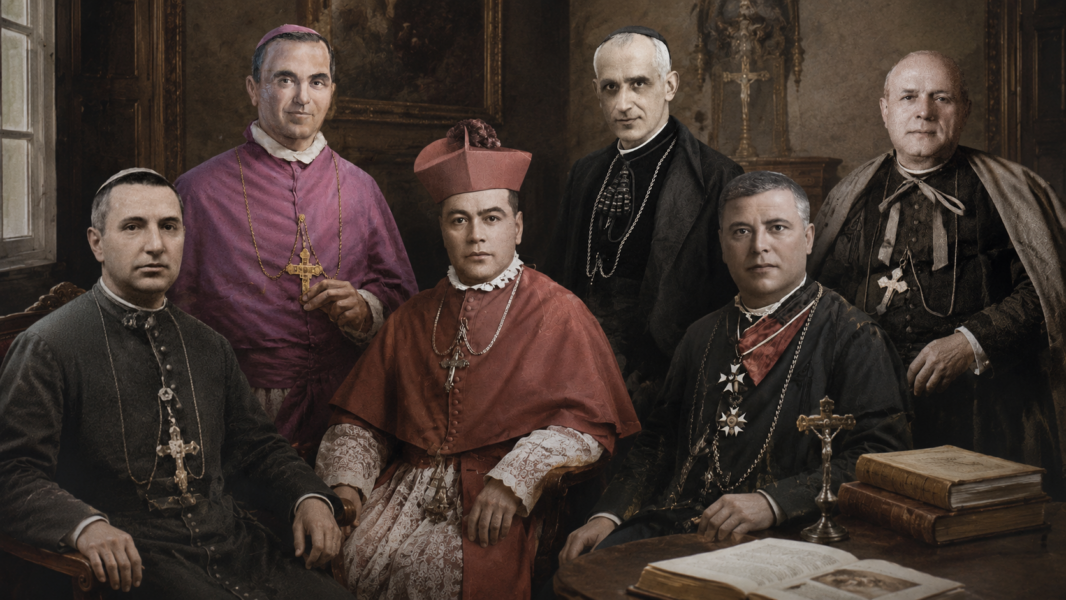
This August marks 90 years since the martyrdom of most of the Spanish bishops who were murdered out of hatred for the faith during the religious persecution unleashed at the outbreak of the Spanish Civil War. Between August 5 and 30, 1936, ten prelates were executed after refusing, in most cases, to abandon their dioceses or renounce their status as bishops. Two more bishops and an apostolic administrator would later be added to their number, victims of the same persecution.
Following the assassination in July of Msgr. Eustaquio Nieto, bishop of Sigüenza, the violence against the episcopate reached its most intense point during the month of August. Many of these shepherds remained with their clergy and faithful despite the danger, rejected the opportunities to flee that were offered to them, and faced death while remaining faithful to their ministry.
The beginning of the martyrdoms
The first was Msgr. Salvio Huix, bishop of Lérida, executed on August 5 after refusing to renounce his episcopal status. He had decided to remain in his diocese despite the advance of religious persecution.
Three days later, on August 8, Msgr. Cruz Laplana, bishop of Cuenca, and Msgr. Florentino Asensio, apostolic administrator of Barbastro, were martyred. Laplana refused to abandon his clergy and rejected the possibility of escaping in disguise. Asensio, consecrated bishop only a few months earlier, suffered severe torture during his captivity before being executed while blessing and forgiving his executioners.
The persecution continued on August 9 with the murder of Msgr. Miguel Serra, bishop of Segorbe, who was arrested along with other clergy and executed after suffering mistreatment during his captivity.
August ended with new assassinations
On August 12, Msgr. Manuel Basulto, bishop of Jaén, and Msgr. Manuel Borrás, auxiliary bishop of Tarragona, attained martyrdom.
Basulto had been arrested along with several members of his family and remained imprisoned in the cathedral of Jaén, which had been converted into a prison. He was executed during a transfer by train along with other inmates. Borrás, for his part, was arrested along with Cardinal Francisco de Asís Vidal y Barraquer. While the cardinal managed to leave Spain, the bishop remained imprisoned until he was executed in Tarragona.
On August 22, Msgr. Narciso de Estenaga, bishop of Ciudad Real and prior of the Military Orders, was murdered. After the assault on the episcopal palace, he took refuge in the home of some friends, where he was located by militiamen and taken to the outskirts of the city to be executed.
The persecution culminated with the martyrdom, on August 30, of Msgr. Diego Ventaja, bishop of Almería, and Msgr. Manuel Medina, bishop of Guadix. Both remained with their priests after the outbreak of the war and suffered imprisonment and numerous humiliations before being executed in the Chisme ravine, in the Almerian municipality of Vícar.
The last prelates murdered during the war
The religious persecution continued throughout the rest of the conflict.
The apostolic administrator of Orihuela, Juan de Dios Ponce y Pozo, was executed on November 30, 1936, after remaining in hiding for several months.
Three days later, on December 3, Msgr. Manuel Irurita, bishop of Barcelona, was murdered. His cause for beatification remains open, and he is the only one of the prelates murdered during the Civil War who has not yet been officially recognized as a martyr by the Church.
And finally, Msgr. Anselmo Polanco, bishop of Teruel and Augustinian religious. Arrested in January 1938, he remained imprisoned for thirteen months until he was executed in February 1939, just weeks before the end of the war.
The testimony of the martyred bishops
The Church has officially recognized almost all of these prelates as martyrs, considering it proven that they were murdered out of hatred for the faith. Their causes for beatification highlight their fidelity to the Church, their decision to remain with their dioceses in the moments of greatest persecution, and the forgiveness they offered to their executioners before dying.
Ninety years later, the testimony of these bishops continues to occupy a prominent place in the memory of the Church in Spain as an expression of the religious persecution suffered during the Civil War and of the fidelity of those who gave their lives without renouncing their faith.