


By Brad Miner
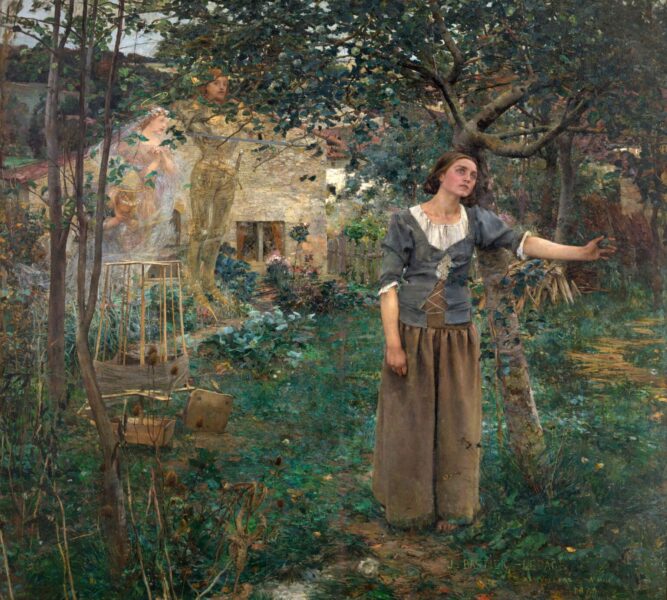
Many readers know of my passion for art, especially painting. I have a special fondness for the works of the great Catholic artists Caravaggio, Rubens, and Vermeer, and some examples of their work are found in the collection of my favorite museum, the Metropolitan Museum of Art (MET) in New York City. What readers don’t know is that none of the works by those great masters at the MET is my favorite. That distinction, such as it is, belongs to Joan of Arc by Jules Bastien-Lepage.
In fact, when my wife and I visit the MET, I’m like a Great Dane puppy dragging her behind me as I hurry up the Grand Staircase to Gallery 827 to stand before Bastien-Lepage’s “Joan.” And I write about this painting, completed in 1879, in part to try to figure out why it is so captivating to me.
Still, although this column is about the painting, Joan’s story deserves a brief re-telling in context.
Jeanne d’Arc, as her compatriots know her, was born (c. 1412) in a small village in northeastern France called Domrémy, which is pronounced like the first syllables of solfège: do, re, mi (fa, sol, la, ti), or at least it is if you glide smoothly over the letter “m,” as some residents of Rouen do. Rouen is where Joan died.
She was a young peasant girl who heard the voices of saints, who told her to seek out the Dauphin of France, see to his coronation, and lead his armies in battle against the English. When we read “dauphin,” we may imagine a small child. Yet Charles VII was 19 when, by right of succession, he became “king,” although he was finally crowned a decade later, and that thanks to Joan.
At just 16, she led French forces during the Hundred Years’ War. She had been hearing those heavenly voices for several years. They belonged to the Archangel Saint Michael and to the fifth-century saints Catherine and Margaret, both virgins and martyrs.
In armor and on horseback, this astonishing teenager successfully led the French in battle, until she was captured by the English, tried for witchcraft, and burned at the stake on May 30, 1431, in part due to the duplicity of Bishop Pierre Cauchon, who sided with the English-allied Burgundians. His surname is a homophone of cochon, the French word for “pig.”
Films have been made about Joan and books have been written, including a novel by none other than Mark Twain, who called Joan “the most extraordinary person the human race has ever produced.” Her life is legendary, but she is no legend. As with any great figure of the Middle Ages, some questionable facts may have adhered to her story like barnacles to a hull, but she really did accomplish incredible things.
So, why do I love this painting? For one thing, the subject is fascinating, n’est-ce pas? This peasant girl who rose so grandly and fell so terribly. Also, Bastien-Lepage’s style is captivating, uniting classical naturalism with the most popular movement of his time, Impressionism.
And the canvas is HUGE: about 8 feet by 9 feet. That’s not the largest painting at the MET. That distinction belongs to another historical scene, Washington Crossing the Delaware (1851) by Emanuel Leutze, which measures 12 feet by 21 feet.
Joan of Arc is also mysterious, in an overwhelming way, with Joan’s gaze lifted and abstracted.
And there is Bastien-Lepage’s own story.
Born in 1848 (died 1884), he came from the same region of France as Joan: essentially the ever-disputed Alsace and Lorraine, which has “changed hands” between France and Germany five or six times since the seventeenth century.
And there was a prophecy, probably contemporary with Joan—although some attribute it to Merlin, of Arthurian fame—about the rise of the so-called Maid of Lorraine, a virgin who would restore France to her glory. Bastien-Lepage knew the legend: its popularity and its context in the Hundred Years’ War. And that resonated deeply with his own experience as a soldier in the Franco-Prussian War (July 1870 to January 1871). Both conflicts had represented, if only temporarily, humiliating defeats for France.
For someone native to the area, as Bastien-Lepage was, stories about the Maid of Lorraine and the young woman many called the Maid of Orléans (that is, Joan, who won a decisive victory there) were like the stories I heard growing up in Ohio about Johnny Appleseed (John Chapman of Leominster, Massachusetts): true, but embellished. Today, Domrémy is known as Domrémy-la-Pucelle (that is, the Maid).
Yet, according to art historian Carel Huydecoper, the specific impetus for Bastien-Lepage’s Joan was the time he spent painting a portrait of the historian Alexandre Henri Wallon, author of Jeanne d’Arc, a two-volume work published in 1860, and this—the conversations between the artist and his model about Joan—sparked the painter’s interest. (Wallon was also one of Mark Twain’s sources).
Joan’s martyrdom may make it seem as though she had been a failure, but when the war ended four years later, the French had won and the English surrendered all of France except the northern port of Calais. The English would control that port for a little more than a century. Then, almost without a fight, they surrendered the besieged city in 1558.
Mary I, England’s last Catholic ruler, lamented that loss. It seemed to suggest that England was no longer a European titan, but simply an isolated island nation. It is claimed (according to Raphael Holinshed) that Mary, whose reign lasted only two years and ended eleven months after the loss of Calais, said: “When I die, ‘Calais’ will be written on my heart.” (Holinshed’s Chronicles were a primary source for Shakespeare’s Henry V, which recounts the story of the young king’s victory at Agincourt, a battle fought when Joan was two years old).
A feminist commentator on the MET’s website writes that Joan was “disguised as a man,” which is nonsense. For heaven’s sake, she was a 17-year-old woman dressed for battle! And everyone knew her sex.
“There is no one to compare her to,” wrote Twain, “no one by whom to measure her. . . . There have been other young generals, but they were not girls; young generals, but they had been soldiers before they were generals: she began as a general.”
To us Catholics, she is Saint Joan of Arc, canonized by Benedict XV in 1920. Sancta Ioanna d’Arc, ora pro nobis!

About the Author
Brad Miner, husband and father, is senior editor of The Catholic Thing and a senior fellow of the Faith & Reason Institute. He was literary editor of National Review and had a long career in publishing. His most recent book is Sons of St. Patrick, written with George J. Marlin. His best-seller The Compleat Gentleman is available in a third revised edition and also as an audiobook on Audible (narrated by Bob Souer). Mr. Miner has served on the board of Aid to the Church in Need USA and also on the Selective Service board in Westchester County, New York.