


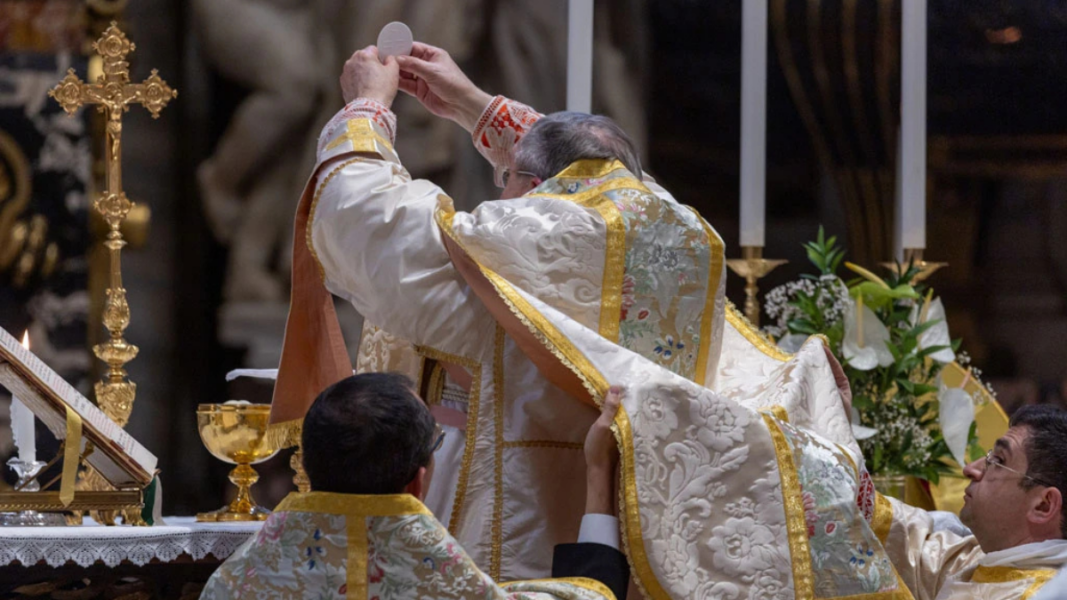
The pastor of the Church of Saints Cyril and Methodius in Sheboygan (Wisconsin, United States) has sparked strong controversy after using a warning addressed to the faithful about the Priestly Fraternity of Saint Pius X (FSSPX) to also question the traditional Mass celebrated in full communion with the Church. In his pastoral message, he maintains that the rite according to the 1962 Missal constitutes only a «concession» for those who «have not yet matured sufficiently in the faith» to accept the liturgy reformed after the Second Vatican Council.
The statements were published by Father Paul Fliss in last Sunday’s parish bulletin and later shared by various users on social media. Paradoxically, the parish itself regularly hosts celebrations according to the 1962 Missal by the Institute of Christ the King Sovereign Priest (ICKSP), a society of apostolic life in full communion with the Holy See dedicated to the apostolate of the traditional liturgy.
The warning against the FSSPX
The message opens by recalling the recent excommunications resulting from the episcopal consecrations carried out without papal mandate by the FSSPX. Fliss states that, “in the eyes of the Church,” all the Fraternity’s sacramental celebrations “are now invalid” and explicitly asks Catholics not to attend any of its religious services.
He then clarifies that this situation does not affect the Institute of Christ the King, which is authorized to celebrate the Mass according to the 1962 Missal in the Archdiocese of Milwaukee. However, this distinction serves as a starting point for a much broader critique of the Vetus Ordo.
“A concession” for those who still do not accept the Novus Ordo
Although he acknowledges that the Institute of Christ the King “is in communion with the Church,” Fliss maintains that “the rite they use does not share the same status or the same dignity as the Mass of Paul VI,” ordinarily celebrated in the vernacular language.
“Having the opportunity to celebrate this Mass in Latin is a concession, permitted for those who have not matured sufficiently in the faith to accept the Mass approved after the Second Vatican Council,” the priest writes.
He adds that the purpose of this concession is for “the grace of God to help those participants overcome their dependence on the old Latin Mass and enter into communion with the rest of the Church by celebrating the Mass in the vernacular language.”
He asks that other Catholics not be invited
Consistent with this approach, the pastor maintains that the community linked to the traditional liturgy should not promote its celebrations.
“For this reason, the Latin Mass community cannot announce its celebrations nor should it invite other Catholics to join its group,” he states.
Although he acknowledges that attending this liturgy once may have an “educational” value or constitute “a new experience,” he believes that Catholics should not join that community on a stable basis “instead of attending the Sunday Mass in English.”
Fliss concludes this reasoning with a rhetorical question: “Why would anyone want to take a step backward in their faith and spiritual life?”
“The Holy Spirit always leads us toward the future”
In the final part of his message, the priest justifies his position by contrasting the spiritual approach that, in his view, characterizes the reformed liturgy with that of the traditional Mass.
He states that the bishops gathered at the Second Vatican Council discerned the need for a deeper participation of the faithful in the life of the Church, allowing them to live more intensely their condition as baptized persons and their commitment to the Christian mission.
According to Fliss, this level of maturity “demands more of the believer than attending a Mass in which the priest recites the prayers while the faithful focus on their individual relationship with God.”
Finally, he summarizes his position with a statement he considers one of the fundamental spiritual principles of the Church: “The Holy Spirit always leads us toward the future.” Therefore, he invites the faithful to look “with faith and hope” at the path by which, he maintains, the Spirit is guiding the Church today.
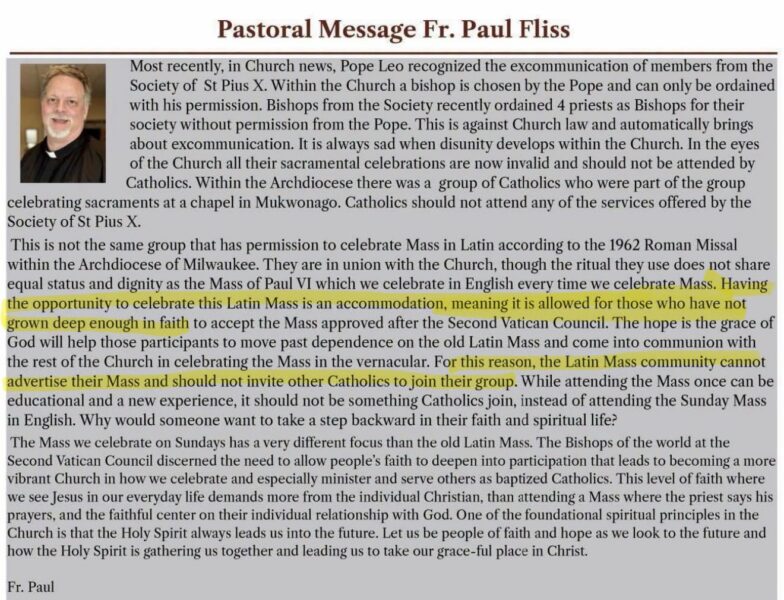
Pastoral message from Fr. Paul Fliss (Spanish translation):
Recently, in Church news, Pope Leo recognized the excommunication of members of the Society of Saint Pius X. In the Church, a bishop is chosen by the Pope and can only be ordained with his permission. Recently, bishops of the Society ordained four priests as bishops for their community without the Pope’s permission. This goes against Church law and carries automatic excommunication. It is always sad when disunity arises within the Church. In the eyes of the Church, all their sacramental celebrations are now invalid and Catholics should not attend them. In the archdiocese there was a group of Catholics who were part of the community that celebrated the sacraments in a chapel in Mukwonago. Catholics should not attend any of the services offered by the Society of Saint Pius X.
This is not the same group that has permission to celebrate the Latin Mass according to the 1962 Roman Missal within the Archdiocese of Milwaukee. They are in communion with the Church, although the rite they use does not share the same status or the same dignity as the Mass of Paul VI, which we celebrate in English every time we participate in Mass. Having the possibility of celebrating this Mass in Latin is a concession, meaning it is permitted for those who have not yet deepened sufficiently in the faith to accept the Mass approved after the Second Vatican Council. The hope is that the grace of God will help those participants overcome their dependence on the old Latin Mass and enter into communion with the rest of the Church by celebrating the Mass in the vernacular language. For this reason, the Latin Mass community cannot announce its celebrations nor should it invite other Catholics to join its group. Although attending this Mass once may be instructive and a new experience, it should not be something to which Catholics join instead of attending the Sunday Mass in English. Why would anyone want to take a step backward in their faith and spiritual life?
The Mass we celebrate on Sundays has a very different focus from the old Latin Mass. The bishops of the world gathered at the Second Vatican Council discerned the need to allow people’s faith to deepen through a participation that would lead to a more living Church in the way of celebrating and, especially, of exercising ministry and serving others as baptized Catholics. This degree of faith, in which we see Jesus in our daily life, demands more of the individual Christian than attending a Mass in which the priest recites his prayers and the faithful focus their attention on their personal relationship with God. One of the fundamental spiritual principles of the Church is that the Holy Spirit always leads us toward the future. Let us be people of faith and hope as we look to the future and contemplate how the Holy Spirit gathers and guides us to occupy the place of grace that belongs to us in Christ.