


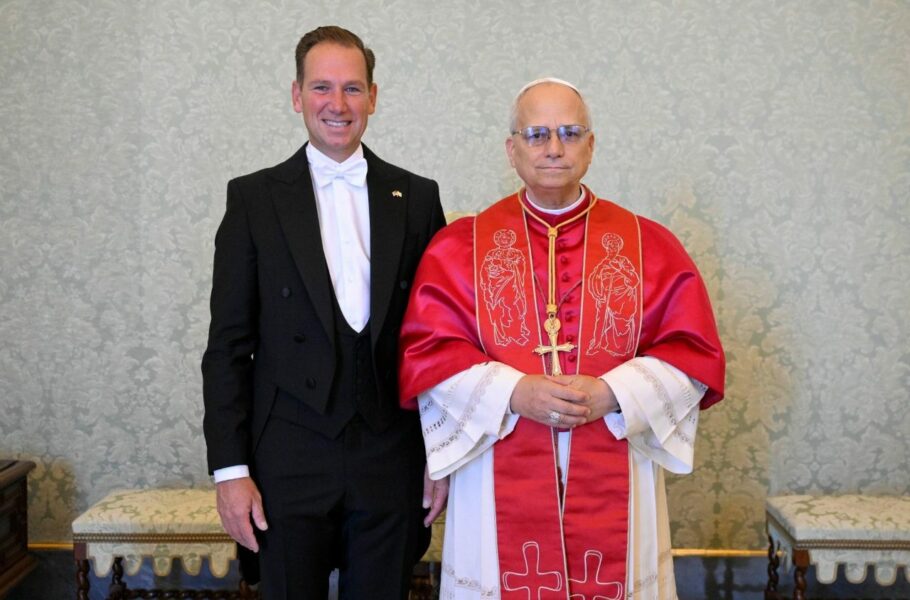
The United States Ambassador to the Holy See, Brian Burch, has sought to clarify the meaning of statements recently published by The New York Times and has insisted that the role of Leo XIV as head of the Vatican City State is “inseparable” from his mission as universal pastor of the Church. In an interview given to the program The World Over with Raymond Arroyo, on EWTN, the diplomat stated that he never intended to present the Pontiff’s interventions on the war with Iran as mere political or diplomatic assessments.
“I think there has been a misunderstanding,” Burch said. “The Pope, as sovereign of the Holy See and as universal pastor of the Church, performs two functions that are inseparable.”
Burch rejects The New York Times interpretation
The controversy arose after The New York Times published an interview in which it quoted the ambassador as saying that “when the Pope acts as the sovereign leader of the Holy See, he is on the same level as other world leaders.” The newspaper further interpreted that Burch distinguished between the Pope’s statements as Vicar of Christ and those made as head of the Vatican State.
The ambassador denied that this was his position and maintained that the newspaper did not accurately reflect the meaning of his words.
“The New York Times does not fully understand the nuances of the Church’s social doctrine or how to apply it,” he stated during the interview with EWTN.
“The Pope calls the world to the highest moral principles”
Burch explained that the diplomatic dimension of the Holy See can never be separated from the spiritual mission of the Roman Pontiff.
“The Pope has this dual function. He is the head of the sovereign territory of the Holy See, which maintains diplomatic relations with the world, but inseparably from that is his role as universal pastor of the Catholic Church,” he noted.
He added that when he intervenes in international affairs, Leo XIV does so to recall “the highest moral principles” and to propose to nations an ideal of coexistence based on peace, justice, and the dignity of the human person.
Prudential decisions belong to rulers
The ambassador distinguished between those universal moral principles and the concrete decisions that political leaders must make in situations of conflict.
According to him, issues such as available intelligence, the evolution of diplomatic negotiations, regional alliances, or the military consequences of an intervention are prudential elements whose assessment falls to those responsible for the common good.
“These are very concrete and prudential questions that influence the judgment on the legitimate use of force,” he stated.
At the same time, he praised the role of Leo XIV as universal pastor for constantly reminding the need to seek peaceful solutions. “The Holy Father calls humanity to that higher ideal of trying to resolve these conflicts without violence and without resorting to the use of force,” he noted.
“There is no disagreement about peace”
Burch also assured that he does not see a fundamental disagreement between President Donald Trump and Leo XIV regarding the objectives pursued.
“There is no disagreement about peace, about the disarmament of Iran, about the need for interreligious dialogue, or about religious freedom,” he stated.
In his view, differences may arise only in the assessment of the most appropriate means to achieve those ends, a task that belongs to civil authorities.
The ambassador concluded by recalling that “original sin exists” and that “there are evil people in the world with evil intentions who, if not stopped, could cause enormous and catastrophic harm,” which is why rulers must exercise prudential judgment when making decisions on security matters, while the Pope continues to offer the moral guidance proper to his ministry as the successor of Peter.