


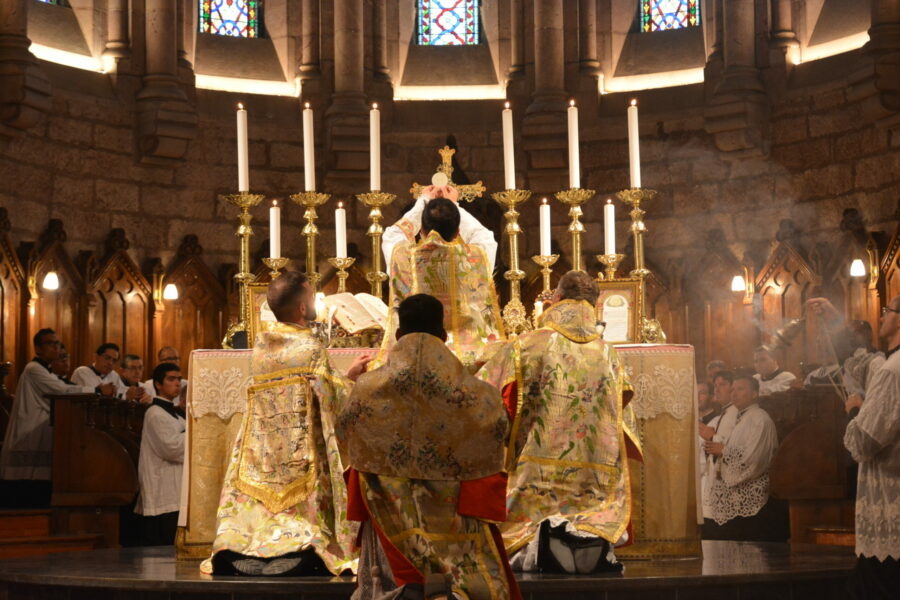
Unlike some bishops who, after the excommunication of the Priestly Fraternity of Saint Pius X, have shown interest in welcoming faithful of the vetus ordo into their dioceses —as is the case in Oslo— and expanding the presence of the Traditional Mass, several German dioceses have made it clear that they have no intention of easing the restrictions on the Traditional Mass imposed by the motu proprio Traditionis Custodes. Despite requests from prominent cardinals and bishops to restore the spirit of Summorum Pontificum, the dioceses consulted by CNA Deutsch are committed to maintaining the current policy unchanged.
The position of these dioceses contrasts with that defended by Cardinal Gerhard Müller, who has called for restoring full freedom for the celebration of the traditional liturgy, or by Archbishop Georg Gänswein, who has considered it necessary to correct the restrictions introduced during the pontificate of Francis.
Regensburg maintains its hard line
The most significant response came from the Diocese of Regensburg, one of the few in Germany that has dispensations from the Holy See to celebrate the Traditional Mass in parish churches.
The diocese’s communications director, Stefan Groß, has insisted that the offering of the Traditional Mass is a pastoral response to the presence of the FSSPX, but he stressed that the conflict with the Fraternity “is not related to the liturgy, but to doctrinal issues.”
According to him, the FSSPX continues to reject fundamental aspects of the Second Vatican Council, especially regarding religious freedom, ecumenism, and relations with non-Christian religions. To illustrate this, he cited statements by the Fraternity’s superior general, Father Davide Pagliarani, in which he defended the rejection of the “true Council,” identified with the new Mass, ecumenism, and religious freedom.
Groß also maintained that the application of Traditionis Custodes “has not posed problems” in Regensburg and denied that the liturgical restrictions have influenced the distancing between Rome and the Fraternity.
Hamburg also rules out changes
The Archdiocese of Hamburg expressed itself along the same lines. Its spokesperson recalled that the norms of Traditionis Custodes remain in force for the entire Church and assured that there is no intention of modifying current practice.
The Traditional Mass will continue to be celebrated only in the places where it is already authorized, and no new measures of openness are planned.
Passau and Cologne also rule out reviewing the situation
The Diocese of Passau and the Archdiocese of Cologne responded much more briefly to the inquiry from CNA Deutsch, but they also showed no willingness to support a return to the regime established by Benedict XVI with Summorum Pontificum, which allowed any priest to celebrate the Traditional Mass without the need for special authorizations.
A divided episcopate
While some dioceses are determined to preserve the restrictive framework of Traditionis Custodes, influential German voices in the Church, such as Cardinal Gerhard Müller and Archbishop Georg Gänswein, have publicly defended the desirability of recovering the orientation set by Summorum Pontificum, distinguishing between the faithful attached to the traditional liturgy and the doctrinal positions of the Priestly Fraternity of Saint Pius X.