


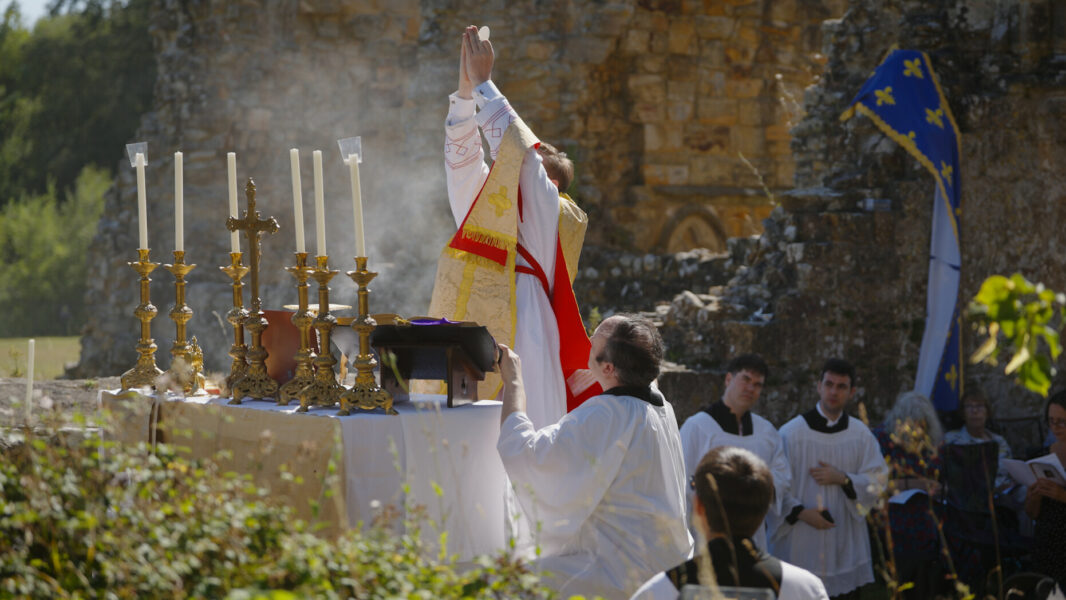
For the second time since the Protestant Reformation, the Holy Mass was once again celebrated on July 11 within the ruined walls of Bayham Abbey, located in the county of Kent, in southeast England.
Father Stephen Morrison, O.Praem., celebrated according to the traditional Roman rite in keeping with the proper use of the Premonstratensian canons. The ceremony crowned a day dedicated to recovering the Norbertine memory of the ancient monastery, founded in 1208 and suppressed by Cardinal Thomas Wolsey in 1525.
The missal used was the last edition of the Premonstratensian rite, published in 1936. According to the program prepared for the celebration, it was also the first Mass celebrated at Bayham since its dissolution using the proper missal of the monastery’s former inhabitants. The organizers clarified that this was not a historical reenactment, but “an act of worship.”
“The faith of our fathers”
In his homily, Father Morrison recalled that this sacred place had resounded for centuries with the chant of the Divine Office and had hosted at least three Masses each day.
“I have the privilege of once again offering the Holy Sacrifice here, on this sacred ground, which once resounded with the chant of the Divine Office and with no fewer than three Masses daily,” he stated.
The priest gave thanks for the historical continuity of the Church and for “our faith, the faith of our fathers.”
“We give thanks because, from the ruins of the crises of this world, God continues to plant the seeds of new growth,” he added.
Morrison concluded his homily by urging the faithful to keep the Eucharist at the center of their lives: “May we treasure the Holy Mass until our last breath and obtain from it the grace to become saints in the times in which Almighty God has placed us. Holy Father Norbert, pray for us.”
Nine hundred years since the approval of the Premonstratensians
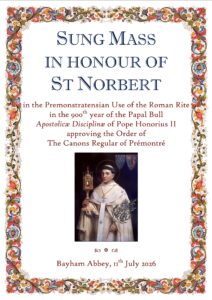
The celebration coincided with the 900th anniversary of the bull Apostolicæ Disciplinæ, by which Pope Honorius II approved the Order of Canons Regular of Prémontré.
The cover of the missal prepared for the day expressly recalled this anniversary and presented the celebration as a sung Mass in honor of Saint Norbert according to the Premonstratensian use of the Roman rite.
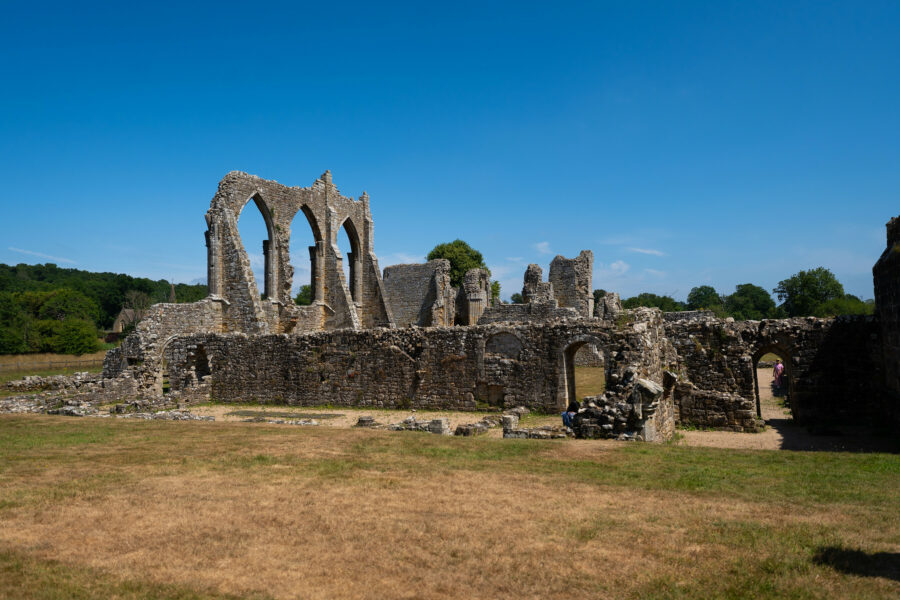
Bayham Abbey was one of approximately thirty Norbertine houses that existed in England before the destruction brought about by the Protestant Reformation. Although the initial suppression took place under Wolsey in 1525, the liturgical program places its final dissolution in 1538, during the general process of closing the monasteries promoted by Henry VIII. Later, during the reign of Elizabeth I, the site passed into secular hands.
Gregorian chant, the rosary, and veneration of the relics
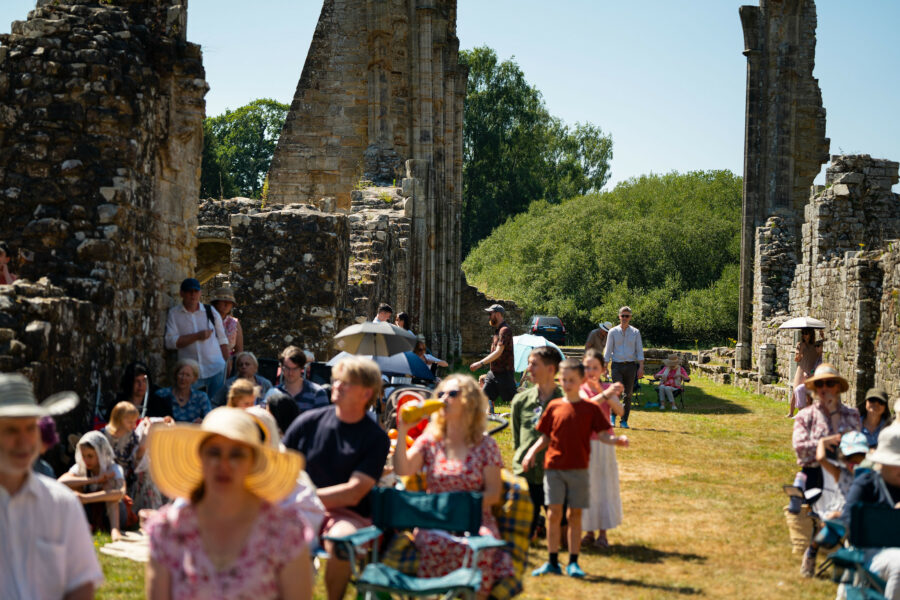
Before the Mass, a Gregorian chant workshop, several short lectures on the history of the abbey, and a family rosary were held.
The ceremony was a solemn Missa Cantata according to the Norbertine rite, accompanied by Gregorian chant and celebrated at the eastern end of the ruins, facing the site of the former high altar. At the conclusion, the faithful venerated a relic of Saint Norbert.
The booklet explained to visitors that the liturgy used differed only in small details from that known to the former canons of Bayham. It also emphasized that Latin not only unites Catholics of different languages and cultures, but also links present-day faithful with their ancestors in the faith.
During the veneration of the relic, the Litany of the Saints was sung. The organizers presented the relic as a tangible link to Saint Norbert and to the centuries of Norbertine prayer that filled the abbey.
A day of evangelization in southern England
The initiative was organized by volunteers from the Archdiocese of Southwark, which encompasses south London and part of southeast England, in collaboration with the Norbertine canons and English Heritage, the body responsible for the conservation of the site.
Also participating were the Schola Gregoriana of Cambridge, the Latin Mass Society, historian Matthew Ward, Mary Alexander, and Father Ed Tomlinson.
The celebration allowed the ruins of Bayham to recover, if only for a few hours, the purpose for which they were built more than eight centuries ago. There, where religious life had been extinguished and the monastery reduced to vestiges, the Holy Mass once again gathered priests, families, and the faithful around the same sacrifice celebrated by the ancient canons.