


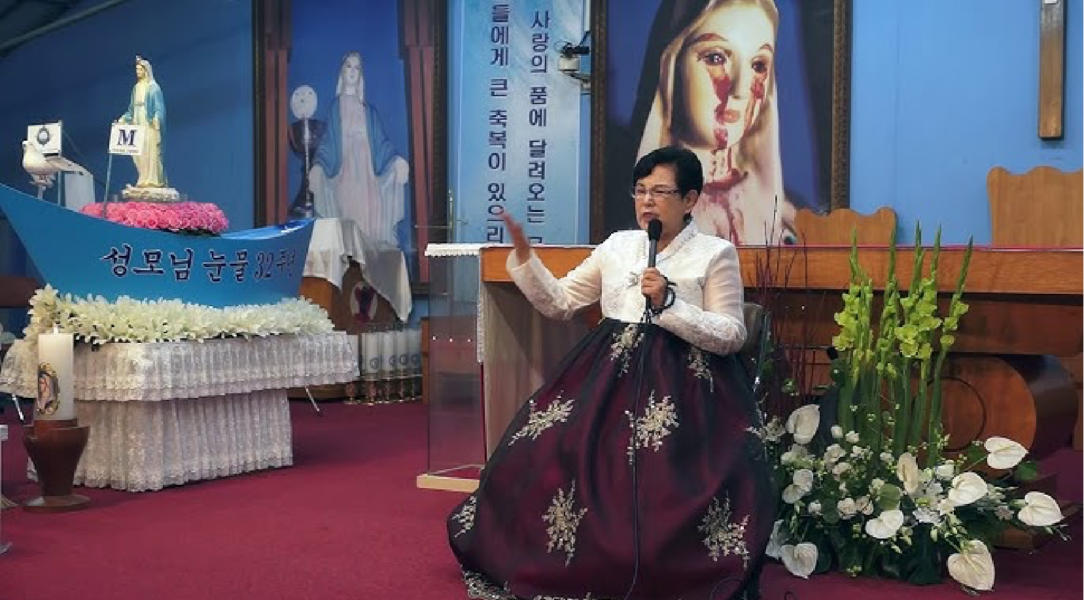
The Episcopal Conference of the Philippines has urged the faithful to refrain from organizing, promoting, or participating in pilgrimages to Naju, in South Korea, where for four decades alleged Marian apparitions, supposed Eucharistic miracles, and other phenomena linked to Julia Kim have been promoted.
According to The Pillar, the warning was issued on July 13 by the president of the Filipino episcopate, Archbishop Gilbert Garcera, in response to the growing participation of faithful, parish groups, and travel agencies from the Philippines in pilgrimages to Naju. The prelate recalled that the South Korean archdiocese of Gwangju issued a negative judgment on the events following a discernment process carried out in communion with the Dicastery for the Doctrine of the Faith.
The intervention of the Filipino bishops therefore responds to the international spread of a movement that is no longer limited to South Korea and has found followers in various Asian countries.
Bishops urge avoidance of pilgrimages to Naju
“We address the diocesan pilgrimage organizers, parish leaders, travel agencies, as well as Filipino pilgrims and devotees, urging them to refrain from organizing, promoting, or participating in pilgrimages to Naju,” Garcera wrote.
The prelate instead encouraged Catholics to visit Marian shrines approved by the Church, both in the Philippines and in other countries, “where authentic Marian devotion is fostered in full communion with the Church.”
The statement appears to be the first occasion on which a national episcopal conference has formally issued its own pastoral guidance on Naju and explicitly asked the faithful not to participate in pilgrimages to the site.
The pronouncement, however, adds to the warnings issued in recent years by various dioceses in Southeast Asia, concerned about the influence the movement has gained among priests and laity.
The origin of the alleged phenomena
The movement arose around Julia Youn Hong-Sun, internationally known as Julia Kim, born on March 3, 1947, in Naju, a city located in the southwest of South Korea.
Kim, who was initially Protestant, claimed to have been miraculously healed of cancer in 1980 after reading in the Gospel of Saint Luke the accounts of Jairus’s daughter and the woman suffering from hemorrhages. She was baptized into the Catholic Church during Easter 1981.
On June 30, 1985, she claimed that an image of the Virgin Mary she had placed in her home began to weep. From July 18 of the same year, she asserted that she received messages from the Virgin and from Jesus Christ.
She also claimed to have witnessed numerous “signs,” including supposed Eucharistic miracles, images that emitted fragrant oil, and tears of blood. A photograph of the supposedly bloodstained Marian image later became one of the main elements in promoting the movement.
In 1987, Kim promoted the construction of the so-called Chapel of the Blessed Virgin, which was destroyed by fire in 2015 and later rebuilt. The building preserves various objects associated with the alleged phenomena.
In 1992, she acquired land on a nearby mountain, which she named “Mountain of the Blessed Virgin,” where she claimed to have discovered a miraculous spring.
The Archdiocese of Gwangju rejected the apparitions
The growing number of visitors led the Archdiocese of Gwangju, under whose jurisdiction Naju falls, to open a formal investigation during the 1990s.
In 1998, the archdiocese published its first pastoral notification. The document noted that the alleged messages attributed to the Virgin appeared to draw elements from other already published works and concluded that they could not be considered credible private revelations.
It also determined that there was insufficient evidence to attribute a supernatural origin to the “signs” presented by Kim.
The then Archbishop of Gwangju, Victorinus Youn Kong-hi, prohibited the publication of materials intended to promote the alleged apparitions, asked Kim to stop spreading the messages, and confirmed the ban on celebrating Masses at sites linked to the movement.
The archdiocese reiterated its position through new pastoral guidelines in 2001 and a second notification in 2005, insisting that the phenomena of Naju did not have the Church’s approval.
Excommunication for disobeying the prohibitions
In January 2008, the then Archbishop of Gwangju, Andreas Choi Chang-mou, promulgated a decree establishing canonical penalties for those who disobeyed the diocesan provisions.
The prelate declared that priests, religious, or laity who presided over or attended the celebration of sacraments or sacramentals in the supposed chapel or on the so-called “hill of Our Lady of Naju” would incur automatic excommunication.
That same year, the then Congregation for the Doctrine of the Faith reportedly confirmed that the Church’s official position on the events was non constat de supernaturalitate, meaning that their supernatural character had not been established.
The archdiocese spoke again in 2011 with a third pastoral notification, published with the support of the doctrinal dicastery, and issued new guidelines in 2012.
In the latter, it recalled that all members of the Episcopal Conference of Korea supported the position adopted by the Archdiocese of Gwangju.
The movement spreads outside South Korea
The sanctions and episcopal warnings failed to curb the popularity of the site, which began to attract pilgrims from Japan, China, Hong Kong, Malaysia, Singapore, the Philippines, and Indonesia.
In 2018, the Episcopal Conference of Korea wrote to the Federation of Asian Bishops’ Conferences to communicate that the events of Naju had not been established as supernatural and to request that priests and faithful be discouraged from visiting the site.
In 2019, Archbishop John Wong of Kota Kinabalu, Malaysia, issued a statement supporting the Korean bishops’ position.
The Archdiocese of Singapore issued a similar warning in 2022 and reiterated it in 2025, noting that those who visited the site against ecclesiastical provisions would incur automatic excommunication. The Malaysian Archdiocese of Kuala Lumpur also spoke in the same vein.
In February 2026, the permanent committee of the Episcopal Conference of Korea decided to address the Federation of Asian Bishops’ Conferences again to request that Catholics on the continent be informed that the shrine operates without Church approval.
A new warning for Asian Catholics
The declaration by the Filipino bishops could mark the beginning of a new series of episcopal pronouncements against pilgrimages to Naju, especially if it responds to an initiative coordinated by the Federation of Asian Bishops’ Conferences.
It could also be a direct response to the number of Filipinos visiting the site, drawn by the alleged phenomena, and to the promotion of these trips by parish groups and specialized agencies.
The international expansion of the movement, in any case, highlights the difficulties of curbing, solely through episcopal warnings, a devotion that has gained followers in numerous countries across the continent.
Julia Kim is currently 79 years old and continues to spread her messages through public interventions and carefully produced videos. Her advanced age also raises questions about the future of a movement closely tied to her personal figure.