


By Auguste Meyrat
For the sake of diplomacy and personal relationships, it is usually a good idea to follow the saying: «If you can’t say something nice about someone, don’t say anything at all.» But when it comes to evaluating challenging and complex situations, this advice should be reversed: «If you can’t say something critical, incisive, or at least useful, don’t say anything at all.» All too often, well-meaning people stifle a truthful analysis with inaccuracies and platitudes that obscure the issues and dismiss possible solutions.
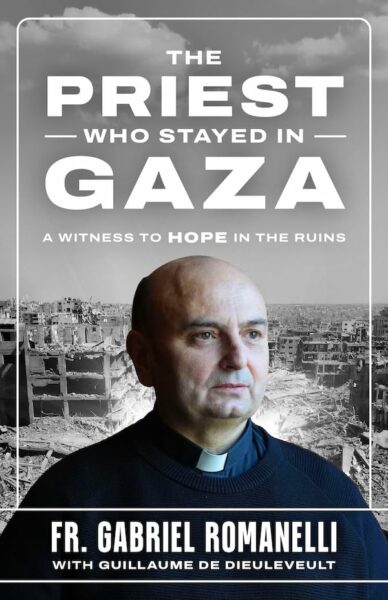
Such is, unfortunately, the case with the well-intentioned but ultimately counterproductive book The Priest Who Stayed in Gaza: A Witness to Hope in the Ruins (The Priest Who Stayed in Gaza: A Witness to Hope in the Ruins) by Father Gabriel Romanelli, an Argentine priest who pastored the ever-shrinking Christian community in Gaza in recent years. Already deteriorated and desperately poor, the Gaza Strip became an active war zone after the Israeli army responded to the horrific terrorist attacks of October 7, 2023, with the aim of recovering the hostages and removing Hamas from power.
True to the book’s title, Romanelli refused to leave the area. Amid the bombs and fighting, he continued to lead the Church of the Holy Family, overseeing the education of children, managing living conditions for homeless families, supervising medical care for the sick and wounded, and celebrating Mass for the few Christians still attending the church.
Unfortunately, the qualities that would make Romanelli an ideal observer turn out to be his downfall. He is too close to the action to offer an objective perspective that undertakes the difficult task of identifying causes and evaluating paths forward. He is too busy mediating conflicts among refugees, rationing food and water supplies, and entertaining children to have a broader view of what is happening.
Another problem is Romanelli’s commitment to «avoid judgments, condemnations, denunciations, and other expressions belonging to the legal sphere.» He believes that doing so will help him «clarify [his] point of view, reflect the atmosphere of the moment, or explain a particular situation,» as well as heal the numerous wounds inflicted by this conflict.
However, this approach often leads to precisely the opposite. Everything he describes happens almost without any explanation: bombs fall, refugees arrive, the Israel Defense Forces impose blockades, humanitarian convoys are looted, hostages are taken and tortured, ceasefires are agreed upon and broken, reconstruction is prohibited—all for apparently unknown reasons.
Although Romanelli thinks that this kind of indiscriminate account from a direct witness will encourage his audience to overcome the tendency to blame one side or the other, what it generates in the reader is blame toward everyone for this seemingly senseless chaos. Despite their misery and the suffering it entails, Gazans largely support Hamas and do little to create a viable society. Despite the numerous casualties and violent reprisals, Israelis maintain the siege on Gaza and transform the area into an open-air prison.
Perhaps worst of all is Romanelli himself, who, despite his endless trials in Gaza, never really explains why he is there or what he is seeking. Broadly speaking, he is a Catholic missionary who preaches the Christian Gospel and leads a local parish. But in his book, he mainly preaches a generic secular humanism (summarized in a repeated line: «Primum vivere: one must live above all») and leads a refugee camp that primarily serves Muslims.
Ironically, he is indignant when journalists portray him as «a man who works for a humanitarian NGO.» He insists that he is «here for Christ; that is the truth.» Meanwhile, the number of Christians under his care rapidly declined, and his pastoral duties were mainly limited to housing refugees and providing them with free childcare and health services. In his defense, this is all he can do due to the radical Islamist regime in Gaza: «speaking was not possible; but giving a sign of charity, yes