


By David Warren
One of the best ways to keep everyone angry, and thus allow us to participate in the modern experience, is to use words in a left-hemisphere way.
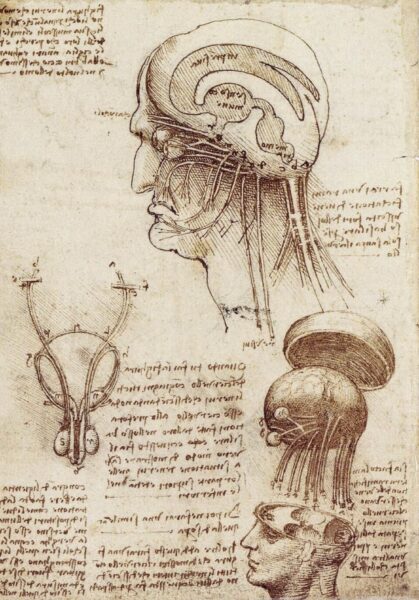
I refer, of course, to Iain McGilchrist, the writer who gave us the most thorough and accessible explanation of our two brains. For we, like other higher animals, have a left hemisphere and a right hemisphere. Both are in use for ordinary consciousness, unless one or the other has been cancelled by some appalling accident.
McGilchrist is an abnormally intelligent neuroscientist, an influential psychiatrist, and was a credible professor of English in his previous life at Oxford. He remains a master of several disciplines in the humanities.
It is uncommon to find such a transition to scientific authority. The intellectual world now seems to specialize in one thing or the other: science or socialism.
But he is not spouting incomprehensible scientific jargon. He really knows, in a demonstrable way, what he is talking about. Nor is he one of those tedious «new atheists.»
The left and right brains had already been treated frequently in popular science literature, which was vaguely aware of the cerebral hemispheres, usually in a silly and sensationalist way that often confused one hemisphere with the other.
Since McGilchrist is no charlatan and is familiar with physiological research (he trained as a physician), he can truly be considered an authority. Nor is he a stranger to epistemology and metaphysics.
Read his book The Matter of Things (2021), some 1500 reasonably entertaining pages, or his earlier masterpiece, The Master and His Emissary: The Divided Brain and the Making of the Western World (2009). Of course, these books will require attention, as would any work that traces the origins of the scientific revolution and explains its limitations. As mere collections of quotations from Western thought, they are formidable.
What McGilchrist demonstrates is that the left brain provides the fictional mental order, lacking in imagination and naturally arrogant, that our swamp-dwelling ancestors used to identify «things»—specifically, food—by ruthlessly excluding all other objects in the environment.
It is similar to a machine, especially in the sense that it shows neither curiosity nor remorse, except in the context of its limited function as a complement to right-hemisphere thinking. Yet it is essential for human life and for most other forms of life, and one cannot get rid of it without dying.
But if one believes that nature and the human mind function like a machine, or in some other deterministic way, one already suffers from left-hemisphere thinking and is one of nature’s aspiring automatons.
It remains the natural method of bureaucracy, of mechanical «progressive» advancement, and of systems of censorship and blind power. Indeed, bureaucrats could be expressly defined as «people we could do without,» precisely in contrast to more intelligent forms of life.
This may sound like a prejudiced political statement, but I urge the reader to study the sciences surrounding «brain lateralization» to form their own conclusion (hopefully, with the right hemisphere); or rather, their own «impression,» since the right brain is never so sure of itself.
It cannot be, because the right brain is tasked with investigating such complex things as beauty, goodness, and truth, and as finite beings, we cannot know their perfection or their final scope.
By contrast, when we were limited to the functions of the left brain, we could not even know that the transcendentals were possible. After all, they are irrelevant to the task of finding food, or even to identifying poisons.
If one were a communist, however—that is, a heroic left-hemisphere revolutionary—one would inevitably hold that nothing else is important. We call this «scientific materialism,» and indeed, it kills you.
But those who use the right hemisphere exist for another purpose (besides preventing those on the left from killing themselves). Instead of locating sources of food, it is necessary for various other purposes, and must continually watch over everything else. Even while eating, the right brain will be working on a coherent escape plan, in case its activity is violently interrupted.
For nature does not consist simply of eating or amoral sex. It involves eating regularly, but unfortunately, from time to time, it involves being eaten.
A good right brain, consciously or unconsciously, is constantly working, paying attention to the immense variety of things. Not only does it improve the chances of survival, but it gives one something to do besides swallowing food.
People need this even more than their pets. Otherwise, they stay in bed all day, feeling hungry.
Indeed, the task of paying awake attention is precisely what the whole brain was designed for, if the reader will allow me a teleological understanding of things. We can reasonably suppose that more than one element has a purpose in the Divine plan and in the design of creatures.
The right brain, in attending to «everything else,» could be identified as the cosmic embodiment of prudence; and now that we are on the right side, perhaps we can sometimes consider some «supernatural» concepts, such as Faith and Reason.
These are part of that «everything else» I mentioned earlier. They are among the things that give the right hemisphere something to do, on countless levels; two of its charms, as I like to say. Ultimately, even our religion and our philosophy, or other gestures toward depth, are shoots of this «everything else,» though not until we become aware of them.
Reason and faith ultimately reside here, and both can be served, or understood, by every part of the intellect.
Note that, even in its broadest and best sense, faith cannot be grasped in the manner of the left hemisphere. It is not something we can identify and capture, like a piece of chocolate. It is more aligned with loyalty, entering easily into the depths.
And reason is not simply logic, as those on the left hemisphere prefer to insist. All the other faculties of the brain come into play to determine what is and what is not.
Be reasonable!
About the author
David Warren is a former editor of the Idler magazine and a columnist for Canadian newspapers. He has extensive experience in the Near and Far East. His blog, Essays in Idleness, is currently at: davidwarrenonline.com.